Spreading crushed rock on farmland has long been touted as one of the most practical ways to pull carbon dioxide out of the atmosphere, but a nagging question has haunted the field: how long does it take for the rock to actually start working, and how much of the promised carbon removal ever reaches the rivers that carry it to the ocean? A new study published in Nature Water offers one of the most direct answers yet. By monitoring an entire headwater catchment in Vermont before and after a single application of basalt powder, researchers detected unmistakable chemical fingerprints of the rock dissolving within weeks, and they found that the signal rises and falls with the seasons in ways that could reshape how carbon removal projects are measured and verified.
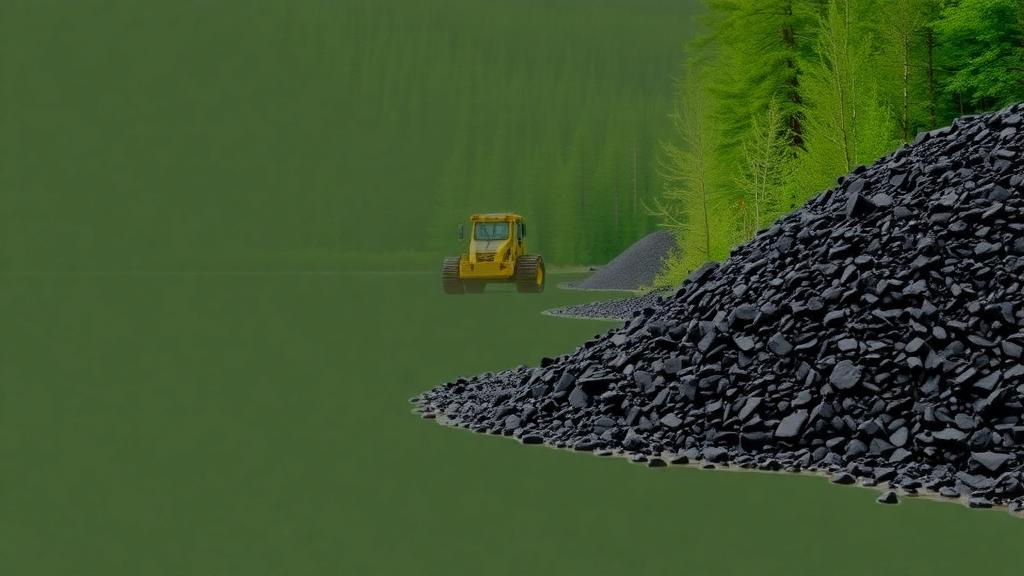
The experiment took place at the Sleepers River Research Watershed in Danville, Vermont, a long-studied 59-hectare agricultural catchment known as W-2, where hayfields and pasture cover roughly three-quarters of the land. After a full year of baseline monitoring, the team spread basalt powder at a rate of 20 tonnes per hectare over 8.9 hectares of the downstream portion of the catchment in June 2023, amounting to about 15 percent of the total watershed area. The basalt, sourced from the Holyoke Basalt formation of the Newark Supergroup, was rich in the calcium-bearing minerals that make silicate weathering an effective carbon sink. When silicate minerals dissolve, they consume atmospheric carbon dioxide and convert it into bicarbonate alkalinity, a form of carbon that can remain safely stored in the ocean for tens of thousands of years once it arrives there.
What happened next surprised even the researchers. Streamwater alkalinity and calcium concentrations in the treated catchment rose above counterfactual estimates within a single month of application. In the first three months, alkalinity exceeded the no-basalt baseline by an average of 267 microequivalents per liter, peaking at 557 microequivalents per liter above the counterfactual in September, while calcium climbed by as much as 696 microequivalents per liter. Because a nearby forested reference watershed, W-9, showed no such changes, the team could attribute the shifts directly to the basalt. The concentration-discharge relationships in the stream also changed character, weakening the natural dilution pattern that had been established during the baseline year, a sign that a new, persistent source of solutes had entered the system.
The evidence went well beyond alkalinity. Concentrations of silica and lithium, both far more abundant in basalt than in the carbonate rocks that could otherwise explain the chemistry, rose in parallel with the base cations. The isotopic composition of lithium shifted as well: the ratio of lithium-7 to lithium-6 in streamwater declined from an average of 19.0 per mil before treatment to 17.5 per mil within three months, moving toward the isotopically light signature of the applied basalt itself, which measured just 2.34 per mil. Rubidium, which substitutes for potassium in the feldspars and micas of the basalt, also increased at equivalent stream discharges. Together, these geochemical tracers painted a coherent picture of freshly applied silicate rock dissolving and its dissolution products racing to the stream.
One curious detail was the preferential export of calcium over sodium and magnesium, with the calcium increase more than twenty times larger than the corresponding rises in the other cations. The researchers attribute this to a combination of mechanisms. The soils at the site are dominated by calcium on their exchange complex, with roughly 85 percent calcium saturation, meaning other basalt-derived cations can displace calcium from exchange sites and flush it downstream early. Non-stoichiometric mineral dissolution plays a role too, since clinopyroxene and calcium-rich plagioclase, both abundant in the feedstock, release calcium preferentially. A small carbonate content in the basalt, about 0.14 percent by weight, likely contributed a minor share as well.
Perhaps the most consequential finding is that the treatment effect was strongly seasonal. Using a generalized additive model coupled with a difference-in-differences framework that leveraged data from the reference watershed, the team found that enhanced weathering accounted for 14 to 18 percent of streamwater alkalinity, calcium, magnesium, sodium and silica during the summer of 2023, but the effect weakened in autumn, became statistically indistinguishable from zero in winter, and rebounded in spring with snowmelt. The same pattern repeated, slightly attenuated, in the second year. Export of basalt-derived alkalinity, expressed as removed carbon dioxide, plunged from a summertime high of about 102 tonnes of CO2 per square kilometer per year to less than 3 tonnes in winter.
The seasonal rhythm reflects two intertwined controls. Temperature governs the kinetics of basalt dissolution, and the researchers quantified this with an Arrhenius analysis of discharge-normalized alkalinity export, deriving an apparent activation energy of 58.5 kilojoules per mole, squarely within the expected range for basalt weathering and actually exceeding laboratory values for calcium-bearing plagioclase. That excess likely reflects additional temperature-dependent processes in the field, such as seasonal swings in soil carbon dioxide from microbial and root respiration, which acidify soil water and accelerate dissolution. Hydrology supplies the second control: an endmember mixing analysis showed that basalt-derived solutes traveled to the stream mainly through quick-flow pathways fed by shallow, near-stream soils, whose solute concentrations jumped by up to 1,200 microequivalents per liter in summer and autumn, while slow-flow water originating upslope showed no detectable weathering signal at all.
Over the full 22-month monitoring window, the exported alkalinity amounted to 63.8 tonnes of CO2 per square kilometer, equivalent to 34.7 tonnes per square kilometer per year, which is among the highest rates reported for any field-based enhanced weathering study and roughly matches the median carbon consumption rate of natural basaltic rivers worldwide. Yet that figure represents only 9.5 to 11 percent of the theoretical maximum carbon removal potential of the applied basalt. The gap is not necessarily a failure. Water isotope analysis showed that only about 23 percent of streamflow was younger than roughly two months, meaning most water lingers in catchment storage, and weathering products traveling along slower, deeper paths may simply not have emerged yet. The mean residence time of water in the catchment is about 1.3 years, so a substantial fraction of the carbon removal signal may still be in transit.
The implications for the booming carbon removal industry are significant. Monitoring schemes that rely on streamwater chemistry will need to account for seasonal variability, or they risk badly misestimating removal, particularly if measurements cluster in winter when the signal vanishes. Deployments that target moist, near-stream corridors will be most responsive to stream-based verification, while upslope applications may require extended monitoring windows stretching well beyond two years to capture the delayed tail of the weathering signal. There are also limits to watch: repeated applications could push streamwater toward calcite saturation in summertime, triggering carbonate precipitation that would claw back alkalinity and reduce net removal.
What the Vermont trial ultimately demonstrates is that a watershed can serve as a natural integrator of enhanced weathering signals, capturing the combined effects of dissolution kinetics, hydrologic transport and climate variability in a single, measurable output at the stream gauge. Despite the cold northern climate that should slow weathering, the high calcium saturation of the soils and favorable hydrologic connections allowed signals to emerge quickly and repeatably across two years. As enhanced weathering scales from experimental plots toward the gigatonne ambitions projected for global croplands, studies like this one provide the template for knowing what to measure, when to measure it, and how to read the seasonal heartbeat of a landscape quietly eating carbon dioxide.
Subject of Research: Watershed-scale monitoring of carbon dioxide removal via enhanced weathering with crushed basalt
Article Title: Multiple lines of evidence reveal rapid, seasonal watershed responses to enhanced weathering
Article References: Sun, F., Rioux, R. A., Suhrhoff, T. J., Tatge, W., Kalderon-Asael, B., Zacharias, Q., Miller-Brown, W. A., MacDonald, A. A., Garcia, E., Shanley, J. B., Raymond, P. A., Planavsky, N. J., & Saiers, J. E. (2026). Multiple lines of evidence reveal rapid, seasonal watershed responses to enhanced weathering. Nature Water. https://doi.org/10.1038/s44221-026-00716-8
Image Credits: AI Generated
DOI: 10.1038/s44221-026-00716-8
Keywords: enhanced weathering, carbon dioxide removal, basalt, alkalinity, streamwater chemistry, hydrology, seasonality, silicate dissolution, carbon sequestration, watershed monitoring, lithium isotopes, climate mitigation
Cite Scienmag News
Violet Maxwell. (October 8, 2026). Crushed Basalt on a Vermont Watershed Shows Carbon Removal Kicks in Within Weeks. Scienmag. https://scienmag.com/crushed-basalt-on-a-vermont-watershed-shows-carbon-removal-kicks-in-within-weeks/
Violet Maxwell. "Crushed Basalt on a Vermont Watershed Shows Carbon Removal Kicks in Within Weeks." Scienmag, 8 October 2026, https://scienmag.com/crushed-basalt-on-a-vermont-watershed-shows-carbon-removal-kicks-in-within-weeks/. Accessed 8 October 2026.
Violet Maxwell. "Crushed Basalt on a Vermont Watershed Shows Carbon Removal Kicks in Within Weeks." Scienmag. October 8, 2026. https://scienmag.com/crushed-basalt-on-a-vermont-watershed-shows-carbon-removal-kicks-in-within-weeks/