


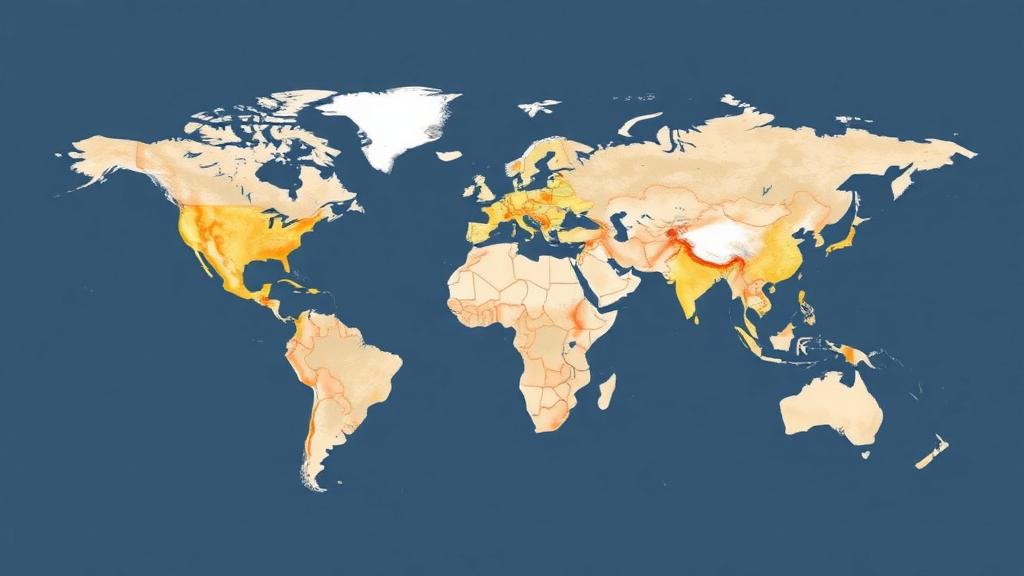
A team of researchers at Nanjing University has built one of the most comprehensive assessments yet of solar-driven interfacial evaporation, the technology that floats a sunlight-absorbing surface at the air–water boundary and turns incoming solar energy directly into vapor. Writing in Nature Water, Yan Song, Peiru Shi, Yuping Du, Yucan Lu, Zibo Zhou, Jia Zhu and colleagues describe how they combined experimentally validated climate–performance models with high-resolution climatic, hydrological and socioeconomic datasets to quantify, hour by hour and across the entire planet, where this technology could realistically deliver clean water, sterilization capacity and critical mineral recovery. The work moves the field beyond laboratory efficiency records toward a geospatially grounded answer to a deceptively simple question: if you deploy an interfacial evaporator somewhere on Earth, how much will it actually produce, and who would benefit?
Solar-driven interfacial evaporation, often abbreviated SDIE, has attracted intense attention over the past decade because it sidesteps the costly infrastructure of conventional desalination. Instead of heating a bulk volume of water, a photothermal material concentrates energy at the interface, generating vapor locally with minimal heat loss. Laboratory studies have reported evaporation rates well beyond what naive thermodynamic estimates would allow, and the literature now spans graphene oxide films, plasmonic aluminum nanoparticle assemblies, flatband titanium oxides, hydrogel composites and self-assembled particle systems. Yet the field has been criticized for benchmarking devices under constant illumination in controlled conditions, while real deployments face clouds, humidity swings, wind, seasonal temperature shifts and variable water chemistry. Performance measured under one sun in a laboratory says little about year-round output in the Sahel or on the Tibetan Plateau.
The Nanjing-led team attacked this gap by constructing models that link local climate to device performance and then validating those models against experiments. The framework draws on ERA5-Land, a state-of-the-art global reanalysis dataset that provides hourly land-surface meteorology from 1950 to the present, including radiation, temperature, humidity and wind. From these variables the researchers computed the coupled heat and mass transfer that governs evaporation from an interfacial device, incorporating established treatments of radiative heating, convective and radiative cooling, and the diffusion of water vapor through the boundary layer above the surface, using classical gaseous diffusion coefficients for the transport physics. The resulting climate–performance models were then checked against experimental measurements, giving the authors confidence that their simulated evaporation rates reflect what a real device would do under realistic, fluctuating weather rather than idealized laboratory illumination.
To make the analysis usable at planetary scale, the team developed SDIE-Geo, an open-source and extensible geospatial toolset that maps SDIE performance at hourly resolution and then aligns that performance with local resource availability, demand and socioeconomic context. This alignment step is what distinguishes the study from a simple productivity map. A region may have abundant sunshine and surface water but little need for additional drinking water; another may have desperate demand but no accessible water body to float a device on. The researchers therefore intersected their performance layer with high-resolution global surface water maps, which track the location and long-term stability of lakes, rivers and other water bodies, and with socioeconomic indicators drawn from World Bank open data. The output is not just an evaporation rate but a deployment potential: a measure of where the technology could meaningfully serve people, agriculture, industry or public health.
The headline results are striking. The analysis identifies year-round sterilization capability in Niger as one key SDIE-based application relevant to the Sustainable Development Goals. Solar steam sterilization has emerged as a promising off-grid alternative to autoclaves that require electricity or fuel, and earlier work demonstrated rapid-response, energy-efficient steam generation for sterilization as well as passive solar steam generators capable of reaching the high temperatures and pressures needed for medical use. By showing that the climate of Niger supports this function throughout the year, the study pinpoints a concrete geography where solar interfacial steam could strengthen infection control in health systems that currently struggle with unreliable power and supply chains.
Perhaps the most eye-catching number concerns drinking water. According to the study, SDIE could provide drinking water for one billion people at two liters per day using a device of just 0.7 square meters. That figure emerges from coupling hourly evaporation performance with realistic constraints on surface water availability, so it already accounts for the fact that a device can only evaporate water that is actually present. Two liters per person per day is the commonly cited minimum for basic drinking water needs, and the result suggests that, in principle, a device roughly the footprint of a small card table could secure that baseline for a person in a suitable location. The authors stress that this is a quantified potential rather than an implementation plan, but the framing is powerful: it converts an abstract global water crisis into a concrete per-capita hardware requirement tied to specific, mappable regions.
The third flagship application lies in resource recovery, specifically lithium. Demand for lithium has surged with the electrification of transport and storage, and much of the world’s lithium reserves sit in saline brines, where conventional extraction is slow, water-intensive and environmentally contentious. Solar-driven evaporation is already used in brine concentration, but it can take many months or years to move brine to the concentrations needed for selective lithium recovery. Building on prior work on solar transpiration-powered lithium extraction and storage, the new analysis finds that SDIE could accelerate lithium-brine concentration by up to 135-fold. That multiplier, grounded in the same validated climate–performance framework, indicates that interfacial evaporation could compress brine processing timelines dramatically in favorable climates, with implications for the cost, footprint and environmental impact of the lithium supply chain.
Beyond these three applications, the framework’s breadth reflects the expanding ambitions of the SDIE field. The literature the authors build upon includes solar-powered circular desalination agriculture using bioevaporators, interfacial evaporation for simultaneous seawater desalination and saline soil remediation, floating solar sea farms, multistage solar membrane distillation for freshwater and electricity cogeneration, hybrid photothermal–photocatalyst sheets that couple purification with overall water splitting, and diffusion-driven selective crystallization for high-purity salt. There are even open fundamental questions, such as the proposed photomolecular effect, in which visible light interacting with the air–water interface may drive evaporation beyond classical thermal limits. A general tool that can evaluate any of these device concepts against real climates gives researchers a common yardstick for comparing designs and prioritizing deployments.
The methodological significance extends past evaporation itself. The authors frame their contribution as establishing a general framework for evaluating climate-sensitive technologies at global scale, a category that includes atmospheric water harvesting, solar drying, solar thermal disinfection and other distributed technologies whose output depends on weather. A precedent is the 2021 Nature analysis that mapped the global potential for harvesting drinking water from air using solar energy; the new work applies a similar geospatial logic but with hourly temporal resolution and device-level physics. Because SDIE-Geo is open source and extensible, other groups can substitute their own device models, update the climatic inputs, or add new demand layers, making the tool a piece of shared infrastructure rather than a one-off analysis. All data and code from the study are publicly available through figshare, and the underlying ERA5-Land reanalysis is openly accessible through the Copernicus Climate Change Service.
The study also carries practical guidance for engineers and policymakers. For device designers, the hourly global maps reveal which environmental variables dominate performance in which regions, informing trade-offs among optical absorption, thermal insulation, salt rejection and water supply architecture. For deployment planners, the alignment of performance with water availability and socioeconomic need highlights where pilot projects are most likely to succeed and where the Sustainable Development Goal dividends, in health, water security and resource supply, would be largest. The work was supported by China’s National Key R&D Program, the National Natural Science Foundation of China and a range of provincial and institutional funds, and it passed peer review with input from researchers including Alessandro Alabastri and Qinghua Ji. As solar interfacial evaporation matures from laboratory curiosity toward field deployment, this kind of quantitative, climate-aware mapping may prove as important as any single materials breakthrough, because it tells the field not just how well a device can work, but where it should go.
Subject of Research: Global mapping of solar-driven interfacial evaporation potential using validated climate–performance models
Article Title: Quantifying the global potential of solar-driven interfacial evaporation using a validated climate–performance model
Article References: Song, Y., Shi, P., Du, Y., Lu, Y., Zhou, Z., & Zhu, J. (2026). Quantifying the global potential of solar-driven interfacial evaporation using a validated climate–performance model. Nature Water. https://doi.org/10.1038/s44221-026-00728-4
Image Credits: AI Generated
DOI: 10.1038/s44221-026-00728-4
Keywords: solar-driven interfacial evaporation, SDIE-Geo, desalination, drinking water, solar steam sterilization, lithium extraction, ERA5-Land, geospatial modeling, Nature Water, Sustainable Development Goals, photothermal materials, climate–performance model
Cite Scienmag News
Faith Mcneil. (October 7, 2026). Global Map Reveals Where Solar Evaporation Could Deliver Water, Sterilization and Lithium. Scienmag. https://scienmag.com/global-map-reveals-where-solar-evaporation-could-deliver-water-sterilization-and-lithium/
Faith Mcneil. "Global Map Reveals Where Solar Evaporation Could Deliver Water, Sterilization and Lithium." Scienmag, 7 October 2026, https://scienmag.com/global-map-reveals-where-solar-evaporation-could-deliver-water-sterilization-and-lithium/. Accessed 7 October 2026.
Faith Mcneil. "Global Map Reveals Where Solar Evaporation Could Deliver Water, Sterilization and Lithium." Scienmag. October 7, 2026. https://scienmag.com/global-map-reveals-where-solar-evaporation-could-deliver-water-sterilization-and-lithium/


