


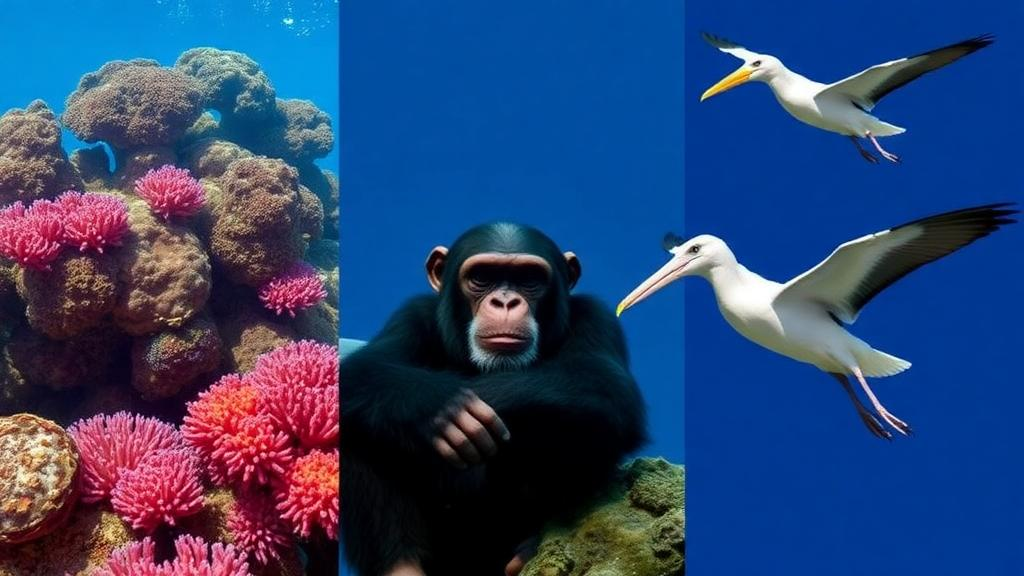
Across the planet, conservation science is dominated by a familiar and often overwhelming narrative of decline: reefs bleaching, forests shrinking, wildlife populations collapsing under the combined weight of climate change, habitat loss and overexploitation. Yet scattered through this landscape of bad news are places that refuse to follow the script. Coral reefs in Papua New Guinea teem with fish even as nearby reefs struggle. Populations of critically endangered Western chimpanzees persist in parts of West Africa where the species has otherwise vanished. Grizzly bears thrive in a Canadian rainforest managed by First Nations, and vulnerable albatross colonies off Tasmania are slowly recovering thanks to unusual scientific partnerships. A new study from the University of Sydney argues that these are not lucky accidents, and that understanding why they succeed may be one of the most useful things conservation science can do.
The research, led by Dr Bing Lin of the university’s Thriving Oceans Research Hub and co-authored by the hub’s director, Professor Josh Cinner, is published in Nature Ecology & Evolution. Rather than cataloguing environmental damage, the team reviewed more than 70 studies of environmental and sustainability success, examining cases where places, species and social-ecological systems perform better than expected despite difficult circumstances. The result is the first attempt to synthesise these seemingly unrelated conservation bright spots into a single framework, revealing the common conditions that allow people and nature to thrive against the odds and offering a way to identify and learn from unexpected success stories.
The central finding is strikingly simple. Dr Lin said the study examined different species on different continents, all facing unique conservation challenges, yet each succeeded for remarkably similar reasons: local knowledge was valued alongside science, communities played a central role in decision-making, and management adapted to local social and environmental conditions. In other words, bright spots arise through a positive interplay of process, people and place. Although every case is unique, common themes included adaptable practices and processes that were good for nature and fit for purpose within the local environmental and cultural setting, particularly when they were bolstered by a community with the capacity to implement those practices despite challenging conditions.
Professor Cinner has spent more than 25 years working alongside coastal communities in Papua New Guinea, where one of the world’s coral reef bright spots was identified. He recalled being, in his words, blown away when a rigorous quantitative analysis of nearly 1,700 coral reefs around the world flagged this site as one of the global bright spots, a result of his original landmark bright spots study published in Nature in 2016. The villages in question have maintained a customary practice of periodically closing parts of their reefs to fishing, a system he compares to fallow agriculture, giving ecosystems time to recover before harvesting resumes. The technique is not new, but its persistence and effectiveness in a region under intense pressure have made it a touchstone for researchers studying reef resilience.
What makes the Papua New Guinean case especially instructive is why the practice has endured. Cinner’s subsequent research found that the marine protection tradition has survived because it is woven into community life. Strong relationships between elders and younger generations, shared responsibility for managing the reefs, and cultural traditions that reward participation have helped sustain abundant marine life while continuing to support local livelihoods. He argues that at a time when the headline story about coral reefs is that they are in trouble, this bright spot provides an alternative narrative of hope and connection, and that the environmental success these communities have achieved comes from extensive local experience and genuine local ownership of decision-making, management and enforcement.
A similar pattern emerged in radically different settings. In western Africa, researchers found that some populations of critically endangered Western chimpanzees were surviving despite widespread regional decline. Beyond those animals living in inaccessible or formally protected areas, the strongest chimpanzee populations were often found where local communities maintained cultural traditions and social norms that discouraged hunting and supported coexistence with wildlife. The protection, in other words, was not always delivered by rangers and fences but by beliefs and behaviours embedded in the social fabric, an observation that aligns closely with the framework’s emphasis on people and place working in concert.
In Canada’s Great Bear Rainforest, First Nations communities have led grizzly bear conservation by placing Indigenous stewardship and knowledge at the heart of environmental governance. According to the study, this approach has strengthened conservation outcomes while reinforcing community authority and the relationships between people and Country. The case illustrates a point the authors see as central: governance that recognises Indigenous and local rights is not merely a matter of fairness, but can be a direct driver of ecological results, because the people closest to the resource hold both the knowledge and the incentive to manage it well over the long term.
Tasmania’s vulnerable Shy albatross demonstrates a different but complementary route to a bright spot. Conservation there has shown how close partnerships between scientists, wildlife managers and policymakers can produce results, with collaborative decision-making leading to innovative interventions to protect albatross chicks from parasites, expanded conservation programs, and an enduring process for testing future population management options. Where the Papua New Guinea and Great Bear Rainforest cases highlight community-led governance, the albatross case highlights what can happen when technical expertise and institutional support are combined with genuine collaboration rather than imposed from outside.
Dr Lin said the new framework provides a practical way to identify, compare and learn from conservation success, helping governments, communities and environmental organisations move beyond celebrating isolated examples. By developing what the researchers describe as a common language across disparate global ecosystems, the framework is intended to let scientists identify the different types of conditions that support conservation success and to compare bright spots consistently for improved outcomes globally. That shift, from celebrating individual success stories to deepening understanding of where and why they occur, is what the authors regard as the study’s most important contribution. Lin noted that conservation is often framed as a story of loss and decline, but there are places where ecosystems and the people who depend on them are thriving despite enormous pressures, and that by bringing together research from around the world the team has shown these are not simply lucky exceptions but cases sharing common characteristics that can serve as windows into real-world resilience.
For a field that often struggles to translate scattered wins into general principles, the framework offers a template that can be applied prospectively rather than retrospectively: look for adaptable, fit-for-purpose practices; check whether communities have the capacity and authority to implement them; and ensure local knowledge sits alongside, not beneath, formal science. Professor Cinner said the findings offer a hopeful message at a time when environmental news is often dominated by crisis. In his view, the review shows that local conservation bright spots are not isolated miracles, but follow patterns that can be recognised, learned from and applied elsewhere, which he describes as giving real reasons for optimism as the world works to protect both people and nature. The research was funded by the Australian Research Council and the National Geographic Society, and the authors declare no competing interests.
Subject of Research: Common drivers of successful conservation bright spots across global ecosystems
Article Title: Against the odds: why some ecosystems thrive
Article References: Against the odds: why some ecosystems thrive. (n.d.). Original publication
Image Credits: AI Generated
DOI: Not provided
Keywords: conservation, bright spots, coral reefs, Papua New Guinea, Western chimpanzees, grizzly bears, Shy albatross, community-based management, Indigenous stewardship, Nature Ecology & Evolution, social-ecological systems, resilience
Cite Scienmag News
Margaret Porter. (October 7, 2026). Coral reefs, chimps and albatrosses: the shared recipe for conservation success. Scienmag. https://scienmag.com/coral-reefs-chimps-and-albatrosses-the-shared-recipe-for-conservation-success/
Margaret Porter. "Coral reefs, chimps and albatrosses: the shared recipe for conservation success." Scienmag, 7 October 2026, https://scienmag.com/coral-reefs-chimps-and-albatrosses-the-shared-recipe-for-conservation-success/. Accessed 7 October 2026.
Margaret Porter. "Coral reefs, chimps and albatrosses: the shared recipe for conservation success." Scienmag. October 7, 2026. https://scienmag.com/coral-reefs-chimps-and-albatrosses-the-shared-recipe-for-conservation-success/


