


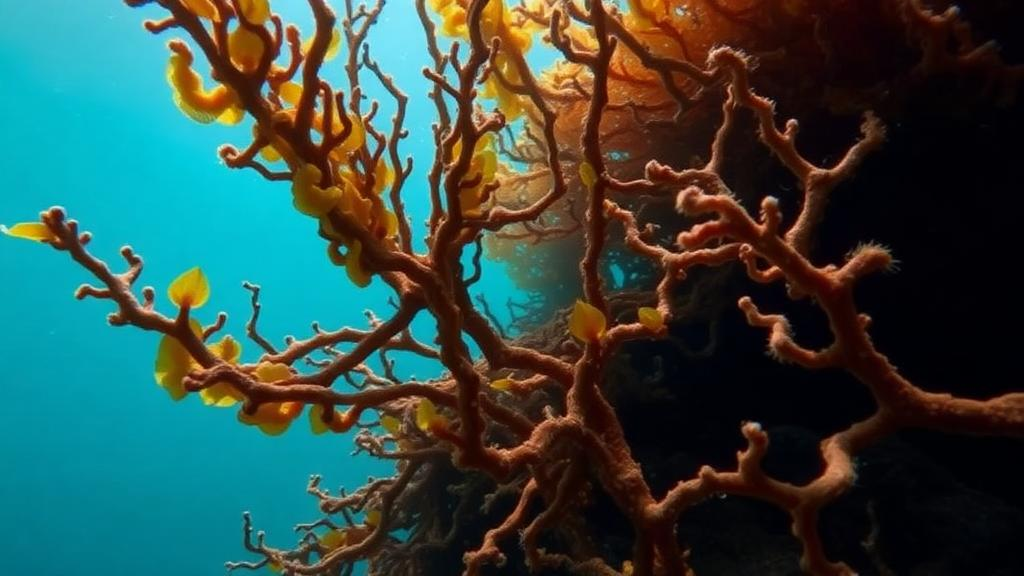
Along the coast of Maine, one of the most consequential ecological transformations in the western North Atlantic is unfolding largely out of sight beneath the waves. Dense, canopy-forming kelp forests, which have historically blanketed the state’s rocky reefs, are steadily giving way to low-lying, carpet-like mats of turf algae. This shift, driven in large part by human-induced warming of coastal waters, has already been shown to degrade habitat value, biodiversity, nutrient cycling, and food web dynamics. Now, a new peer-reviewed study published in the Proceedings of the National Academy of Sciences by researchers at Bigelow Laboratory for Ocean Sciences reveals that the consequences of this state change extend far deeper than previously understood — all the way down to the microbial communities and the chemical landscapes they collectively create on the seafloor.
The research, led by Shane Farrell, a former University of Maine doctoral student in the laboratory of Senior Research Scientist Douglas Rasher, is among the first investigations to grapple with the microbial consequences of kelp forest collapse in a cold-water system. While scientists have long documented the visible losses that follow the decline of foundation species — the large, structurally complex organisms that define entire habitats — the fate of the microscopic life that underpins ecosystem functioning has remained largely unexplored in temperate kelp systems. The new findings make clear that when kelp disappears, the reef does not simply lose a canopy; it loses an entire biochemical regime.
What distinguishes this study from much of the existing literature is its deliberate choice of scale. Microbial communities in marine environments can be sampled from the water column, from the surfaces of individual kelp fronds, or from within algal tissues, and each of those niches hosts distinct assemblages of organisms. Farrell and colleagues reasoned that the broadest and most ecologically meaningful unit was the reef itself — the integrated microbial community living on and within the benthic habitat. That decision reflects a growing recognition in ecology that habitats function as integrated systems of all the organisms they contain, including those invisible to the naked eye, and that understanding environmental change requires examining the full spectrum of life, not merely the species large enough to be counted by a diver.
Answering a question at that scale demanded a novel synthesis of traditional field ecology and cutting-edge molecular techniques. The team focused on six sites along the Maine coast — three dominated by kelp and three dominated by turf algae — and surveyed them during both spring and summer, capturing seasonal variation in both the biological community and its chemistry. Divers conducted surveys to characterize the algal assemblages at each site, establishing the ecological context for the molecular work. Back in the laboratory, the researchers applied metagenomics, sequencing the DNA present in reef samples to identify which microbial species were there and, crucially, which biochemical processes their genes encoded. They paired this with metabolomics, a technique that provides a snapshot of the small chemical compounds present in the environment at a given moment, revealing the molecular currency flowing through the ecosystem.
The results were striking. Kelp forests and turf-dominated reefs turned out to host microbial communities that were taxonomically and functionally different — different species, but also different suites of genes and, by extension, different capacities for metabolism and chemical transformation. The metabolomic profiles diverged as well, indicating that the two habitat states are characterized by fundamentally different chemical environments. In other words, the transition from kelp to turf does not merely swap one set of visible organisms for another; it rewrites the underlying biochemical operating system of the reef. This pattern aligns with what scientists working in other systems have observed: comparable state shifts on coral reefs and in terrestrial forests likewise produce profound reorganizations of microbial communities and their functions.
One of the most illustrative findings concerns photosynthesis at the microbial scale. The loss of kelp means the loss of canopy cover, the towering fronds that shade the reef below and shape its light environment. With that shade gone, the study found an apparent increase in the abundance of photosynthetically active microbial communities. Most notably, Synechococcus — a genus of cyanobacteria that tends to thrive in warmer, well-lit waters — was rare at the kelp forest sites but abundant on the turf-dominated reefs. That distribution suggests a possible shift in the reef’s primary energy economy, from one fueled largely by the carbon fixed and released by kelp to one increasingly driven by microbial photosynthesis under brighter, warmer conditions. Such a shift, the authors note, could ripple outward, altering fundamental processes such as nutrient retention and carbon storage, and potentially diminishing the beneficial services these ecosystems provide to humans.
The researchers are careful to frame the scope of their conclusions. The study does not provide direct measurements of the precise rates of metabolic processes underway on the reefs; metagenomics and metabolomics offer an inferential window, revealing which microbes and compounds are present rather than how fast reactions are proceeding. Even so, the snapshot is ecologically telling. The identity of the microbial species present, the functional genes they carry, and the metabolites accumulating in the environment together paint a coherent picture of how each habitat state is likely to function — and how differently a turf-dominated reef operates compared with the kelp forest it replaced. These microbial-scale changes, the authors argue, represent a critical but largely invisible dimension of ecosystem degradation that conventional monitoring, focused on fish and macroalgae, entirely misses.
The broader significance of the work lies in what it says about the cascading consequences of losing foundation species. Kelp forests are among the most productive habitats on Earth, and in the Gulf of Maine they anchor coastal food webs, shelter juvenile fish and invertebrates, buffer coastlines, and support fisheries. Rasher’s team has previously documented how warming-driven kelp decline erodes these services, from biodiversity losses to disrupted nutrient cycling and altered food web dynamics. The new study adds a deeper layer to that picture: the relationships between underwater forests, their microbial members, and the chemical landscapes they collectively create may be essential to kelp forest functioning and resilience in a warming world. If microbial communities shift in lockstep with the macroscopic habitat, then recovery of kelp may depend not only on replanting fronds or reducing local stressors, but on restoring the microbial and chemical conditions that a healthy forest generates and maintains.
As co-author Tim D’Angelo, a Senior Research Associate at Bigelow Laboratory, observed, every habitat is an integrated system of all the organisms it contains, even those that cannot be seen. The results reinforce a two-way relationship: microbial life is altered by environmental change, and in turn it acts as an engineer of its own environment, shaping the chemistry and conditions that larger organisms experience. A full understanding of ecosystem change, the authors contend, therefore requires investigation of the microbial component — a perspective that remains rare in studies of temperate reef systems. As warming continues to push coastal ecosystems across ecological thresholds, studies like this one suggest that the earliest and most fundamental signals of transformation may be written not in the visible landscape, but in the genes and molecules of the smallest inhabitants of the seafloor.
The research was supported by the National Science Foundation’s Established Program to Stimulate Competitive Research under Grant OIA-1849227, along with the Louise H. and David S. Ingalls Foundation, the PADI Foundation, the Essex Avenue Foundation, and the German Research Foundation. The study, published in the Proceedings of the National Academy of Sciences, was based on an observational field design combining dive surveys, metagenomic sequencing, and metabolomic profiling across seasonally sampled kelp and turf-dominated reefs. For the Gulf of Maine — one of the fastest-warming bodies of ocean water on the planet — the findings carry a sobering implication: the decline of kelp forests is not a single loss but a cascade, one that reaches from the canopy of swaying fronds down to the microscopic chemistry of the reef itself, and possibly to the resilience of the ecosystem as a whole.
Subject of Research: Microbial and metabolomic consequences of kelp forest collapse on temperate rocky reefs
Article Title: Loss of kelp forests reverberates down to microbial level
Article References: Loss of kelp forests reverberates down to microbial level. (n.d.). Original publication
Image Credits: AI Generated
DOI: Not provided
Keywords: kelp forests, turf algae, microbiome, metagenomics, metabolomics, Maine coast, Gulf of Maine, ocean warming, foundation species, cyanobacteria, Synechococcus, ecosystem state shift
Cite Scienmag News
Violet Maxwell. (October 6, 2026). When Kelp Forests Collapse, Even the Microbes Beneath Them Change. Scienmag. https://scienmag.com/when-kelp-forests-collapse-even-the-microbes-beneath-them-change/
Violet Maxwell. "When Kelp Forests Collapse, Even the Microbes Beneath Them Change." Scienmag, 6 October 2026, https://scienmag.com/when-kelp-forests-collapse-even-the-microbes-beneath-them-change/. Accessed 6 October 2026.
Violet Maxwell. "When Kelp Forests Collapse, Even the Microbes Beneath Them Change." Scienmag. October 6, 2026. https://scienmag.com/when-kelp-forests-collapse-even-the-microbes-beneath-them-change/


