


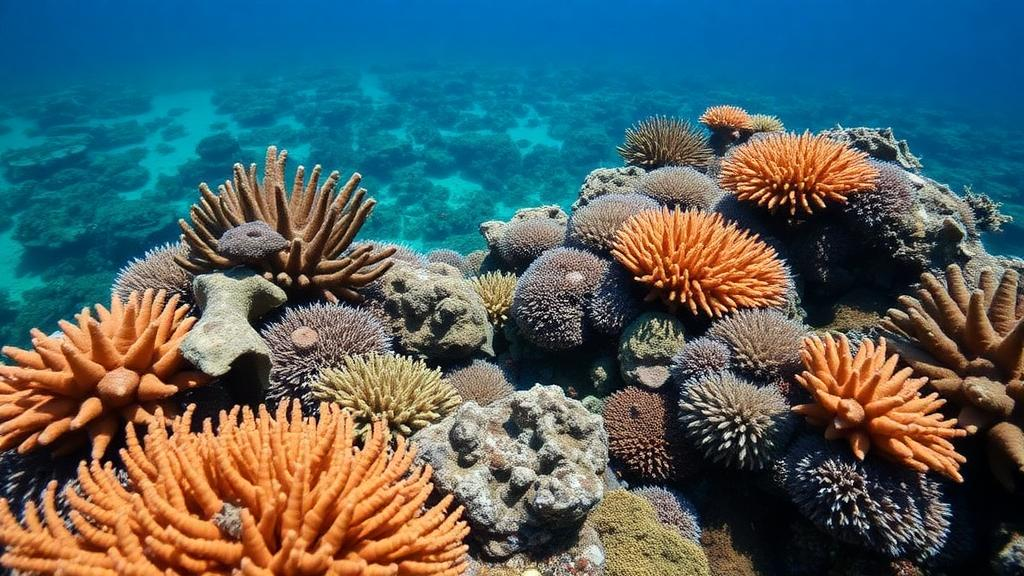
A record-breaking marine heat wave that gripped the Florida Keys in the summer of 2023 has delivered one of the most detailed case studies yet of how climate stress and disease interact to kill coral, and the findings carry an urgent message for reef conservation worldwide. Researchers at the University of Georgia analyzed hundreds of square feet of coral colonies during and after the event, which pushed water temperatures above 87 degrees Fahrenheit for 41 consecutive days, shattering every previous record for the region. Their results, published in the journal Coral Reefs, show that heat was the primary killer of coral during the event, but that preexisting disease dramatically amplified the damage, and that the precise location of a coral colony on the reef played a decisive role in whether it lived or died.
The 2023 heat wave was not an isolated anomaly. Every summer since has brought similarly hot, prolonged periods of elevated water temperature to the Florida Keys, suggesting that the conditions studied by the team are becoming the new baseline rather than an extreme exception. As global ocean temperatures continue to climb, marine heat waves are arriving more frequently, lasting longer, and reaching greater intensities. For reef-building corals, which live close to their upper thermal limits in many parts of the tropics, this trajectory represents an accelerating threat that compounds existing pressures from pollution, overfishing, and coastal development.
To document what happened with unprecedented precision, the researchers deployed high-resolution three-dimensional layered photo imaging and underwater mapping techniques across the affected reef sites. This approach allowed them to track the fate of individual coral colonies and even specific tissue regions within colonies, distinguishing between healthy tissue, diseased lesions, and recently dead areas. The resulting dataset captured the spatial anatomy of a mass mortality event in a way that traditional survey methods could not, revealing patterns of vulnerability that had previously been suspected but never quantified at this scale during an actual bleaching catastrophe.
The mechanism behind the devastation begins with bleaching, a physiological stress response that has become tragically familiar to reef scientists. Under normal circumstances, corals host microscopic symbiotic algae within their tissues. These algae photosynthesize and supply the coral with the bulk of its energy, and they are also responsible for the brilliant colors that make reefs famous. When water temperatures rise too high, this symbiosis breaks down: the coral expels its algae, exposing the white calcium carbonate skeleton beneath the translucent tissue. A bleached coral is not immediately dead, but it is starving, and its disrupted microbiome leaves it increasingly susceptible to infection and further stress over time.
What the new study demonstrated is that disease and heat do not merely add together; they multiply each other’s lethality. Corals that entered the heat wave with existing disease lesions faced nearly four times higher risk of dying from the thermal stress compared with healthy corals. Even more striking, healthy coral tissue located directly adjacent to diseased tissue was almost twice as likely to die during the extreme heat as healthy tissue situated farther away from any diseased area. In other words, infection acted as a localized amplifier of mortality, spreading risk outward from disease lesions into otherwise healthy parts of the same colony and neighboring colonies.
Multiple stressors are not a good thing, as Camilla Nivison, the study’s corresponding author and a doctoral student in UGA’s Odum School of Ecology, observed. When corals are handling threats from multiple directions at the same time, she noted, it becomes unsurprisingly more challenging for them to survive. This interaction effect has profound implications for how scientists model reef futures. Predictions based on temperature alone may substantially underestimate mortality in reefs that already carry a burden of disease, which is precisely the condition of many reefs near human population centers where water quality has degraded.
That burden is strongly linked to water quality, a factor that local communities can actually control. Corals growing in poor-quality water frequently carry more disease, and that disease tends to be more severe than what afflicts reefs in cleaner waters. Nutrient pollution from coastal runoff feeds pathogenic bacteria and stresses coral immune systems, priming reefs for the kind of catastrophic losses observed in 2023. James Porter, co-author of the study and Josiah Meigs Distinguished Professor Emeritus in the Odum School of Ecology, emphasized that water quality protection is fundamentally a local issue, and that the results demonstrate measures to improve local water quality will also improve coral survival.
Amid the grim statistics, the study uncovered a genuinely hopeful and actionable pattern: location on the reef mattered enormously. Corals situated along the outer edges of reefs were significantly more likely to survive the warm temperatures. The explanation appears to lie in hydrodynamics. Water moves faster around reef edges, and that increased flow continuously sweeps away metabolic wastes diffusing out of coral tissue while simultaneously enhancing the delivery of food particles. As Nivison explained, the more water moving across a coral, the more it removes harmful accumulations, which helps protect coral tissue especially when it is stressed by heat. Edge-dwelling corals effectively enjoy better ventilation and sanitation than their counterparts in more sheltered interior zones.
This topographic insight offers a practical strategy for restoration. As conservationists replant coral fragments to combat ongoing die-offs, the study suggests that placing new corals near reef edges gives them a measurably better chance of regrowing and thriving. Nivison argued that restoration efforts should be concentrated in places where corals are most likely to survive, noting that some reefs during the heat wave functioned as oases with minimal damage. Nobody has been able to pin down exactly why, she said, but it appears that topography is important. Identifying and protecting these natural refugia, and seeding them with restored coral, could buy critical time for reef ecosystems as the climate continues to warm.
The longer context of the study is sobering. Elkhorn coral, once the most common coral throughout the Caribbean, suffered catastrophic losses during the 2023 heat wave. Porter compared the loss of this species across the Caribbean to the death of oak trees from Maine to Florida, an analogy that conveys the scale of ecological transformation underway. His perspective spans more than five decades of diving: since 1972, he noted, more than two-thirds of all living coral worldwide has been lost. The health of the ocean, he argued, directly determines the health of coral reefs, and as go coastal oceans, so go coral reefs. While no local action can reverse global warming, the study’s authors insist that meaningful progress is possible at the community level through pollution mitigation and water quality improvement. Coral reefs support extraordinary biodiversity and provide enormous value to humankind, and the choices made in coastal watersheds, from reducing nutrient runoff to targeting restoration at reef edges, will help determine how much of that living heritage survives the hot decades ahead.
Subject of Research: Coral mortality during the 2023 Florida Keys marine heat wave and its interaction with disease and reef topography
Article Title: Warmer oceans and increasing disease put coral reefs at risk
Article References: Warmer oceans and increasing disease put coral reefs at risk. (n.d.). Original publication
Image Credits: AI Generated
DOI: Not provided
Keywords: coral reefs, coral bleaching, marine heat wave, coral disease, Florida Keys, water quality, reef restoration, elkhorn coral, reef topography, climate change, ocean warming, University of Georgia
Cite Scienmag News
Violet Maxwell. (October 6, 2026). Disease and Record Heat Combined to Devastate Florida’s Coral Reefs, Study Finds. Scienmag. https://scienmag.com/disease-and-record-heat-combined-to-devastate-floridas-coral-reefs-study-finds/
Violet Maxwell. "Disease and Record Heat Combined to Devastate Florida’s Coral Reefs, Study Finds." Scienmag, 6 October 2026, https://scienmag.com/disease-and-record-heat-combined-to-devastate-floridas-coral-reefs-study-finds/. Accessed 6 October 2026.
Violet Maxwell. "Disease and Record Heat Combined to Devastate Florida’s Coral Reefs, Study Finds." Scienmag. October 6, 2026. https://scienmag.com/disease-and-record-heat-combined-to-devastate-floridas-coral-reefs-study-finds/


