


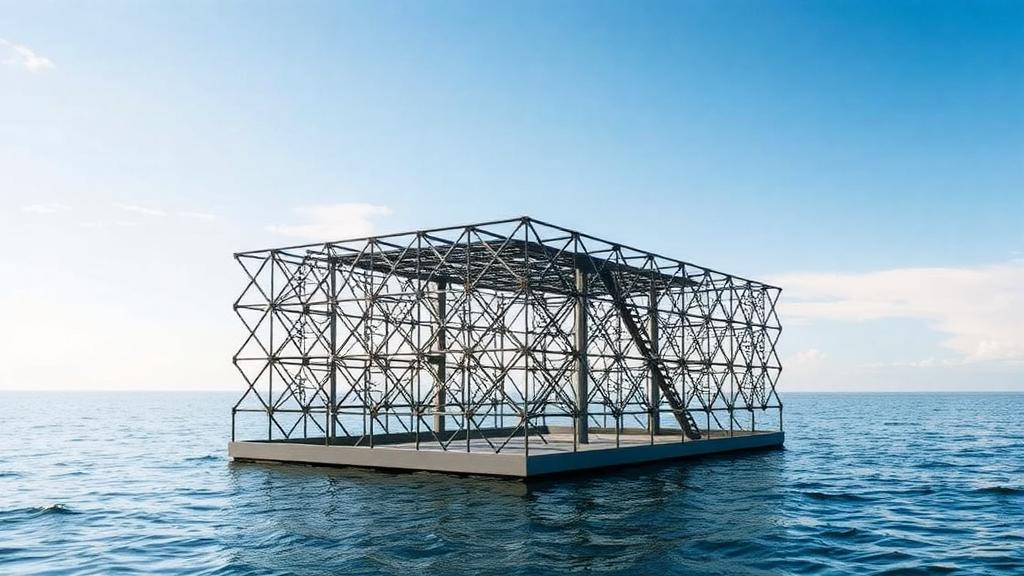
A team of Australian engineers has achieved something that sounds almost contradictory: a titanium structure that floats. Researchers at RMIT University have 3D-printed a titanium lattice so light and cleverly designed that it remains buoyant in water, even after suffering severe cracking and structural damage. The breakthrough, published in the journal Advanced Materials, is being hailed as the first reported demonstration of a floating metal-hybrid lattice metamaterial, and it could reshape how engineers approach jetties, buoys, floating sensors and other marine infrastructure that has long depended on far weaker materials.
The central problem the team set out to solve is deceptively simple. Metallic lattice structures, in which thin struts form an open, interconnected framework, can be extraordinarily light. Some have densities less than one-tenth that of water, which in theory should make them ideal candidates for flotation. In practice, however, those open spaces are their undoing. Water pours freely through the interconnected pores of an open-cell lattice, filling every void until the structure loses whatever buoyancy its low density promised. According to lead researcher Dr Jordan Noronha of RMIT’s Centre for Additive Manufacturing, this fundamental flaw has made strong, lightweight metallic lattices unsuitable for marine applications, until now.
The RMIT team’s solution lies in a selective filling strategy. Rather than sealing the entire lattice or coating it in a waterproof shell, the engineers filled only the hollow titanium struts themselves with polyurethane foam, leaving the external openings of the structure unobstructed. The result is a hybrid material that allows seawater to flow through its open architecture while the sealed, foam-filled channels inside the struts retain their buoyancy. Crucially, the researchers validated this sustained flotation with samples that floated in freshwater for more than two months, demonstrating that the effect is not a fleeting laboratory curiosity but a durable property of the material itself.
Underpinning the achievement is a conceptual innovation in how engineers calculate whether an open structure will float. Conventional density measurements include all the open space within a lattice, even though water can occupy that space and it therefore contributes nothing to buoyancy. The RMIT team developed a new measure, which they call skeletal density, that considers only the parts of the structure that actually exclude water: the solid titanium walls and the sealed, foam-filled channels within the struts. This reframing yields an elegantly simple design rule. As Noronha explained, if the skeletal density of a structure is lower than that of the surrounding liquid, the structure will float, even when water flows freely through all of its external openings.
The mechanical performance of the new material is equally striking. When compared at the same overall density, the titanium hybrid lattice proved 70 percent stronger than the stainless steel or high-density polyethylene that is widely used in marine construction today. That comparison matters, because the plastics and steels currently deployed in jetties, buoys and floating sensor platforms represent the benchmark that any new material must beat, not merely match. A lattice that combines the corrosion resistance of titanium with strength well beyond these incumbent materials, while also floating, occupies a genuinely new position in the design space of marine engineering.
Corrosion, the perennial enemy of anything placed in the ocean, was addressed in short-term testing using natural seawater drawn from Melbourne’s Port Phillip Bay. After two weeks of immersion, the lattice lost only 0.15 percent of its mass, and its strength declined by less than 1 percent. While the researchers themselves describe this as short-term testing and point to long-term performance under realistic marine and deep-sea conditions as a next step, the early results suggest that the titanium framework can withstand the chemically aggressive environment that degrades so many conventional marine materials.
Perhaps the most remarkable property of the hybrid lattice is its resilience under damage. The structure remained buoyant even after significant cracking, failure at key connection points and the fracture of an entire lattice layer. It sank only after being severely crushed and compacted. The secret lies in the microstructure of the polyurethane foam: tiny, sealed cells within the foam trap gas and prevent water from flooding the hollow struts. In this way the foam acts as a distributed barrier against flooding, unlike conventional hollow marine structures, which can rapidly fill with water and lose flotation the moment their walls are breached. For safety-critical applications such as floating platforms and navigation buoys, this damage tolerance could prove decisive.
The team moved beyond laboratory coupons to demonstrate the technology at a functional scale with a 3D-printed marine buoy. Placed in a turbulent seawater tank that was rotated up to 45 degrees, the buoy remained stable without needing a sealed casing, a protective coating or any additional flotation aid. That the device survived these conditions with no supplementary buoyancy measures underscores the practicality of the skeletal-density approach: the flotation is intrinsic to the material’s architecture rather than bolted on as an afterthought.
Project leader Distinguished Professor Ma Qian said the next steps include scaling up the demonstration parts and testing long-term performance under realistic marine and deep-sea conditions. He also emphasised that the structure is highly tailorable, and the group is open to exploring applications well beyond marine infrastructure. By changing the material inside the titanium framework, he noted, a similar structure could be tailored for energy absorption, thermal management, vibration control and other uses. This versatility reflects a broader trend in metamaterials research, where the geometry of a structure, rather than its composition alone, dictates properties that no conventional solid material can offer.
The research was led by RMIT’s Centre for Additive Manufacturing in collaboration with the Conservatoire National des Arts et Métiers in France, with support from the Australian Research Council and RMIT’s School of Engineering. The study, titled Breaking the surface: buoyant metal–polymer open–cell hybrid lattice metamaterials, was published in Advanced Materials on 28 August 2026. For a field in which the ocean has always demanded a trade-off between strength and weight, the arrival of a titanium structure that floats, survives damage and shrugs off seawater marks a genuinely new chapter, one that engineers of jetties, buoys and deep-sea systems will be watching closely.
Subject of Research: Buoyant metal–polymer hybrid lattice metamaterials for marine infrastructure
Article Title: Engineers create world-first floating titanium
Article References: Engineers create world-first floating titanium. (n.d.). Original publication
Image Credits: AI Generated
DOI: Not provided
Keywords: titanium lattice, metamaterial, 3D printing, buoyancy, marine infrastructure, polyurethane foam, skeletal density, corrosion resistance, RMIT University, Advanced Materials, additive manufacturing, floating structures
Cite Scienmag News
Denise Maddox. (October 6, 2026). Floating Titanium Lattice Breaks the Rules of Marine Engineering. Scienmag. https://scienmag.com/floating-titanium-lattice-breaks-the-rules-of-marine-engineering/
Denise Maddox. "Floating Titanium Lattice Breaks the Rules of Marine Engineering." Scienmag, 6 October 2026, https://scienmag.com/floating-titanium-lattice-breaks-the-rules-of-marine-engineering/. Accessed 6 October 2026.
Denise Maddox. "Floating Titanium Lattice Breaks the Rules of Marine Engineering." Scienmag. October 6, 2026. https://scienmag.com/floating-titanium-lattice-breaks-the-rules-of-marine-engineering/


