


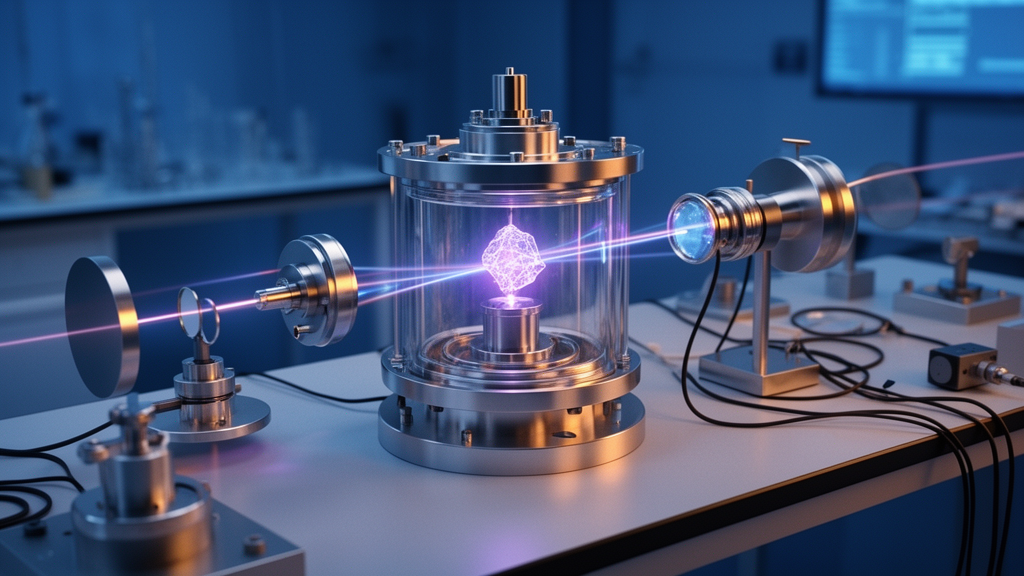
For decades, the most precise timekeeping devices on Earth have shared a common design: they tick using electrons. Every optical atomic clock built to date excites the outer electrons of atoms or ions with laser light, and the exquisitely regular frequencies of those transitions serve as the pendulum strokes of modern metrology. Now a collaboration between Germany’s national metrology institute, the Physikalisch-Technische Bundesanstalt (PTB) in Braunschweig, and the Technical University of Vienna has crossed a threshold that many physicists once considered a distant dream. In two papers published in Nature, the team reports the first demonstration of an optical nuclear clock, a device whose timekeeping reference comes not from an atom’s electron shell but from the nucleus itself. The clock operated stably for more than twenty-four hours without any user intervention, and it was compared directly against an optical atomic clock at the Austrian metrology institute BEV–PTP in Vienna.
The physics behind this achievement is as unusual as it is elegant. In ordinary atoms, the particles packed into the nucleus are bound together so tightly that a laser simply does not carry enough energy to disturb them. Exciting a nucleus typically requires gamma rays, not the gentle, precisely tuned light used in atomic clocks. Thorium-229 is the lone known exception. This isotope possesses two energy states so closely spaced in energy that the gap falls within reach of ordinary laser light. Because it has two very closely adjacent energy states, a laser is sufficient to alter the state of the atom’s nucleus, as Ekkehard Peik of PTB explains. It was Peik who, back in 2003, first proposed the principle of a nuclear clock based on thorium, setting in motion a research program that would take roughly two decades to reach its current milestone.
Finding the exact laser frequency needed to excite the thorium-229 nucleus was a search Peik likened to hunting for a needle in a haystack. The transition energy was known only approximately, and to excite the nucleus the laser had to be matched to it within one millionth of an electron volt. The breakthrough came from an unexpected direction: crystal growth. Thorsten Schumm and his team at the Technical University of Vienna grew special calcium fluoride crystals doped with large numbers of thorium nuclei. Because millions of thorium nuclei could be interrogated simultaneously inside the transparent crystal, the odds of stumbling upon the correct laser frequency improved dramatically. That strategy paid off some two and a half years ago, when the collaboration achieved the world’s first laser excitation of an atomic nucleus, the critical breakthrough on the path to a new class of atomic clock.
Yet even that landmark result left a crucial gap between proof of principle and a functioning clock. The first laser system the team used occupied several square meters of optical table space and could only be operated in pulsed mode, Peik recalls. Pulsed operation posed a fundamental problem for clockwork. In the initial experiments, the crystals were irradiated with the laser for two minutes at a time, then the beam was blocked so the fluorescent light emitted by the excited nuclei could be observed and measured. That fluorescence decays slowly, with a time constant of around ten minutes, far too sluggish to stabilize a laser frequency to the nuclear resonance as optical clock operation demands. A clock, in essence, needs a continuous, immediate feedback signal, not a slow afterglow read out in interrupted intervals.
The solution emerged from an intensive collaboration with the Max Born Institute in Berlin. In December of 2025, the PTB physicists presented a compact, continuously emitting solid-state laser with very high frequency resolution, a device that replaced the sprawling pulsed apparatus of the earlier experiments. The new laser was far more stable in both frequency and power, and it enabled a decisive change in measurement strategy. Instead of waiting for the nuclei to fluoresce after the laser was switched off, the team could now measure the laser power absorbed by the nuclei directly, while the laser was still shining. The signal arrived with no time delay and required no beam blocking, which meant it could be used to tune the laser frequency to the nuclear resonance over both short and long timescales, exactly the feedback loop a clock requires.
With the laser system built at PTB and the thorium-doped calcium fluoride crystals produced in Vienna, the collaboration assembled a complete clock and demonstrated something no nuclear clock had ever done: continuous, stable operation for more than a full day without human intervention. During that run, the clock was compared against an optical atomic clock at the Austrian metrology institute in Vienna, providing an external benchmark for its performance. The two Nature papers document both the underlying spectroscopy and the clock demonstration. One paper, by Ira Morawetz and colleagues, describes continuous-wave laser absorption spectroscopy of the thorium-229 nucleus, while the second, led by Luca Toscani, presents the thorium-229 optical nuclear clock with its feedback loop.
The pace of this progress stands out sharply against the history of the field. Optical atomic clocks based on trapped atoms and ions took decades to mature from laboratory curiosities into instruments that now underpin the redefinition of the second. The thorium-229 nuclear clock has traveled from first laser excitation to a continuously operating, feedback-stabilized clock in roughly two and a half years, a rate Peik describes as exceptionally high for such a young field of research. The new device also breaks conceptual ground in two ways at once. It is the first clock based on a nuclear resonance rather than an electronic transition, and it uses a solid-state material, a doped crystal, as its timekeeping element, whereas every other optical atomic clock currently under development relies on individual atoms or ions suspended in vacuum traps.
The measurement capabilities unlocked by the new clock are already being put to work on questions beyond timekeeping. One of the published studies examined the tendency of the thorium nucleus to occupy different positions within the calcium fluoride crystal lattice. Each site produces a slightly shifted nuclear resonance, yielding a spectrum that encodes information about the microscopic structure of the host crystal. Mapping that spectrum is not merely an academic exercise; understanding and controlling the environments of the thorium nuclei will be essential to optimizing the clock’s performance. In a second application, the team conducted an initial test searching for possible couplings between the thorium-229 nucleus and certain forms of dark matter, the invisible substance that makes up most of the matter in the universe yet has never been directly detected. A nuclear clock, whose resonance frequency depends on the fundamental forces binding the nucleus, offers a sensitive probe for any hypothetical dark-matter field that would subtly alter those forces over time.
Interest in the results spread quickly through the scientific community even before formal publication. The findings drew strong attention at conferences, and reports arrived just weeks after the Vienna announcement of similar experiments by a collaboration of Chinese institutes led by Tsinghua University, confirming that thorium-229 nuclear clock research has become a genuinely global pursuit within only a few years of its beginnings in Braunschweig and Vienna. Peik is candid about where the device stands today. The stability now achieved with the nuclear clock does not yet set any world records compared with the best optical atomic clocks based on trapped atoms or ions, he notes, but the team can now clearly identify where the current technical limits lie and which properties of the laser systems and thorium crystals need further improvement to make the clock truly competitive.
Why does a nuclear clock matter so much to physicists? The answer lies in the physics of the nucleus itself. Nuclear states are governed by the strong nuclear force, which responds to new physics differently than the electromagnetic forces that govern electron transitions. A clock based on a nuclear resonance is therefore sensitive to a different class of possible deviations from established theory, including variations in fundamental constants and interactions with dark matter, and it can compare against electronic clocks to reveal discrepancies neither could detect alone. Solid-state operation also hints at future devices that could be more compact and robust than today’s vacuum-trapped ion systems. The ticking has only just begun, but the thorium-229 nuclear clock has already opened a new window onto both the most precise measurement of time ever conceived and some of the deepest unanswered questions in fundamental physics.
Subject of Research: Development of the first continuously operating optical nuclear clock based on the thorium-229 nuclear transition
Article Title: The nuclear clock has begun ticking
Article References: The nuclear clock has begun ticking. (n.d.). Original publication
Image Credits: AI Generated
DOI: Not provided
Keywords: nuclear clock, thorium-229, atomic clock, PTB, TU Wien, laser spectroscopy, calcium fluoride crystal, optical clock, dark matter, metrology, nuclear resonance, Nature
Cite Scienmag News
Katie Riggs. (October 8, 2026). Nuclear Clock Runs Steady for Over a Day in Thorium Breakthrough. Scienmag. https://scienmag.com/nuclear-clock-runs-steady-for-over-a-day-in-thorium-breakthrough/
Katie Riggs. "Nuclear Clock Runs Steady for Over a Day in Thorium Breakthrough." Scienmag, 8 October 2026, https://scienmag.com/nuclear-clock-runs-steady-for-over-a-day-in-thorium-breakthrough/. Accessed 8 October 2026.
Katie Riggs. "Nuclear Clock Runs Steady for Over a Day in Thorium Breakthrough." Scienmag. October 8, 2026. https://scienmag.com/nuclear-clock-runs-steady-for-over-a-day-in-thorium-breakthrough/


