


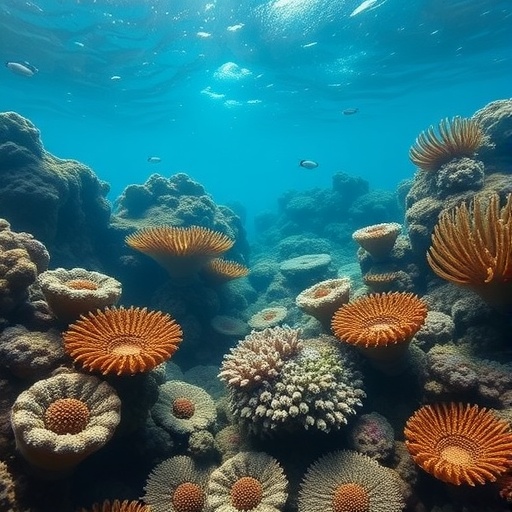
In a groundbreaking new study emerging from Edith Cowan University (ECU), scientists have revealed that the waters once spanning the region between Australia and Southeast Asia hosted the largest coral reef expansions of the past 100 million years. This discovery sheds critical light on how these ancient reef systems laid the foundation for what is now recognized as the world’s richest marine biodiversity hotspot. The research, expertly led by Dr. Alexandre Siqueira, an acclaimed marine biologist and recipient of the Australian Research Council’s Discovery Early Career Researcher Award (ARC DECRA), offers unprecedented insight into the environmental and biological phenomena propelling this marine explosion during the Miocene epoch.
Coral reefs are widely acknowledged as one of Earth’s most biodiverse ecosystems, harboring nearly a quarter of all marine species despite covering less than one percent of the ocean floor. Yet, the processes by which such astounding diversity emerged have long remained elusive to researchers. This latest investigation marks a pivotal advancement by identifying a geological and evolutionary turning point approximately 20 to 10 million years ago when coral reefs expanded dramatically, surpassing any known modern reef growth both in size and complexity.
Dr. Siqueira and his international team pursued a meticulous meta-analytical approach, synthesizing three independent strands of evidence: geological data, fossil records, and genetic phylogenies. By integrating these diverse methodologies, they triangulated the timing and spatial dynamics of ancient reef proliferation within the Indo-Australian Archipelago, a marine region currently famed for its extraordinary species richness. This triangulation not only confirmed the timing of the reef boom but also correlated it with the emergence of numerous coral clades and iconic reef fish lineages, including parrotfishes, which are critical for reef ecosystem services today.
The study points to a complex interplay of tectonic movements, environmental shifts, and biological innovation that ignited this ancient marine renaissance. A key driver was the northward migration of the Australian tectonic plate, which, upon encountering the shallow continental shelves of Southeast Asia, generated vast shallow marine habitats ideal for coral growth. This tectonically created seascape, coupled with fluctuating oceanic conditions such as nutrient availability and sea temperatures, precipitated an exponential increase in reef area and structural complexity, opening ecological niches that facilitated rapid species diversification.
Strikingly, the research overturns conventional wisdom regarding primary reef locations during this period. The focal point of the Miocene reef expansion was not the Caribbean or the Indo-Pacific’s current diversity heartlands, but rather the waters off northwestern Australia. The ancient reef system in this locale, coined the ‘Great Indo-Australian Miocene Reef System,’ encompassed immense reef formations, including precursors to the Ashmore Reef, Scott Reef, and the Rowley Shoals. Geological reconstructions suggest that some individual reefs within this system may have dwarfed any modern counterparts, rivaling or even exceeding the Great Barrier Reef in size and scope during its peak.
These massive reef complexes likely played a dual evolutionary role: acting as biodiversity incubators and serving as a reservoir from which life radiated outward into other Indo-Pacific regions. Over millions of years, this west Australian marine cradle facilitated the generation and dispersal of both coral and fish species, thereby influencing the genetic and taxonomic composition of tropical oceans globally. This revelation spotlights the previously underappreciated historical importance of Australia’s northwest reefs, reframing our understanding of how contemporary marine biodiversity hotspots were seeded and shaped.
Despite these illuminating findings, Dr. Siqueira cautions that many questions still linger regarding the finer details of reef dynamics during the Miocene. The complex interactions among tectonics, sea level fluctuations, and marine ecology necessitate further investigation. However, this study decisively shifts the paradigm, highlighting that ancient reef systems were not static entities but experienced dramatic spatial and temporal flux, with ecological consequences that resonate to this day.
Importantly, the ancient reefs’ expansion coincides with significant coral lineage diversification, suggesting reef size and habitat complexity directly influenced evolutionary trajectories. Larger, more structurally intricate reef systems created abundant microhabitats, fostering speciation through ecological partitioning and niche specialization. Iconic reef fish lineages, such as the parrotfish, are believed to have emerged during this period, underpinning critical reef ecosystem functions that sustain coral health through bioerosion and algal grazing.
From a technological standpoint, this research exemplifies the power of combining multidisciplinary datasets—fossil chronologies, molecular phylogenetics, and sedimentological evidence—to unravel deep-time biodiversity patterns. By leveraging advanced genetic sequencing and radiometric dating techniques, the team reconstructed past biodiversification events with remarkable temporal resolution, providing a nuanced narrative of how coral reef ecosystems evolved in response to Earth system changes.
As these revelations reshuffle long-held assumptions, they bear significant implications for contemporary marine conservation under accelerating climate change. Understanding that reef biodiversity originated and flourished under a defined set of geological and environmental conditions helps pinpoint vulnerabilities and adaptive capacities within coral ecosystems. It underscores the urgency to protect extant reefs, particularly lesser-studied regions like northwest Australia, whose historical influence on marine biodiversity has been undervalued.
In conclusion, the ‘Great Indo-Australian Miocene Reef System’ emerges as a monumental chapter in Earth’s marine evolutionary history. Its ancient, mammoth reefs fostered biodiversity waves that sculpted today’s complex tropical marine ecosystems, integrating evolutionary innovation with shifting Earth dynamics. This pioneering study opens new vistas for marine science, inspiring future explorations into how past environmental revolutions shape the resilience and diversity of life beneath our oceans’ waves.
Cite Scienmag News
Gavin Prescott. (May 14, 2026). Ancient Reefs Reveal Secrets Behind Modern Marine Life Evolution. Scienmag. https://scienmag.com/ancient-reefs-reveal-secrets-behind-modern-marine-life-evolution/
Gavin Prescott. "Ancient Reefs Reveal Secrets Behind Modern Marine Life Evolution." Scienmag, 14 May 2026, https://scienmag.com/ancient-reefs-reveal-secrets-behind-modern-marine-life-evolution/. Accessed 3 September 2026.
Gavin Prescott. "Ancient Reefs Reveal Secrets Behind Modern Marine Life Evolution." Scienmag. May 14, 2026. https://scienmag.com/ancient-reefs-reveal-secrets-behind-modern-marine-life-evolution/


