


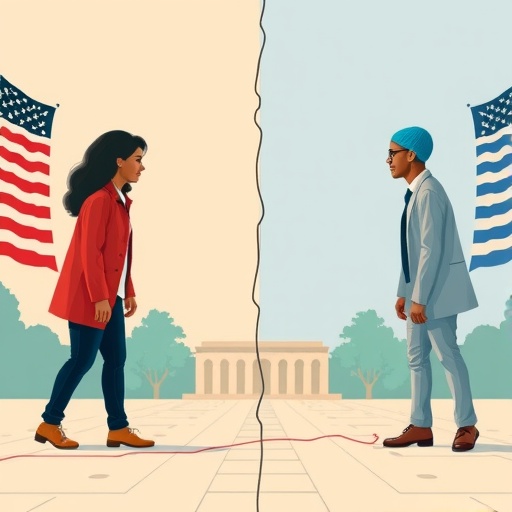
In recent years, the intertwining of politics and public health in the United States has emerged as a powerful and concerning phenomenon. A groundbreaking study published in Nature Human Behaviour by Elder and O’Brian (2026) sheds light on the extent to which political polarization has not only shaped opinions and policy decisions but has also tangibly influenced health outcomes across the nation. This research probes deeply into the complex and multifaceted relationship between political identity and public health indicators, unveiling patterns with significant implications for both scientific understanding and public policy.
Examining health outcomes at the county level, Elder and O’Brian’s work reveals a stark and growing divide aligned with political affiliations. Their comprehensive analysis shows that counties that favored the Republican Party have experienced worse health outcomes compared to their Democratic counterparts over recent decades. This divergence is not marginal; it manifests across multiple key indicators, including life expectancy, mortality rates, chronic disease prevalence, and access to healthcare services. The study’s temporal scope, spanning from 1980 to 2019, highlights a progressive intensification of these disparities, especially after the early 2000s.
The methodology behind this study employs rigorous statistical modeling and spatial analysis to untangle the effects of politics from confounding socioeconomic and demographic variables. By controlling for income, education, race, and urban-rural status, the authors isolate political party vote share as a critical predictive variable. The results indicate that political alignment robustly correlates with health outcomes even when accounting for other sociodemographic factors. Such findings point to political polarization as an independent driver of public health inequalities, challenging conventional wisdom that attributes health disparities predominantly to economic circumstances.
One of the study’s most compelling contributions is its identification of mechanisms through which politics may influence health outcomes. The authors propose that partisan divisions shape behaviors and environments that directly affect health. For example, political ideologies can determine attitudes toward vaccination, mask-wearing, acceptance of scientific consensus, and engagement with preventive healthcare services. Furthermore, these divisions influence legislative priorities at state and local levels, impacting public health funding, Medicaid expansion, environmental regulations, and health education programs.
The impact of political polarization on health behaviors is vividly illustrated in the differing responses to the COVID-19 pandemic. Data analyzed reveals that counties with stronger Republican support tended to have higher rates of COVID-19 infection, hospitalization, and mortality, likely reflecting lower uptake of mitigation measures and vaccines. These variations contribute to widening the preexisting health gap and underscore the immediate public health consequences of political partisanship. The authors caution that such trends may become entrenched if political identity continues to serve as a determinant of health-related choices.
Beyond infectious disease, Elder and O’Brian’s analysis extends into chronic health conditions and mortality metrics. They report that mortality rates from diseases commonly linked to lifestyle and environmental factors—such as heart disease, respiratory illness, and substance use disorders—diverge significantly between politically conservative and liberal regions. Intriguingly, this divergence began to accelerate notably in the early 2000s, paralleling an era of increasing political fragmentation and media polarization.
The persistence of these disparities throughout rural and urban classifications further complicates the narrative. While previous research has often highlighted urban-rural divides in health, this study suggests that political allegiance may surpass geographic location as a predictor of health outcomes. In some cases, rural counties with Democratic majorities demonstrate better health metrics than urban counties with Republican majorities, emphasizing that political identity exerts a unique influence transcending traditional demographic boundaries.
Elder and O’Brian also explore social determinants of health that intersect with political polarization. Variables such as educational attainment, income inequality, and racial composition underpin health disparities, but they interact complexly with political behavior. The authors discuss how political polarization can exacerbate social fragmentation, reduce trust in institutions, and foster echo chambers that reinforce unhealthy behaviors or skepticism toward medical guidance. This social dynamic further entrenches health inequalities along partisan lines.
Another dimension of the study centers on policy responsiveness in politically polarized contexts. The authors argue that when health outcomes become politicized, evidence-based policymaking faces obstacles. Polarization can delay or obstruct interventions such as expanding Medicaid, tobacco control, and environmental protections, especially in Republican-led states or counties. The fragmentation creates an uneven health policy landscape, where residents’ access to quality care and prevention programs depends heavily on local political climates.
The implications of these findings extend well beyond academic interest; they have urgent relevance for healthcare providers, policymakers, and public health advocates. Recognizing political polarization as a determinant of health necessitates new approaches that transcend partisan divides. Elder and O’Brian advocate for bipartisan efforts that prioritize public health as a unifying goal, accompanied by strategies to rebuild trust and engage diverse communities irrespective of political affiliation.
Importantly, the study situates the US experience in a comparative international context, noting that such pronounced health polarization along political lines is relatively rare. Other advanced democracies tend to exhibit smaller health outcome differences among political constituencies, partly due to differing political cultures, social welfare systems, and public trust mechanisms. This comparative perspective highlights the unique challenges posed by the American political landscape.
Technically, the study utilized a vast array of datasets, including county-level mortality data from the Centers for Disease Control and Prevention, election results from state and national databases, and demographic indicators from the US Census Bureau. Advanced geospatial statistical techniques allowed the authors to model how patterns evolved geographically and temporally, integrating cross-sectional and longitudinal data for a robust analytical framework.
The researchers also applied sophisticated machine learning models to predict health outcomes based on a suite of predictors, confirming the dominant role of political variables after controlling for other factors. Sensitivity analyses ensured robustness against potential biases such as data quality differences between counties or temporal changes in reporting standards. This methodological rigor enhances the credibility of their conclusions and sets a benchmark for future investigations into sociopolitical determinants of health.
Looking forward, Elder and O’Brian emphasize the need for ongoing longitudinal studies to monitor how evolving political dynamics continue to shape health trajectories. They raise important questions about potential interventions that could mitigate the health impacts of polarization, including public health messaging tailored to diverse political audiences, reforms in health governance, and efforts to reduce misinformation. Moreover, interdisciplinary collaboration among political scientists, epidemiologists, and health communication experts is critical to developing effective solutions.
Lastly, the study provokes reflections on the broader societal consequences of political polarization beyond individual health. Given that population health is fundamental to economic productivity, social stability, and national security, deepening divides may have cascading effects on societal well-being. Elder and O’Brian conclude that addressing political polarization is not only a matter of democracy and civic engagement but also a vital public health imperative.
This landmark research has sent ripples across both political science and public health communities, highlighting how intricately politics weaves into the fabric of Americans’ health. As public discourse grows increasingly divisive, understanding and addressing the health repercussions of political polarization becomes ever more urgent. Through rigorous analysis and nuanced interpretation, Elder and O’Brian’s study offers a clarion call to heal not just political rifts but also the profound health disparities they propagate across the United States.
Cite Scienmag News
Phoebe Ingram. (May 14, 2026). Health Outcomes Deepen US Political Divides. Scienmag. https://scienmag.com/health-outcomes-deepen-us-political-divides/
Phoebe Ingram. "Health Outcomes Deepen US Political Divides." Scienmag, 14 May 2026, https://scienmag.com/health-outcomes-deepen-us-political-divides/. Accessed 8 September 2026.
Phoebe Ingram. "Health Outcomes Deepen US Political Divides." Scienmag. May 14, 2026. https://scienmag.com/health-outcomes-deepen-us-political-divides/


