


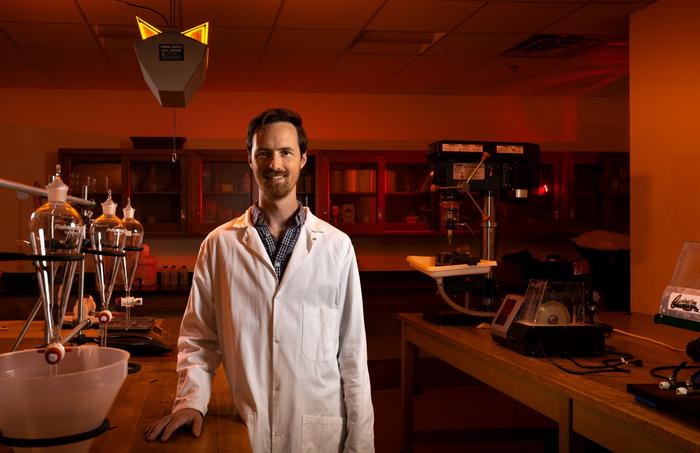
A new study out of The University of Texas at Arlington shows that frozen land in Alaska is eroding faster than it can be replaced due to climate change.

Credit: Photo courtesy UT Arlington
A new study out of The University of Texas at Arlington shows that frozen land in Alaska is eroding faster than it can be replaced due to climate change.
“In the Northern Hemisphere, much of the ground is permafrost, meaning it is frozen year-round. Permafrost is a delicate natural resource. If it is lost faster than it is regenerated, we endanger infrastructure and release carbon, which can warm the atmosphere,” said Nathan D. Brown, assistant professor of earth and environmental sciences at UT Arlington. “Under a warming climate, a major question is whether arctic rivers will erode permafrost in thawing riverbanks faster than permafrost can regenerate.”
It happens slowly, but all rivers naturally change their paths over time. Floods, earthquakes, vegetation growth, and wildlife are constantly at work shifting rivers, charting new paths for water, and depositing sediment where water once flowed.
A difference seen with Alaskan rivers is that the land on riverbanks can be permanently frozen. Called permafrost, it’s a mixture of soil, gravel and sand often bound together by ice. Permafrost is important because it holds large amounts of organic carbon, which is then released when it melts. This carbon can combine with oxygen to become carbon dioxide, a greenhouse gas that warms Earth’s atmosphere.
To better understand the fate of permafrost in a warming world, Dr. Brown—along with colleagues from the California Institute of Technology; Massachusetts Institute of Technology; University of California at Santa Barbara; Los Alamos National Laboratory; the University of Chicago; and the University of Pennsylvania—mapped and dated floodplain deposits, determined permafrost extent, and characterized vegetation along the Koyukuk River in Alaska to model how permafrost formation varies with air temperature. The Koyukuk is a 425-mile feeder stream of the Yukon River and the last major tributary to flow into the Yukon before it empties into the Bering Sea, the major waterway separating America and Russia.
In the American Geophysical Union journal AGU Advances, the team reported that while new permafrost is developing along the Koyukuk River floodplain, it is not forming fast enough to replace what is disappearing due to rising temperatures.
“By dating these permafrost deposits, we found that permafrost formation in this region can take thousands of years,” said Brown. “Under a warming climate, permafrost formation is expected to take longer, while thawing permafrost riverbanks will become more susceptible to erosion. The net result will be loss of permafrost and contribution of carbon to the atmosphere.”
**Financial support for this research was provided by the National Science Foundation awards 2127442 and 2031532; Foster and Coco Stanback; the Linde Family; the Caltech Terrestrial Hazards Observation and Reporting Center; the Resnick Sustainability Institute; the National Defense Science and Engineering Graduate Fellowship; the Fannie and John Hertz Foundation Cohen/Jacobs and Stein Family Fellowship; and a Department of Energy Office of Science, Biological and Environmental Research Subsurface Biogeochemical Research Program Early Career award.**
Journal
AGU Advances
Method of Research
Observational study
Subject of Research
Not applicable
Article Title
Permafrost Formation in a Meandering River Floodplain
Article Publication Date
5-Jul-2024
COI Statement
The authors declare no conflicts of interest relevant to this study.
Cite Scienmag News
Sloane Callahan. (August 7, 2024). Alaskan land eroding faster due to climate change. Scienmag. https://scienmag.com/alaskan-land-eroding-faster-due-to-climate-change/
Sloane Callahan. "Alaskan land eroding faster due to climate change." Scienmag, 7 August 2024, https://scienmag.com/alaskan-land-eroding-faster-due-to-climate-change/. Accessed 3 September 2026.
Sloane Callahan. "Alaskan land eroding faster due to climate change." Scienmag. August 7, 2024. https://scienmag.com/alaskan-land-eroding-faster-due-to-climate-change/

