


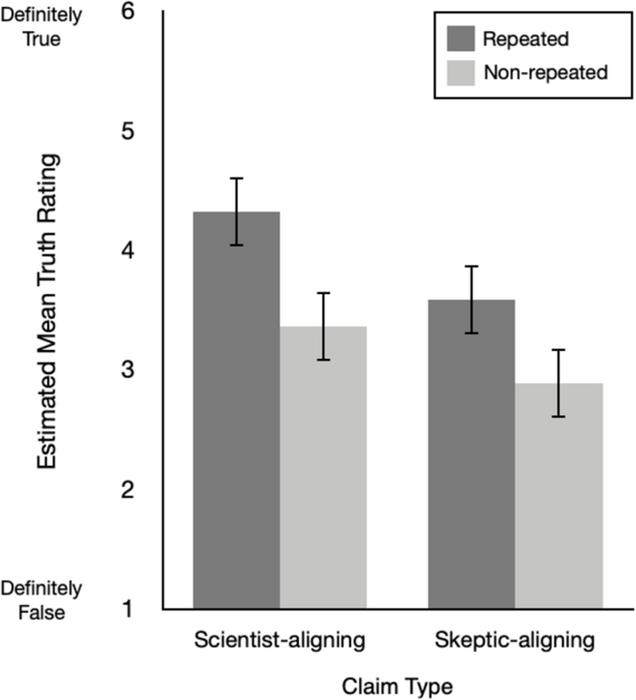
Climate science supporters rated climate-skeptical statements as “truer” after just a single repetition, according to a study published August 7, 2024 in the open-access journal PLOS ONE led by Mary Jiang from The Australian National University, Australia, and coauthored by Norbert Schwarz from the University of Southern California, USA, and colleagues. The results held true even for the strongest climate science supporters surveyed.

Credit: Jiang et al. 2024, PLOS ONE, CC-BY 4.0 (
Climate science supporters rated climate-skeptical statements as “truer” after just a single repetition, according to a study published August 7, 2024 in the open-access journal PLOS ONE led by Mary Jiang from The Australian National University, Australia, and coauthored by Norbert Schwarz from the University of Southern California, USA, and colleagues. The results held true even for the strongest climate science supporters surveyed.
Amidst the influx of content that a person consumes each day, the principle of motivated cognition suggests they are likelier to find truth in the statements that mirror their own beliefs. However, a second phenomenon, the illusory truth effect, suggests that just one repeated exposure to an idea — regardless of what it is — can elevate its perceived validity.
Schwarz and colleagues examined these ideas in the arena of climate science, questioning how self-identified climate science supporters might react when repeatedly exposed to climate-skeptical claims. Would repetition have an effect despite the conviction of their own beliefs?
The researchers fashioned two similar experiments, the first including 52 participants and the second 120. At least 90% of participants across both experiments endorsed climate science: the scientific evidence of human-caused climate change.
Participants reviewed a series of statements classified as climate-skeptical, climate-science, or weather-related filler statements. After 15 minutes, they reviewed a second series of claims, half of which were repetitions of the previous statements. They rated the claims from “Definitely True” to “Definitely False” on a six-point Likert scale. In Experiment 2, the participants also classified each claim as scientist- or skeptic-aligned, and defined their own climate views using the Six Americas Super Short Survey.
In the climate science endorsers, the repetition did increase perceived validity of all claim types — including the ones participants flagged retrospectively as antithetical to their own beliefs. This held true even for the strongest climate science supporters, those participants who self-identified as “Alarmed” by climate change.
These results reinforce the benefits of amplifying truth by repetition and the risks of spreading false information, the researchers write. They suggest that further studies include non-climate issues (e.g., immigration, education, healthcare, etc.), experiment with time spans and rounds of repetition, and invert the experiment to study how climate skeptics are affected by repetition of claims supporting climate science.
Lead author Mary Jiang adds: “People find claims of climate skeptics more credible when they have been repeated just once. Surprisingly, this increase in belief as a result of repetition occurs even when people identify as a strong endorser of climate science.”
#####
In your coverage please use this URL to provide access to the freely available article in PLOS ONE:
Citation: Jiang Y, Schwarz N, Reynolds KJ, Newman EJ (2024) Repetition increases belief in climate-skeptical claims, even for climate science endorsers. PLoS ONE 19(8): e0307294.
Author Countries: Australia, USA
Funding: The author(s) received no specific funding for this work.
Journal
PLoS ONE
Method of Research
Experimental study
Subject of Research
People
Article Title
Repetition increases belief in climate-skeptical claims, even for climate science endorsers
Article Publication Date
7-Aug-2024
COI Statement
The authors have declared that no competing interests exist.
Cite Scienmag News
Courtney Benton. (August 7, 2024). Repetition boosts belief in climate-skeptical claims, even among climate science endorsers. Scienmag. https://scienmag.com/repetition-boosts-belief-in-climate-skeptical-claims-even-among-climate-science-endorsers/
Courtney Benton. "Repetition boosts belief in climate-skeptical claims, even among climate science endorsers." Scienmag, 7 August 2024, https://scienmag.com/repetition-boosts-belief-in-climate-skeptical-claims-even-among-climate-science-endorsers/. Accessed 3 September 2026.
Courtney Benton. "Repetition boosts belief in climate-skeptical claims, even among climate science endorsers." Scienmag. August 7, 2024. https://scienmag.com/repetition-boosts-belief-in-climate-skeptical-claims-even-among-climate-science-endorsers/

