


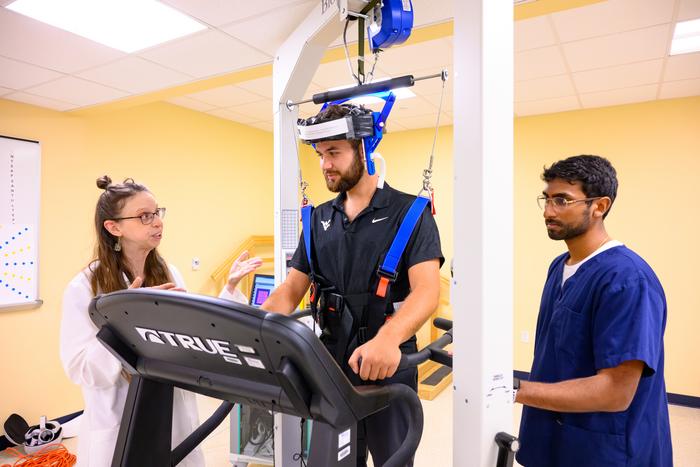
An upright neuroimaging device developed by West Virginia University neuroscientists, physicists and engineers that allows patients to move around while undergoing a brain scan could help set priorities for the evolution of imaging tools.

Credit: (WVU Photo/Davidson Chan)
An upright neuroimaging device developed by West Virginia University neuroscientists, physicists and engineers that allows patients to move around while undergoing a brain scan could help set priorities for the evolution of imaging tools.
Researchers tested their prototype in a real world setting to assess its accuracy and determine needs for improvement. The prototype is being designed to address issues with traditional Positron Emission Tomography – PET – scanners which require patients to lie still for imaging.
“A lot of PET imaging is being done for research or diagnostics with patients with diseases that cause involuntary or uncontrollable movement such as Parkinson’s. This makes it difficult or impossible to test these patients when their symptoms become too severe, since regular brain imagers require staying very still. Also, if you want to study human behaviors like walking, anxiety-provoking tasks or even addiction, this device could provide a way to image,” said Julie Brefczynski-Lewis, research assistant professor in the Department of Neuroscience at the WVU School of Medicine and the Rockefeller Neuroscience Institute.
“It’s also helpful with imaging for patients with cognitive issues like dementia because they have trouble staying still and even understanding the instruction they need to stay still, so they usually have to be anesthetized. If we want to image their brain while they’re awake and alert, this would be a way to do that as well.”
The scanner is an upgrade of an earlier prototype Brefczynski-Lewis and her team developed with funding from West Virginia Clinical and Translational Science Institute.
While both versions are helmets, the first was heavier and only allowed slight movement of the head from side to side. The new one, called an Ambulatory Motion-enabling PET, or AMPET, is lighter weight and fits the head much like hard hats construction workers wear. A balanced support is at the top.
“What we like about the AMPET is that it moves with the head, and you can be in a real environment where you’re immersed and walk with it on,” she said. “What we demonstrated in the study is that when the patients walk, it’s not moving relative to the head and that’s what allowed us to get a relatively clean image. We also wanted to see what should be improved by us or other laboratories that are making these devices.”
The study, conducted by Brefczynski-Lewis and colleagues from the School of Medicine, was published in the journal Nature Communications Medicine.
“The purpose of this study was, we have this new technology and we can model it on a computer until the cows come home. But until you work with actual patients, you don’t know how it’s really going work in the real world,” she said.
To test the prototype, the team enlisted volunteer outpatients who were scheduled for other scans and were already receiving medications used for imaging. Participants fitted with the helmet walked in place while researchers watched for motion tolerance and assessed neural activity in motor-related brain regions.
“We observed brain activity in the parts of the brain that control leg movements when the patients walked, which was what we had hoped to see,” Brefczynski-Lewis said.
Their findings were further confirmed by observing one patient who had a prosthetic leg from hip to foot. His brain activity displayed predominantly in the area that represented the natural leg.
“That was almost a separate test in itself that we didn’t expect,” she said.
To enhance the prototype, researchers want to add a motion tracking system as well as make the helmet bigger so that it could image a larger area of the brain.
“Motion tracking is already made for other technologies, so all we have to do is apply it to our device,” Brefczynski-Lewis said. “That will help because sometimes we miss the area of the brain we want to see.”
In addition to performing imaging for patients who aren’t able to stay still, Brefczynski-Lewis said the AMPET can be useful to neuroscientists researching human behaviors and activities with natural movement such as gestures, conversation and balance.
“In order to study balance, people have been in MRIs lying down and imagining themselves balancing, which isn’t the same as actually balancing, or they have a surface imager that doesn’t capture the deep brain structures,” she explained. “You can see some parts of the brain, but not the deep core parts of the brain that are usually more involved with things like movement, balance, emotion, memory, fear and joy.”
In the future, Brefczynski-Lewis and her team envision the AMPET being used to monitor brain activity and provide treatment for people with PTSD, study mindfulness meditation and integrate with virtual reality technologies.
“To be able to image the brain in motion, we’re showing that there’s a whole new field that could open up because of our device,” she said. “We can extend our neuroimaging research into human behaviors that are natural — how we interact with the world and how we interact with others.
Collaborating on the study with Brefczynski-Lewis were students Nanda K. Siva of Parkersburg and Colson Glover of Lewisburg; Kaylee Nott of Point Pleasant, West Virginia IDeA Network of Biomedical Research Excellence summer intern; Alexander Stolin, Gary Marano, Benjamin Parker, MaryBeth Mandich and James W. Lewis, WVU School of Medicine; Christopher Bauer, Sonia Chandi, Si Gao and Helen Melnick, University alumni; Stan Majewski, former WVU researcher; and Jinyi Qi.
Journal
Communications Medicine
Method of Research
Experimental study
Subject of Research
People
Article Title
Real-time motion-enabling positron emission tomography of the brain of upright ambulatory humans
Article Publication Date
13-Jun-2024
Cite Scienmag News
Cassandra Pierce. (August 7, 2024). Walking the walk, WVU develops motion compatible brain scanner. Scienmag. https://scienmag.com/walking-the-walk-wvu-develops-motion-compatible-brain-scanner/
Cassandra Pierce. "Walking the walk, WVU develops motion compatible brain scanner." Scienmag, 7 August 2024, https://scienmag.com/walking-the-walk-wvu-develops-motion-compatible-brain-scanner/. Accessed 3 September 2026.
Cassandra Pierce. "Walking the walk, WVU develops motion compatible brain scanner." Scienmag. August 7, 2024. https://scienmag.com/walking-the-walk-wvu-develops-motion-compatible-brain-scanner/

