


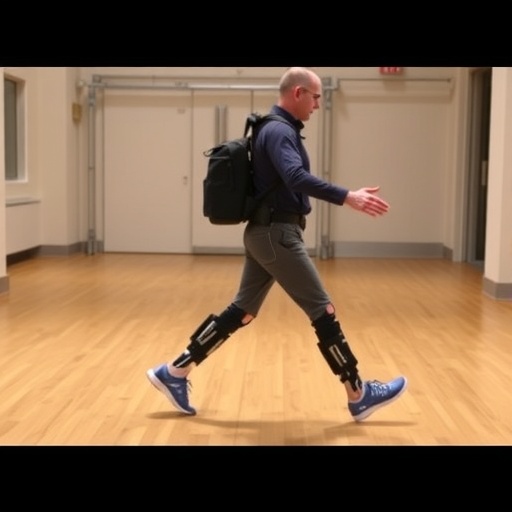
Physical therapy for stroke survivors has long relied on the physical presence and hands-on expertise of therapists walking alongside their patients. Now, a remarkable technological leap is reshaping this dynamic. Researchers at Northwestern University in collaboration with Shirley Ryan AbilityLab have unveiled a revolutionary rehabilitation system that forges a direct, real-time link between therapists and patients via robotic exoskeletons. This novel system, known as Therapist-Exoskeleton-Patient Interaction (TEPI), ushers in a new era of highly adaptive, personalized post-stroke gait therapy.
At the heart of TEPI lies a pair of lower-limb exoskeletons worn by the therapist and the stroke survivor, virtually coupled at the hips and knees through a sophisticated control interface. The virtual connection mimics the behavior of springs and shock absorbers, dynamically transmitting forces and movements between the two exoskeletons. This bidirectional, compliant coupling enables therapists to intuitively influence patient gait patterns in real time, offering a level of interaction that is vastly more nuanced than conventional robotic or manual therapies.
Traditional stroke rehabilitation often involves therapists physically assisting patients through limited aspects of movement, constrained by human strength and availability. In contrast, TEPI leverages robotics to augment the therapist’s capacity, delivering whole-body gait training that adjusts fluidly to the patient’s evolving performance. The hands-on adaptability of therapists is thus preserved but enhanced with robotic precision and scalability, facilitating more comprehensive, sustained walking practice without requiring multiple caregivers.
The core engineering breakthrough enabling TEPI is a control framework that models the mechanical interaction between therapist and patient exoskeletons as a coupled spring-damper system. This design imparts compliance and responsiveness, harmonizing the biomechanical inputs from both participants while preventing unnatural or jarring forces. By embedding this interactive virtual linkage, TEPI provides continuous haptic feedback to therapists, allowing them to modulate support, resistance, and corrective assistance in tune with patient movement intentions.
In a recent clinical evaluation published in Science Robotics, TEPI demonstrated superior outcomes compared to conventional therapist-guided treadmill training. Stroke survivors using the system achieved significantly greater joint range of motion, executed longer and higher stepping patterns, and maintained muscle activation at levels comparable to or exceeding standard therapy regimes. Importantly, patient motivation and enjoyment remained consistently high, underlining the system’s potential to foster engagement and adherence during demanding rehabilitation processes.
The TEPI platform addresses prominent limitations of current rehabilitation exoskeletons, many of which rely on rigid, preprogrammed gait cycles that lack real-time adaptability. By contrast, TEPI integrates therapist expertise directly into the robotic control loop, enabling instantaneous behavioral adjustments that match the patient’s unique recovery trajectory. This synergy of human judgment and machine assistance embodies a new paradigm in rehabilitation robotics, where technology serves to amplify, not replace, therapeutic skill.
José L. Pons, the project’s visionary leader and a professor at Northwestern, emphasizes that TEPI’s promise lies in its ability to unify the therapeutic closeness of manual training with the replicability and intensity of robotic interventions. Such hybrid systems are poised to transform stroke recovery protocols by bridging gaps between efficacy, accessibility, and individualized care. They not only alleviate therapist physical burden but also enhance the precision and personalization of rehabilitation exercises.
The development team included multidisciplinary experts spanning mechanical engineering, physical medicine, biomedical engineering, and robotics, fostering innovation at the interface of human-machine interaction and clinical practice. This collaboration ensured that TEPI’s control algorithms and mechanical design were continuously refined based on real-world clinical feedback, resulting in a system deeply attuned to both biomechanical and therapeutic demands.
Looking ahead, the research group plans to expand TEPI’s application beyond treadmill walking, exploring its integration into functionally critical daily activities such as overground ambulation, stair climbing, and sit-to-stand transitions. Longitudinal studies are also underway to assess the benefits of repeated therapy sessions over extended recovery periods. Additionally, efforts are progressing to miniaturize and streamline the technology for potential deployment in home environments, promising scalable remote rehabilitation solutions that can transcend geographic and logistical barriers.
TEPI’s pioneering approach was made possible by funding from the U.S. National Science Foundation’s National Robotics Initiative, reflecting the strategic importance of robotics in advancing healthcare outcomes. By embedding robotic exoskeletons within a responsive therapeutic framework, the system exemplifies how cutting-edge engineering can catalyze transformative changes in the treatment of neurological impairments.
This breakthrough not only advances rehabilitation science but also redefines the human role in therapy. TEPI empowers therapists to become active collaborators with their patients through enhanced, augmented physical connection, promoting a more effective and responsive recovery journey for stroke survivors. It stands as a shining example of innovation that is as empathetic as it is technological — a true step forward in restoring mobility and quality of life.
News Publication Date:
17-Jun-2026
Web References:
http://dx.doi.org/10.1126/scirobotics.adz9628
Keywords
Robotic exoskeletons, Robotics, Robotic gaits, Robotic walking, Physical therapy, Physical rehabilitation, Brain damage, Brain injuries, Brain ischemia, Neuromuscular diseases, Neurological disorders
Cite Scienmag News
Cassandra Pierce. (June 17, 2026). Breakthrough Exoskeleton Therapy Promises to Transform Gait Rehabilitation for Stroke Survivors. Scienmag. https://scienmag.com/breakthrough-exoskeleton-therapy-promises-to-transform-gait-rehabilitation-for-stroke-survivors/
Cassandra Pierce. "Breakthrough Exoskeleton Therapy Promises to Transform Gait Rehabilitation for Stroke Survivors." Scienmag, 17 June 2026, https://scienmag.com/breakthrough-exoskeleton-therapy-promises-to-transform-gait-rehabilitation-for-stroke-survivors/. Accessed 3 September 2026.
Cassandra Pierce. "Breakthrough Exoskeleton Therapy Promises to Transform Gait Rehabilitation for Stroke Survivors." Scienmag. June 17, 2026. https://scienmag.com/breakthrough-exoskeleton-therapy-promises-to-transform-gait-rehabilitation-for-stroke-survivors/


