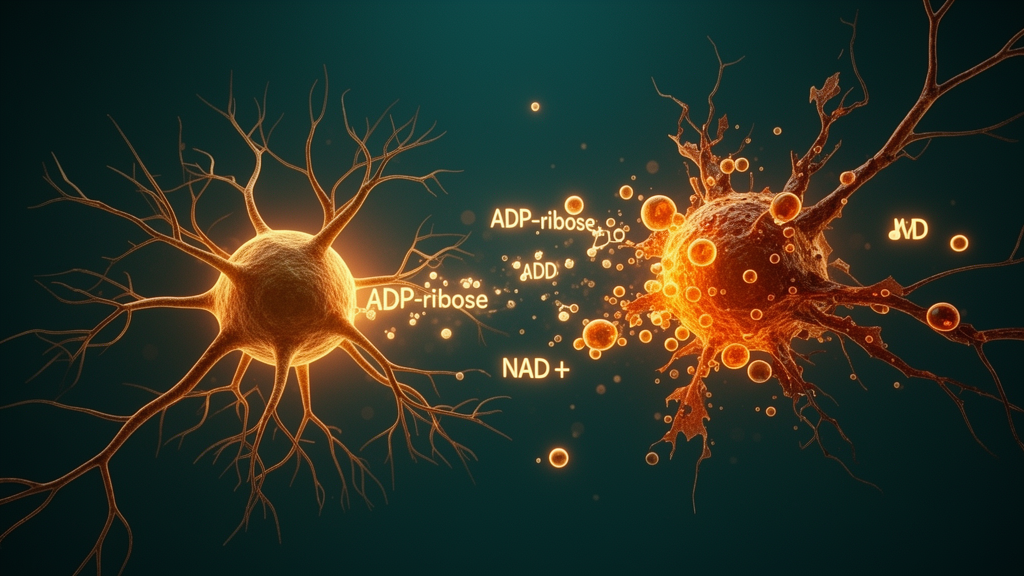
A previously overlooked byproduct of NAD+ breakdown can trigger a form of regulated cell death in neurons, according to a study published in Nature Chemical Biology on 28 October 2026. The work identifies ADP-ribose, a catabolite generated through the sequential action of the enzymes PARP1 and poly(ADP-ribose) glycohydrolase, as an inducer of ferroptosis, an iron-dependent cell death process marked by lipid peroxidation.
The research addresses a long-standing puzzle in neurobiology. Excessive consumption of nicotinamide adenine dinucleotide, or NAD+, is known to fuel neurological disease processes, yet supplementation with NAD+ itself has shown limited benefit in patients. The authors propose that toxicity arising from NAD+ catabolism, rather than the loss of NAD+ alone, may explain this gap, pointing to downstream metabolites as unappreciated drivers of pathology.
At the center of the new findings is the equilibrative nucleoside transporter 2, known as ENT2 and encoded by the gene SLC29A2. The researchers report that extracellular ADP-ribose directly binds to and inhibits this nucleoside transporter. With ENT2 blocked, nucleotide salvage through the transporter is suppressed, and cells respond with compensatory hyperactivation of de novo purine and pyrimidine biosynthesis pathways.
This metabolic rerouting has toxic consequences. According to the study, the shift toward de novo nucleotide synthesis engages two enzymes: xanthine oxidase and dihydroorotate dehydrogenase, abbreviated XO and DHODH. Together, these enzymes unleash bursts of superoxide, a reactive oxygen species. The resulting oxidative burst triggers lipid peroxidation in neuronal membranes, culminating in ferroptotic neuronal death.
The team found that ADP-ribose accumulates across multiple neurological disease models, linking the metabolite to pathological settings rather than an artificial experimental condition. In addition, acute administration of ADP-ribose in vivo recapitulated ferroptotic neurodegeneration, providing direct evidence that the catabolite is sufficient to drive this form of neuronal loss in living organisms.
Beyond establishing the mechanism, the study tested whether interrupting the pathway could rescue disease outcomes. In intracerebral hemorrhage models, the researchers targeted ADP-ribose signaling through three distinct strategies: knockdown of PARP1 to limit production of the catabolite, hydrolysis of ADP-ribose mediated by the enzyme NUDT9 to accelerate its clearance, and dual inhibition of XO and DHODH to block the superoxide-generating arm of the pathway.
Notably, these interventions rescued delayed cognitive deficits in the intracerebral hemorrhage models, suggesting that the ADP-ribose pathway is not merely a correlate of injury but a druggable vulnerability. The authors describe the ADP-ribose–ENT2 axis as a metabolic driver of neuronal ferroptosis that is relevant to disorders characterized by NAD+ hyperconsumption.
The findings reframe how scientists may think about NAD+ metabolism in the nervous system. Rather than viewing NAD+ depletion solely as an energy problem to be corrected by supplementation, the study highlights catabolic intermediates as active agents of damage, with ADP-ribose acting on a specific transporter to rewire nucleotide metabolism and provoke oxidative cell death. The identification of multiple intervention points, from the producing enzyme PARP1 to the clearance enzyme NUDT9 and the downstream oxidases, offers a map of potential therapeutic targets for conditions involving NAD+ hyperconsumption and ferroptotic neurodegeneration.
Subject of Research: The role of the NAD+ catabolite ADP-ribose in driving neuronal ferroptosis through ENT2-mediated metabolic rewiring
Article Title: ADP-ribose induces neuronal ferroptosis through ENT2-mediated nucleotide rewiring
Article References: Ni, H., He, Y., Ye, Q., Cui, P., Yuan, J., Lv, G., Lei, H., Wang, Q., Wang, F., ZhuGe, Q., Chen, B., Liang, L., Zhang, Y., & Yuan, L. (2026). ADP-ribose induces neuronal ferroptosis through ENT2-mediated nucleotide rewiring. Nature Chemical Biology. https://doi.org/10.1038/s41589-026-02355-2
Image Credits: AI Generated
DOI: 10.1038/s41589-026-02355-2
Keywords: ADP-ribose, NAD+ catabolism, ferroptosis, ENT2, PARP1, nucleotide metabolism, superoxide, lipid peroxidation, xanthine oxidase, DHODH, intracerebral hemorrhage, neurodegeneration
Cite Scienmag News
Diana Fleming. (October 28, 2026). ADP-ribose, an NAD+ catabolite, drives neuronal ferroptosis through ENT2 inhibition. Scienmag. https://scienmag.com/adp-ribose-an-nad-catabolite-drives-neuronal-ferroptosis-through-ent2-inhibition/
Diana Fleming. "ADP-ribose, an NAD+ catabolite, drives neuronal ferroptosis through ENT2 inhibition." Scienmag, 28 October 2026, https://scienmag.com/adp-ribose-an-nad-catabolite-drives-neuronal-ferroptosis-through-ent2-inhibition/. Accessed 28 October 2026.
Diana Fleming. "ADP-ribose, an NAD+ catabolite, drives neuronal ferroptosis through ENT2 inhibition." Scienmag. October 28, 2026. https://scienmag.com/adp-ribose-an-nad-catabolite-drives-neuronal-ferroptosis-through-ent2-inhibition/