Seventy-five years after Rosalind Franklin’s pioneering research on carbon materials, chemists at the University of Oxford have described, atom by atom, how disordered carbon forms. In a new study published in the journal Chemical Science, researchers from the university’s Department of Chemistry used machine learning simulations to trace how a common polymer transforms into hard carbon, revealing the atomic-scale processes that give this technologically important material its disordered structure. The work focuses on one of the long-standing puzzles of carbon chemistry: why some carbons stubbornly refuse to convert into graphite, even when heated to very high temperatures. By following the movement of individual atoms as a polymer breaks down, the simulations provide a detailed microscopic picture of how hard carbon develops, a process that has remained difficult to observe experimentally or to simulate directly with conventional methods.
Hard carbon is an important anode material for sodium-ion batteries, which are attracting interest as economically viable alternatives to conventional lithium-ion batteries. The appeal of sodium chemistry lies in the high natural abundance and low cost of the element, which make sodium-ion cells attractive candidates for applications where the raw material supply chain matters. Unlike graphite, the workhorse anode of lithium-ion technology, hard carbon contains curved, irregularly arranged carbon structures that resist transformation into ordered graphite even at very high temperatures. That resistance is not a minor curiosity.
The origins of this unusual behaviour have puzzled scientists for decades. In the 1950s, Rosalind Franklin established the distinction between graphitizing and non-graphitizing carbons, showing that the choice of precursor plays a crucial role in determining the resulting carbon structure. Some carbon-rich starting materials, when heated, readily rearrange themselves into the flat, stacked sheets of graphite; others freeze into a permanently disordered state. Franklin’s insight identified the precursor as the decisive factor, but the underlying atomic mechanism remained hidden.
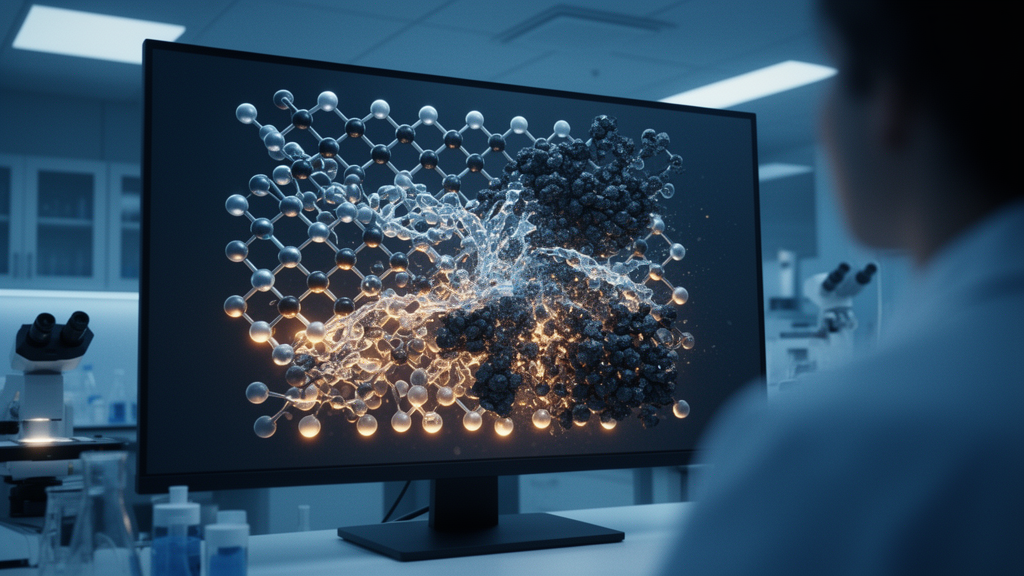
The Oxford team’s study focused on polyvinylidene chloride, or PVDC, a polymer that is a classic precursor of non-graphitizing carbon. To investigate the thermal decomposition of this polymer, the researchers used machine learning-driven atomistic simulations, which combine the accuracy of quantum-mechanical calculations with the computational efficiency needed to study complex chemical structures. The approach allowed them to follow the movement of individual atoms and observe how chemical bonds break and form as the polymer is heated. Where a conventional quantum-mechanical calculation would have been prohibitively expensive for a system of this size and complexity, the machine learned model made it possible to watch the entire transformation unfold, from an intact polymer chain to an extended carbon network, at the level of individual atoms.
The simulations reveal that the removal of hydrogen and chlorine atoms from the PVDC precursor generates highly reactive carbon sites that progressively form new carbon–carbon bonds. Over time, these bonds connect the remains of the polymer chains together into an extended network. In other words, the transformation is not a simple collapse of the polymer into an amorphous blob, but a stepwise chemical process in which individual reactive sites on neighbouring fragments find one another and link up, gradually knitting the disintegrating chains into a connected carbon framework. Watching this process unfold in the simulation offers exactly the kind of mechanistic detail that has been missing from the experimental picture.
Crucially, unlike graphite, this network contains not only six-membered carbon rings but also five- and seven-membered rings that introduce curvature. The researchers offer an intuitive analogy: think of a classic football, in which five-sided pentagons allow an otherwise hexagonal surface to curve into a sphere. Similarly, the non-hexagonal motifs in hard carbon distort the carbon network, preventing it from forming the flat, ordered layers characteristic of graphite. Each five- or seven-membered ring acts as a local defect that bends the sheet out of plane, and the accumulation of such defects throughout the growing network locks in the curved, irregular architecture that defines hard carbon.
The simulations reveal why some carbon resists forming graphite: as the common packaging polymer PVDC breaks down, reactive carbon sites link together, forming five- and seven-membered rings that disrupt the formation of ordered graphite layers. With hard carbon emerging as a key material for sodium-ion batteries, the findings show how machine learning can unlock the atomic-scale processes behind complex materials, paving the way for more targeted material design. If the relationship between a precursor’s molecular structure and the disordered carbon it produces can be understood at this level of detail, researchers may eventually be able to choose or design precursors whose decomposition pathways deliver the carbon architectures best suited to storing sodium, rather than relying on trial and error.
The study was led by Litong Wu, building on pilot studies conducted by former students Zitong Wu and Zakariya El-Machachi, under the supervision of Professor Volker Deringer at Oxford’s Department of Chemistry. Their approach demonstrates how machine learned simulations can uncover chemical pathways in complex materials that would be prohibitively expensive to study using conventional quantum-mechanical methods. Lead author Litong Wu said: “Working on this project felt like opening a book that no one had ever read before. Out of the chaos of atoms moving at high temperatures, neat and intuitive patterns start to appear. It was a real honour to revisit the work of Rosalind Franklin, someone I’ve long admired. I’m equally proud that our study shows what modern computational methods, combined with today’s computing power, can make possible.”
Professor Deringer added his own tribute to the collaborative effort behind the work. “I will just add to Litong’s words how delighted I am to see multiple members of our group making this research possible: herself as a current DPhil student expertly leading the study; Zitong as a former MChem project student (whom I had first taught in her first year on the course!); and Zak as a DPhil alum who helped build the foundations for this work,” he said.
Beyond advancing our understanding of hard-carbon formation, the work promises future steps in connecting precursor chemistry to the structure and electrochemical properties of battery anodes. This prospect reflects the group’s broader vision of designing amorphous functional materials with the help of machine learning-driven atomistic simulations. The paper, titled “Atomistic mechanisms of hard carbon formation from polyvinylidene chloride”, will be published in Chemical Science and available via Open Access, with the authors’ research data also available openly so that they can be readily used for further research. The work was funded by the EPSRC Centre for Doctoral Training in Inorganic Chemistry for Future Manufacturing, an Oxford Clarendon Fund Scholarship, a Jesus College Clarendon Old Members’ Award, UK Research and Innovation, and the UKCP consortium.
Subject of Research: Machine learning simulations of the atomic-scale formation of hard carbon from the polymer PVDC
Article Title: Machine learning simulations reveal how plastic transforms into hard carbon
Article References: Machine learning simulations reveal how plastic transforms into hard carbon. Original publication (Bibliographic details unavailable.)
Image Credits: AI Generated
DOI: Not provided
Keywords: hard carbon, polyvinylidene chloride, machine learning simulations, sodium-ion batteries, Rosalind Franklin, graphitization, University of Oxford, Chemical Science, atomistic simulation, anode materials, carbon rings, materials chemistry
Cite Scienmag News
Teresa Odom. (October 28, 2026). Machine learning simulations trace how plastic turns into hard carbon atom by atom. Scienmag. https://scienmag.com/machine-learning-simulations-trace-how-plastic-turns-into-hard-carbon-atom-by-atom/
Teresa Odom. "Machine learning simulations trace how plastic turns into hard carbon atom by atom." Scienmag, 28 October 2026, https://scienmag.com/machine-learning-simulations-trace-how-plastic-turns-into-hard-carbon-atom-by-atom/. Accessed 28 October 2026.
Teresa Odom. "Machine learning simulations trace how plastic turns into hard carbon atom by atom." Scienmag. October 28, 2026. https://scienmag.com/machine-learning-simulations-trace-how-plastic-turns-into-hard-carbon-atom-by-atom/