


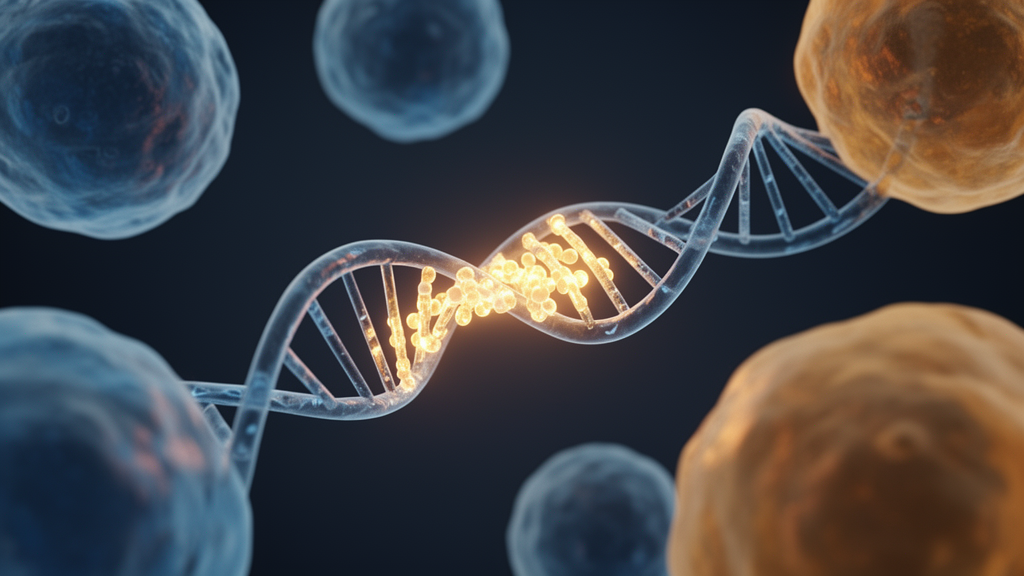
In a discovery that reshapes how scientists think about cellular identity, researchers studying the microscopic worm Caenorhabditis elegans have identified a gene that does not drive cell transformation itself but instead unlocks the door that normally keeps cells locked into their fates. The gene, lin-15A, belongs to a family of proteins characterized by a distinctive THAP DNA-binding domain, and according to a new study published in PLOS Genetics, it acts as what the authors call a transdifferentiation Licenser, a molecule that weakens the molecular safeguards defending a cell’s identity so that a natural, programmed change of identity can proceed.
The research, led by Sarah Frieda Becker, Marie-Charlotte Morin, Julien Lambert, Shashi Kumar Suman, Francesco Nicola Carelli, Alex Appert, Stéphane Roth, Sarah Hoff-Yoessle, Jessica D. Medina-Sanchez, Manuela Portoso, Julie Ahringer, and Sophie Jarriault, focuses on one of the most remarkable examples of natural cellular plasticity in biology: the conversion of a rectal cell known as the Y cell into a neuron called the PDA. This Y-to-PDA transdifferentiation happens spontaneously during normal worm development, without any injury, experimental reprogramming, or artificial manipulation. Because it occurs reliably and naturally, it offers scientists a clean window into how multicellular organisms permit, control, and restrain changes in cell identity.
For more than a decade, cellular plasticity has been one of the hottest topics in biology. The ability of one cell type to become another underlies both the promise of regenerative medicine and the danger of cancer, where differentiated cells lose their specialized functions and revert to uncontrolled proliferation. Yet while researchers have catalogued many factors that actively push cells toward new identities, the mechanisms that actively prevent such changes, and the ways organisms get around those barriers when change is needed, remain far less well understood. The new study addresses precisely this gap, arguing that the molecular machinery of natural transdifferentiation is more diverse and more layered than previously appreciated.
Using careful genetic analysis in C. elegans, the team showed that lin-15A operates in parallel to plasticity factors that had already been described in the Y-to-PDA conversion. This parallel action is significant. It means that lin-15A is not simply another cog in a known machine but represents a distinct branch of the regulatory network, one that had gone unnoticed because it does not fit the conventional profile of a reprogramming factor. When the researchers examined worms carrying null mutations that eliminate lin-15A function entirely, they found that the transdifferentiation process was compromised, revealing that the gene is required for the natural conversion to unfold properly.
The most striking finding, however, concerns what lin-15A actually does. Rather than acting as an engine that pushes the Y cell toward its neuronal fate, the evidence suggests that LIN-15A works by antagonizing several chromatin-modifying complexes. Chromatin, the packaged form of DNA inside the cell nucleus, is the physical substrate of cell identity. Specialized complexes chemically modify chromatin to lock in the expression patterns that define a differentiated cell, effectively safeguarding that identity against change. These identity safeguarding mechanisms are powerful, and they explain why most cells, even under stress, rarely switch types spontaneously. By interfering with multiple such complexes simultaneously, LIN-15A appears to loosen these locks, lowering the barrier that would otherwise prevent the Y cell from beginning its transformation.
This distinction between driving and licensing is the conceptual heart of the study. The authors propose a two-part model for how controlled cell identity conversions are coordinated in living organisms. In this model, plasticity factors function as Drivers, molecules that actively steer a cell toward its new identity by activating the gene programs of the target cell type. Licensers, by contrast, such as lin-15A, attenuate identity safeguarding mechanisms, clearing the path so that the Drivers can do their work. Neither class alone is sufficient; the conversion requires both the removal of barriers and the provision of directional force. This framework offers a new vocabulary for thinking about natural reprogramming and suggests that similar licensing activities may exist in other transdifferentiation systems across the animal kingdom.
Perhaps the most surprising result is that even cells that are developmentally programmed to undergo transdifferentiation still exhibit reprogramming barriers. One might assume that a cell destined by evolution to change identity would face no resistance at all, that the program would simply run like any other developmental script. The data show otherwise. The Y cell, despite being hardwired for conversion, still needs help overcoming the chromatin-based defenses of its rectal identity. This finding underscores how deeply entrenched cell identity is, and how even nature’s own reprogramming events must actively dismantle protective mechanisms rather than simply switch on new ones.
Equally intriguing is the context-dependence of lin-15A’s role. The study demonstrates that lin-15A is not a core plasticity factor in its own right. It does not universally promote cellular transformations wherever it is expressed. Instead, it functions as a plasticity factor specifically in the Y cell context. This context specificity raises fascinating questions about how licensing activities are targeted to particular cells and particular moments in development. It suggests that the interplay between a gene’s intrinsic biochemical activity and the cellular environment in which it acts determines whether it serves as a general regulator or a highly specialized enabler of change.
The implications extend well beyond worm biology. If natural transdifferentiation relies on a division of labor between Drivers and Licensers, then engineered reprogramming in medicine may need to account for both components. Current approaches to generating replacement cells for regenerative therapies typically focus on delivering powerful driving factors, such as transcription factor cocktails, to force cells into new identities. The new work suggests that a complementary strategy, deliberately weakening the chromatin-based safeguards of the starting cell, could make such conversions more efficient and more faithful to natural processes. Conversely, in cancer, where cells inappropriately shed their differentiated identities, understanding licensing mechanisms could reveal new therapeutic targets: ways to reinforce identity safeguarding and prevent malignant dedifferentiation.
The study also highlights the enduring value of C. elegans as a model for fundamental discovery. Because the worm’s cells can be followed individually through development, and because the Y-to-PDA conversion is a natural event that can be observed and genetically dissected with precision, researchers can identify mechanisms that would be nearly impossible to isolate in more complex systems. The identification of a THAP domain gene as a licensing factor adds a new family of proteins to the plasticity toolbox and opens avenues for exploring whether related genes perform analogous roles in other organisms, including humans. As the authors conclude, diverse molecular activities coordinate controlled cell identity conversions, and recognizing that some of these activities work by removing barriers rather than providing direction may fundamentally change how scientists approach the problem of cellular identity, both in the laboratory and, eventually, at the bedside.
Subject of Research: The role of the lin-15A gene in licensing natural Y-to-PDA transdifferentiation in C. elegans by antagonizing chromatin-based identity safeguarding mechanisms
Article Title: The SynMuvA lin-15A licenses natural transdifferentiation by antagonizing identity safeguarding mechanisms
Article References: Becker, S. F., Morin, M.-C., Lambert, J., Suman, S. K., Carelli, F. N., Appert, A., Roth, S., Hoff-Yoessle, S., Medina-Sanchez, J. D., Portoso, M., Ahringer, J., & Jarriault, S. (2026). The SynMuvA lin-15A licenses natural transdifferentiation by antagonizing identity safeguarding mechanisms. PLOS Genetics, 22(9), e1012290. https://doi.org/10.1371/journal.pgen.1012290
Image Credits: AI Generated
DOI: 10.1371/journal.pgen.1012290
Keywords: cell plasticity, transdifferentiation, lin-15A, Caenorhabditis elegans, chromatin, cell identity, PLOS Genetics, reprogramming, THAP domain, developmental biology, gene regulation, regenerative medicine
Cite Scienmag News
Juliet Wilcox. (October 9, 2026). A Molecular License to Change: How One Gene Unlocks Natural Cell Identity Switching. Scienmag. https://scienmag.com/a-molecular-license-to-change-how-one-gene-unlocks-natural-cell-identity-switching/
Juliet Wilcox. "A Molecular License to Change: How One Gene Unlocks Natural Cell Identity Switching." Scienmag, 9 October 2026, https://scienmag.com/a-molecular-license-to-change-how-one-gene-unlocks-natural-cell-identity-switching/. Accessed 9 October 2026.
Juliet Wilcox. "A Molecular License to Change: How One Gene Unlocks Natural Cell Identity Switching." Scienmag. October 9, 2026. https://scienmag.com/a-molecular-license-to-change-how-one-gene-unlocks-natural-cell-identity-switching/


