


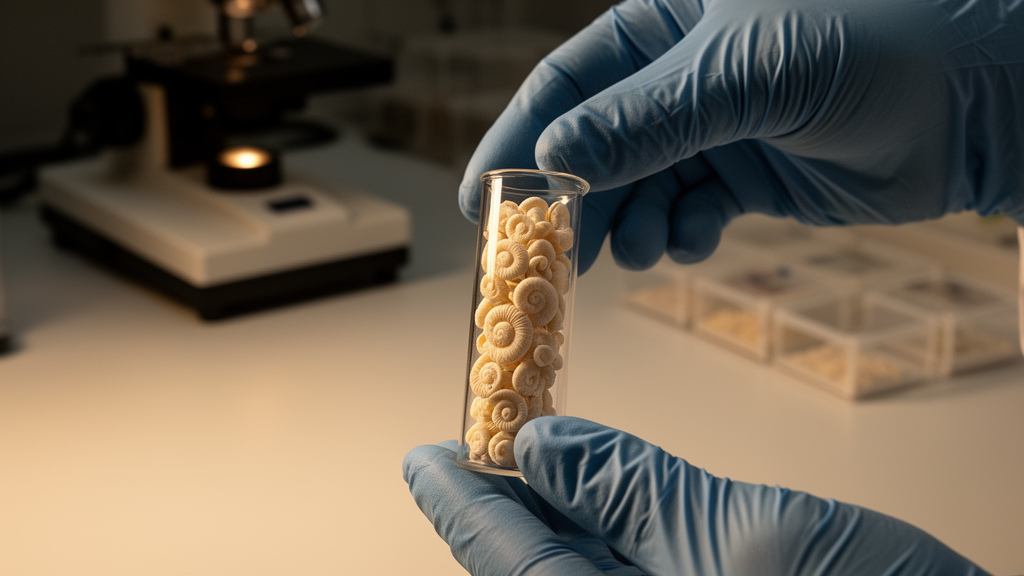
Buried in the mud and sand of the seafloor lies one of the most powerful record-keeping systems on Earth. Single-celled organisms called foraminifera, which build intricate shells of calcium carbonate or cemented sand grains, rain down onto the ocean bottom in their trillions and preserve a chemical and ecological snapshot of the waters above. Now, a team of Indonesian researchers has shown that these microscopic architects obey a surprisingly orderly rule across one of the most complex ocean regions on the planet: the seas of the Indonesian archipelago, where the mighty Indonesian Throughflow shuttles water between the Pacific and Indian Oceans.
The new study, published in the Journal of Micropalaeontology, analyzed 35 surface sediment samples collected from nine locations spanning the Java Sea, the Sunda Strait, the Makassar Strait, the Sumba Strait, waters near Simeulue Island, and offshore Papua. The samples cover an extraordinary bathymetric range, from beach-face sands at zero depth to lower bathyal muds more than 4,300 meters below the surface. By cataloguing which foraminiferal species live where, the team built the first comprehensive, statistically validated set of depth-indicator species for the tropical Indo-Pacific, a region whose deep-sea biodiversity has long remained under-sampled compared with temperate Atlantic and Mediterranean waters.
The central finding is a clean confirmation of a decades-old ecological idea known as the TROX model, short for TRophic-OXygen. Proposed in the mid-1990s, the model predicts that in shallow marine settings, foraminiferal communities are governed mainly by physical forces such as wave energy, substrate type, and hydrodynamic disturbance, whereas in deeper waters, biogeochemical factors such as dissolved oxygen and the flux of organic food take over as the dominant controls. Until now, the model had been validated only in cooler temperate seas. The Indonesian data show that the same fundamental transition operates in the tropics, with the pivotal shift occurring around the outer neritic zone at the continental shelf edge.
The statistical machinery behind the conclusion was rigorous. The researchers combined indicator value analysis, which scores how faithfully a species is concentrated in a particular environment, with detrended correspondence analysis, an ordination technique that arranges samples along environmental gradients, and hierarchical clustering based on Bray-Curtis dissimilarity. Together, these methods discriminated the assemblages with 89 percent classification accuracy across six bathymetric zones: transitional, inner neritic, middle neritic, outer neritic, upper bathyal, and lower bathyal. Detrended correspondence analysis confirmed that water depth was the primary structuring gradient, with the first axis correlating strongly with depth and explaining the majority of the variance in the community data.
One of the most striking quantitative results involves the ratio of planktonic to total foraminifera, a metric micropaleontologists abbreviate as %P. Planktonic foraminifera float in the open water column, so the proportion of their shells among the seafloor fauna rises as the water gets deeper and benthic species become scarcer. In the transitional beach environments of this study, %P was essentially zero, ranging from 0 to 0.6 percent. By the lower bathyal zone, it exceeded 90 percent, peaking at 97 percent. The relationship follows a clean exponential curve with depth, expressed by the equation %P equals the natural logarithm of depth multiplied by 12, and it explains 86 percent of the variance. In practical terms, this gives geologists a ready-made depth gauge: measure the planktonic percentage in a fossil assemblage, and you can estimate the ancient water depth.
Species richness told a complementary story. Benthic diversity climbed from the harsh transitional zone, where only 10 to 16 species per sample survived the pounding surf, to a peak of roughly 120 species in the middle neritic zone, with the single richest sample yielding 47 species at 84 meters depth. Beyond that ecological optimum, benthic richness declined steadily as oxygen dwindled and pressure mounted. Planktonic richness, by contrast, increased continuously with depth, from one or two species in the shallows to 17 to 23 species in the deep basins, where keeled, heavily built forms such as Globorotalia dominate over the globular species typical of nearshore waters.
The indicator species themselves form a vivid ecological cast list. In the high-energy transitional zone, robust genera such as Amphistegina, Calcarina, and Sphaerogypsina dominate, but the researchers caution that these are largely transported corpses, winnowed shoreward from their true neritic habitats by waves and currents. The inner neritic zone splits into two distinct communities depending on the seafloor: fine sands host Ammonia, Asterorotalia trispinosa, and Elphidium hispidulum, while silty bottoms favor agglutinated forms such as Haplophragmoides. The middle neritic zone belongs to Quinqueloculina seminulum and Pseudorotalia. Farther out, Brizalina aenariensis, Gyroidina broeckhiana, and Cibicides mark the outer shelf, where oxygen first emerges as a limiting factor. On the upper slope, infaunal specialists such as Bulimina marginata and Uvigerina asperula take over, and in the deepest samples, Lenticulina orbicularis, Uvigerina peregrina, and the dysoxia-tolerant Globobulimina pacifica rule the mud.
These ecological assignments carry direct consequences for reading the rock record. Because fossil foraminifera are abundant, well preserved, and depth-specific, oil companies and academic geologists routinely use them to reconstruct ancient depositional environments. But most existing calibration schemes were built from Atlantic and Mediterranean data, and this study shows that tropical Indo-Pacific assemblages follow their own regional patterns. The Indonesian team found, for example, that substrate type can override depth as the primary control within the inner neritic zone, meaning that two communities at identical depths can look completely different if one sits on sand and the other on silt. Accurate paleobathymetry in shelf settings therefore requires integrating assemblage data with grain-size analysis and other sedimentological evidence rather than relying on species lists alone.
The deep-water results were, in some ways, even more revealing. Upper bathyal samples from different basins split into isolated clusters, apparently reflecting regional oceanographic differences such as the position and intensity of the oxygen-minimum zone and the complex circulation imposed by the Indonesian Throughflow. Lower bathyal samples, however, grouped together cleanly, distinguished by their very high planktonic percentages and characteristic deep-water taxa. This suggests that beyond roughly 1,000 meters, the steep environmental gradients of oxygen, pressure, temperature, and food supply make deep-sea assemblages easier to classify than their shelf counterparts, a reassuring result for anyone attempting to reconstruct ancient slope and basin deposits.
The authors are candid about the limitations of their dataset. Organic carbon flux and dissolved oxygen, the two central variables of the TROX model, were not measured directly at the sampling sites, and the counts represent total assemblages of living and dead shells rather than stained living communities, introducing potential biases from post-mortem transport and time averaging. Future work, they note, should incorporate field geochemical measurements, metabolic tracers such as Rose Bengal staining, and water-column profiles to sharpen the calibration. Even so, the framework they have established, spanning six depth zones from beach to bathyal depths across the Indonesian seas, offers scientists a locally tuned toolkit for decoding millions of years of tropical marine history. Every core drilled through an Indonesian sedimentary basin now comes with a richer, more precise dictionary for translating its microscopic fossils into ancient depths, ancient oxygen levels, and ancient currents.
Subject of Research: Benthic foraminiferal assemblages as paleobathymetric and paleoenvironmental proxies in Indonesian seas
Article Title: Benthic foraminiferal assemblages as proxies for paleoenvironmental indicators in the Indo-Pacific (Indonesia)
Article References: Fitriany, R., Maryunani, K. A., Putra, P. S., Nugroho, S. H., & Ardhyastuti, S. (2026). Benthic foraminiferal assemblages as proxies for paleoenvironmental indicators in the Indo-Pacific (Indonesia). Journal of Micropalaeontology, 45(1), 487-512. https://doi.org/10.5194/jm-45-487-2026
Image Credits: AI Generated
Keywords: foraminifera, micropaleontology, paleobathymetry, Indonesian seas, TROX model, benthic ecology, planktonic percentage, bathymetric zonation, indicator species, Indo-Pacific, oceanography, paleoenvironmental reconstruction
Cite Scienmag News
Violet Maxwell. (October 9, 2026). Tiny Seafloor Fossils Reveal a Hidden Rule Governing Life in Tropical Seas. Scienmag. https://scienmag.com/tiny-seafloor-fossils-reveal-a-hidden-rule-governing-life-in-tropical-seas/
Violet Maxwell. "Tiny Seafloor Fossils Reveal a Hidden Rule Governing Life in Tropical Seas." Scienmag, 9 October 2026, https://scienmag.com/tiny-seafloor-fossils-reveal-a-hidden-rule-governing-life-in-tropical-seas/. Accessed 9 October 2026.
Violet Maxwell. "Tiny Seafloor Fossils Reveal a Hidden Rule Governing Life in Tropical Seas." Scienmag. October 9, 2026. https://scienmag.com/tiny-seafloor-fossils-reveal-a-hidden-rule-governing-life-in-tropical-seas/


