


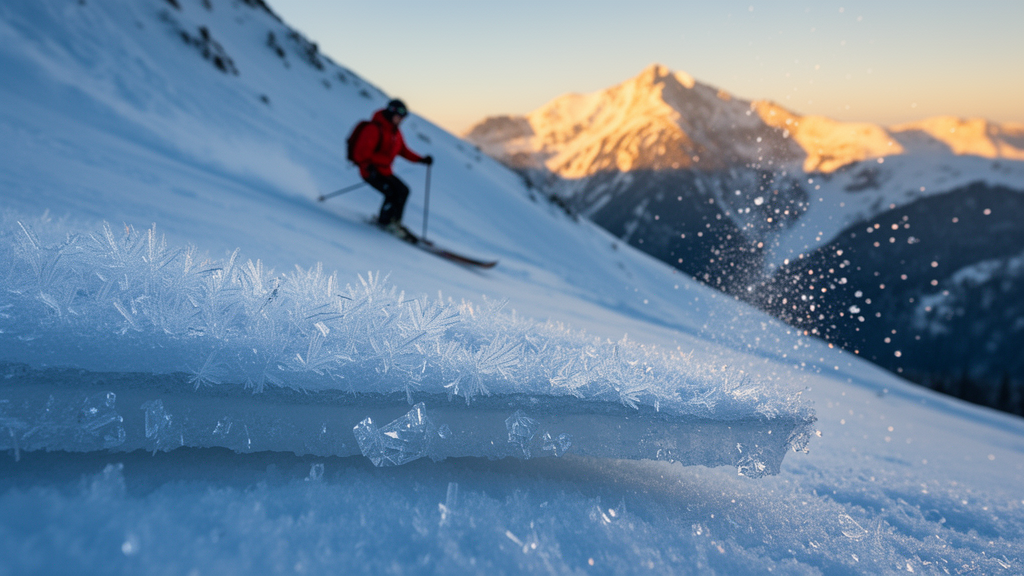
On cold, clear winter nights in the Colorado Rockies, an almost invisible transformation takes place on the surface of the snowpack. Water vapor in the air deposits directly onto the snow as delicate, feathery ice crystals known as surface hoar. These shimmering crystals are beautiful under headlamp light, but they are also among the most dangerous features a snowpack can develop. When subsequent snowfall buries them, the hoar layer becomes a weak interface that can fail catastrophically, releasing the slab avalanches that are the most destructive type of snow hazard. In Montana during the mid-1990s, one study found that 31 percent of reported avalanches were associated with buried surface hoar layers. Now, new research published in The Cryosphere suggests that this notorious crystal type may become substantially rarer as the climate warms, with cascading consequences for avalanche forecasting, snow remote sensing, and the physics embedded in land-surface models.
The study, led by William Rudisill of Lawrence Berkeley National Laboratory together with Dan Feldman, Adrienne Marshall, and Arielle Koshkin, draws on an unusually rich set of observations from three co-located field campaigns in the East River Watershed near Crested Butte, Colorado. The Surface Atmosphere Integrated Field Laboratory, or SAIL, deployed by the U.S. Department of Energy’s Atmospheric Radiation Measurement program, provided cloud radar, lidar, radiation, and balloon-sonde measurements. The Sublimation of Snow campaign contributed a 20-meter instrumented tower with eddy-covariance sensors, and the SPLASH campaign added down-looking radiometers used to retrieve the temperature of the snow surface itself. Together, these campaigns captured simultaneous measurements of the atmospheric energy budget, snow thermodynamics, wind circulations, turbulence, and manual observations of surface hoar during the winters of 2022 and 2023.
The physics of surface hoar formation is a delicate balancing act. On clear nights, the snow surface radiates heat to space, cooling far below the temperature of the air above it. The team confirmed that surface hoar is favored when the snow surface is roughly 10 degrees Celsius colder than the near-surface air, creating a humidity gradient that drives water vapor from the atmosphere onto the snowpack. Because the snow surface is, by definition, saturated with respect to ice, its specific humidity falls rapidly as it cools, while the air above remains relatively moist. Molecular diffusion alone is too slow to explain the observed accumulation of hoar mass, so turbulent exchange must supply the vapor, yet windy nights are precisely the conditions that qualitatively preclude hoar growth. Resolving this paradox is central to the new work.
Clouds turn out to be a decisive factor. Using two winters of data, the researchers composited fully clear and fully cloudy 24-hour periods and found that nocturnal clouds exert a radiative forcing of 30 to 40 watts per square meter, preventing the snowpack from cooling and effectively shutting down the humidity gradient that drives deposition. On clear nights, the snow surface temperature plummeted to below minus 24 degrees Celsius shortly before sunrise, and the humidity difference between air and snow reached values of minus 0.5 to minus 1.0 grams per kilogram, consistently favoring deposition. Balloon soundings revealed that these gradients were not merely a near-surface phenomenon: the air was drier in terms of specific humidity than the snow surface well above the 800-meter depth of the surrounding valley, meaning the deposition-favoring profile extended through the entire planetary boundary layer and into the troposphere.
The team also confronted the turbulence paradox directly. Clear nights in the valley were dominated by shallow katabatic winds, gentle drainage flows that peaked at around 5 meters above the ground and ran down-valley. These flows generated just enough turbulence to deliver vapor to the surface without warming it. Critically, the researchers found that surface hoar events occurred at bulk Richardson numbers above 0.2, a stability regime in which the standard stability correction used in many land models predicts essentially zero turbulent exchange. Models that truncate turbulence at this threshold simply cannot reproduce observed hoar growth. By adopting a long-tailed stability correction, the team enabled the physics-based SUMMA model to produce deposition rates sufficient to explain the measured surface hoar mass, a finding with broad implications for how snow models handle highly stable boundary layers.
Ground truth came from a labor-intensive technique known as Stössel box measurements. On nine evenings in February 2023, researchers weighed snow samples placed in boxes, left them exposed overnight, and reweighed them the following morning. Six events showed appreciable deposition, with redundant measurements agreeing within 40 percent and values ranging from 40 to 180 grams per square meter. The SUMMA model, validated against these measurements and against eddy-covariance fluxes, reproduced snow surface temperature and humidity with correlations of 0.99, though it underestimated hoar mass on some nights. Notably, even the largest deposition events represent a small addition to the snowpack’s total mass, but they exert an outsized influence on its mechanical structure and on the surface energy balance, where a single 100-gram-per-square-meter night translates to about 6.5 watts per square meter of heating.
The sensitivity experiments revealed a subtle but important role for snow density. Because low-density snow conducts heat poorly, it insulates the surface from the warmer snow below, allowing the surface to cool more strongly and favoring deposition. When the team prescribed high thermal conductivity representative of dense snow, the overnight deposition dropped by 54 percent relative to a low-density scenario. This suggests that surface hoar should form preferentially on clear nights following fresh, low-density snowfall, a hypothesis the authors note has yet to be confirmed by direct field observation. Both observations and the model also converged on clear meteorological thresholds: deposition gives way to sublimation when overnight air temperatures rise above roughly minus 8 to minus 10 degrees Celsius or when wind speeds exceed 2 to 3 meters per second.
Armed with a validated model configuration, the researchers turned to the future. They forced SUMMA with an ensemble of nine dynamically downscaled global climate models from the WUS-D3 dataset under the SSP3-7.0 emissions scenario, running simulations from 1980 to 2100. The results are striking. The total wintertime nocturnal water vapor flux onto the snowpack declines at a rate of 6.1 grams per square meter per degree of warming, an 81 percent decrease by the end of the century. The frequency of surface hoar events falls by 14 percent per winter, at a rate of about 2.5 fewer nights per degree of warming. Counterintuitively, this decline occurs even as atmospheric humidity increases, because the snow surface warms faster than the air, weakening the very gradients that drive crystal growth. Meanwhile, sublimation events grow larger and more frequent, so the snowpack increasingly sheds vapor rather than gaining it.
The implications extend well beyond avalanche forecasting. Surface hoar influences snow albedo, surface roughness, emissivity, radar-scattering properties, and specific surface area, all quantities that remote sensing missions rely on to retrieve snow water equivalent and other properties from orbit. A systematic decline in surface hoar could therefore bias satellite retrievals and alter how snowpacks absorb solar energy, potentially feeding back into melt timing. The authors caution that their study site has a cold continental climate, so the projected declines may represent a low-end estimate for warmer snow regions, where the frequency of sufficiently cold nights could collapse nonlinearly. They also acknowledge open questions, including discrepancies between eddy-covariance fluxes and manual hoar measurements, the role of katabatic winds in non-standard turbulent transport, and the possibility that some hoar mass originates from vapor moving upward within the snowpack itself.
What emerges from this work is a portrait of a fundamental snow metamorphism process that is exquisitely sensitive to the details of a warming atmosphere: to clouds, to humidity, to wind, and to the density of the snow beneath. The feathery crystals that avalanche forecasters dread may become scarcer in a warmer world, but understanding exactly how and where requires reconciling measurements that currently disagree by factors of several. As the authors conclude, additional work on turbulent exchange under extreme stability and on vapor transport in complex terrain is needed before surface hoar can be reliably predicted in the land and snow models that underpin hazard forecasting and climate projection alike. For now, the study provides both a warning and a roadmap: the coldest, clearest nights that build the snowpack’s most treacherous weak layers are precisely the nights that a warming climate is steadily erasing.
Subject of Research: Climate sensitivity of surface hoar formation on snowpacks in the Colorado Rockies
Article Title: Reduced surface hoar in a warming world
Article References: Reduced surface hoar in a warming world. (n.d.). https://doi.org/10.5194/tc-20-5585-2026
Image Credits: AI Generated
Keywords: surface hoar, snowpack, avalanche, The Cryosphere, climate change, Colorado Rockies, snow metamorphism, turbulent flux, SUMMA model, SAIL campaign, sublimation, longwave radiation
Cite Scienmag News
Sloane Callahan. (October 9, 2026). Feathery frost that triggers deadly avalanches is fading as winters warm. Scienmag. https://scienmag.com/feathery-frost-that-triggers-deadly-avalanches-is-fading-as-winters-warm/
Sloane Callahan. "Feathery frost that triggers deadly avalanches is fading as winters warm." Scienmag, 9 October 2026, https://scienmag.com/feathery-frost-that-triggers-deadly-avalanches-is-fading-as-winters-warm/. Accessed 9 October 2026.
Sloane Callahan. "Feathery frost that triggers deadly avalanches is fading as winters warm." Scienmag. October 9, 2026. https://scienmag.com/feathery-frost-that-triggers-deadly-avalanches-is-fading-as-winters-warm/


