Friday, October 30, 2026
Science
No Result
View All Result
  • Login
  • HOME
  • SCIENCE NEWS
  • CONTACT US
  • HOME
  • SCIENCE NEWS
  • CONTACT US
No Result
View All Result
Scienmag
No Result
View All Result
Home Science News Biology

Ferroptosis emerges as a central vulnerability in digestive system cancers

October 29, 2026
in Biology
Nathaniel Bowman
By Nathaniel Bowman Scienmag Editorial Profile - Precision Oncology
Reading Time: 2 mins read
0
Ferroptosis emerges as a central vulnerability in digestive system cancers

Ferroptosis emerges as a central vulnerability in digestive system cancers

65
SHARES
587
VIEWS
Share on FacebookShare on Twitter
ADVERTISEMENT

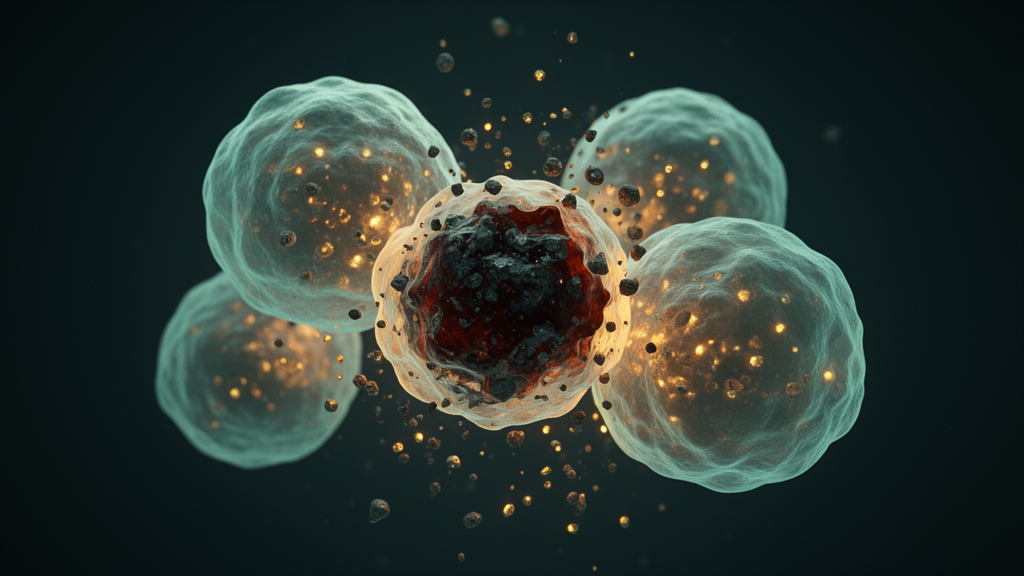
An iron-dependent form of cell death called ferroptosis is increasingly recognized as a key mediator of tumor progression and therapy response in digestive system malignancies, according to a structured narrative review published in Frontiers in Cell and Developmental Biology. The review focuses on colorectal cancer, hepatocellular carcinoma, gastric cancer and pancreatic ductal adenocarcinoma, the cancers for which ferroptosis regulatory mechanisms have been most clearly defined, and also considers evidence from esophageal squamous-cell carcinoma and extrahepatic cholangiocarcinoma.

Ferroptosis is driven by the accumulation of lipid peroxides, particularly in membranes rich in polyunsaturated fatty acids. It is initiated by aberrant iron metabolism, intense reactive oxygen species production, oxidative damage to membrane structures, and disruption of the cystine/glutamate antiporter system, known as System Xc−, together with the glutathione–glutathione peroxidase 4 antioxidant pathway. The review reports that aberrant iron homeostasis, lipid metabolic reprogramming, redox imbalance and remodeling of the tumor microenvironment are common events found in digestive system malignancies, and that these modifications collectively contribute to ferroptosis sensitivity as well as tumor growth, treatment resistance and immune evasion.

A central argument of the review is that ferroptosis is not governed by a single linear pathway. Instead, it is orchestrated through multilayered regulatory networks involving transcriptional and epigenetic control, metabolic rewiring, immune modulation, exosome-mediated communication and extensive crosstalk between numerous signaling pathways. The authors organize this evidence within a three-tier mechanistic-to-translational framework that connects a common iron–lipid–redox vulnerability axis to tumor-type-specific resistance programs and biomarker-directed therapeutic prioritization, intended to delineate context-dependent ferroptosis vulnerabilities and priorities for future clinical evaluation.

On the therapeutic side, the review highlights the application of ferroptosis inducers, nano-platform delivery systems, tumor microenvironment-responsive methodologies and multimodal combination schemes as emerging approaches with potential translational implications for digestive system malignancies. These strategies are presented as promising directions rather than established clinical options, and the review frames them as requiring further evaluation.

The authors are explicit that clinical translation remains limited. They cite mechanistic complexity, tumor heterogeneity, incompletely defined resistance mechanisms, uncertainty about reliable predictive biomarkers, and unaddressed biosafety issues with nanoplatforms as the principal obstacles standing between the laboratory findings described in the review and clinical application. As a narrative review, the work synthesizes existing literature rather than presenting new experimental data, and its conclusions about therapeutic opportunities should be read as a map of current evidence and future priorities rather than as results from clinical trials.

Subject of Research: Ferroptosis regulatory networks and therapeutic opportunities in digestive system malignancies

Article Title: Targeting ferroptosis in major digestive system malignancies: regulatory networks and therapeutic opportunities

Article References: Qin, X., Wen, Q., Yang, Y., Sun, K., Guan, W., Ma, L., Sun, P., Zhang, M., Wu, Y., Li, L., & Wang, K. (2026). Targeting ferroptosis in major digestive system malignancies: regulatory networks and therapeutic opportunities. Frontiers in Cell and Developmental Biology, 14, 1945918. https://doi.org/10.3389/fcell.2026.1945918

Image Credits: AI Generated

DOI: 10.3389/fcell.2026.1945918

Keywords: ferroptosis, colorectal cancer, hepatocellular carcinoma, gastric cancer, pancreatic cancer, lipid peroxidation, GPX4, tumor microenvironment, ferroptosis inducers, nanoplatforms, treatment resistance, biomarkers

Cite Scienmag News

Nathaniel Bowman. (October 29, 2026). Ferroptosis emerges as a central vulnerability in digestive system cancers. Scienmag. https://scienmag.com/ferroptosis-emerges-as-a-central-vulnerability-in-digestive-system-cancers/

Nathaniel Bowman. "Ferroptosis emerges as a central vulnerability in digestive system cancers." Scienmag, 29 October 2026, https://scienmag.com/ferroptosis-emerges-as-a-central-vulnerability-in-digestive-system-cancers/. Accessed 30 October 2026.

Nathaniel Bowman. "Ferroptosis emerges as a central vulnerability in digestive system cancers." Scienmag. October 29, 2026. https://scienmag.com/ferroptosis-emerges-as-a-central-vulnerability-in-digestive-system-cancers/

Tags: BiomarkerscolorectalColorectal cancerferroptosisferroptosis as therapeutic vulnerabilityFerroptosis in digestive system cancersferroptosis inducersferroptosis regulatory mechanismsferroptosis signaling pathwaysgastricgastric cancerGPX4hepatocellularhepatocellular carcinomairon metabolism in cancer therapy resistanceiron-dependent cell deathlipid metabolic reprogramming in tumorslipid peroxidationlipid peroxidation in tumor progressionnanoplatformsoxidative stress and redox imbalancepancreatic cancerpancreatic cancerstreatment resistancetumor microenvironmenttumor microenvironment remodeling
Share26Tweet16
Previous Post

ChatGPT-4 Boosts Neurosurgery Residents’ Emergency Decision Accuracy in Simulation Study

Next Post

Neonatal Thalamus Disruption Rewires Prefrontal Dopamine Signaling in Rats

Related Posts

Inflammatory stimulation reshapes microglial vesicle miRNA cargo and modestly alters recipient cells
Biology

Inflammatory stimulation reshapes microglial vesicle miRNA cargo and modestly alters recipient cells

October 30, 2026
Slovenia Rewrites Its Curriculum to Teach Evolution Earlier and More Completely
Biology

Slovenia Rewrites Its Curriculum to Teach Evolution Earlier and More Completely

October 30, 2026
Ancestral genistein diet shifts quail body weight across three generations
Agriculture

Ancestral genistein diet shifts quail body weight across three generations

October 30, 2026
Fungal biotechnology faces two valleys of death on the road from lab to factory
Biotechnology

Fungal biotechnology faces two valleys of death on the road from lab to factory

October 30, 2026
Gene-Silencing Vector Shows Strong Protection Against Rabies in Mice
Biology

Gene-Silencing Vector Shows Strong Protection Against Rabies in Mice

October 30, 2026
Gastrodia elata Powder Reshapes Gut Microbes in Broilers, Leaves Blood Chemistry Largely Unchanged
Biology

Gastrodia elata Powder Reshapes Gut Microbes in Broilers, Leaves Blood Chemistry Largely Unchanged

October 30, 2026
Next Post
Neonatal Thalamus Disruption Rewires Prefrontal Dopamine Signaling in Rats

Neonatal Thalamus Disruption Rewires Prefrontal Dopamine Signaling in Rats

  • Mothers who receive childcare support from maternal grandparents show more optimized

    Mothers who receive childcare support from maternal grandparents show more parental warmth, finds NTU Singapore study

    27656 shares
    Share 11059 Tweet 6912
  • University of Seville Breaks 120-Year-Old Mystery, Revises a Key Einstein Concept

    1061 shares
    Share 424 Tweet 265
  • Bee body mass, pathogens and local climate influence heat tolerance

    682 shares
    Share 273 Tweet 171
  • Researchers record first-ever images and data of a shark experiencing a boat strike

    546 shares
    Share 218 Tweet 137
  • Groundbreaking Clinical Trial Reveals Lubiprostone Enhances Kidney Function

    531 shares
    Share 212 Tweet 133
Science

Embark on a thrilling journey of discovery with Scienmag.com—your ultimate source for cutting-edge breakthroughs. Immerse yourself in a world where curiosity knows no limits and tomorrow’s possibilities become today’s reality!

RECENT NEWS

  • Rainfall and wetter soils drive nutrient spikes in Chinese city waters
  • Digital tools in dementia-friendly spaces show promise, but benefits depend on stage and setting
  • Genetic programming model predicts solar reflectance of cotton fabrics across UV, visible and infrared
  • Transparent AI communication builds public readiness in US and China experiments

Categories

  • Agriculture
  • Anthropology
  • Archaeology
  • Athmospheric
  • Biology
  • Biotechnology
  • Blog
  • Bussines
  • Cancer
  • Chemistry
  • Climate
  • Earth Science
  • Editorial Policy
  • Marine
  • Mathematics
  • Medicine
  • Pediatry
  • Policy
  • Psychology & Psychiatry
  • Science Education
  • Science News
  • Social Science
  • Space
  • Technology and Engineering

Subscribe to Blog via Email

Enter your email address to subscribe to this blog and receive notifications of new posts by email.

Join 5,151 other subscribers

© 2025 Scienmag - Science Magazine

Welcome Back!

Login to your account below

Forgotten Password?

Retrieve your password

Please enter your username or email address to reset your password.

Log In
No Result
View All Result
  • HOME
  • SCIENCE NEWS
  • CONTACT US

© 2025 Scienmag - Science Magazine

Discover more from Science

Subscribe now to keep reading and get access to the full archive.

Continue reading