


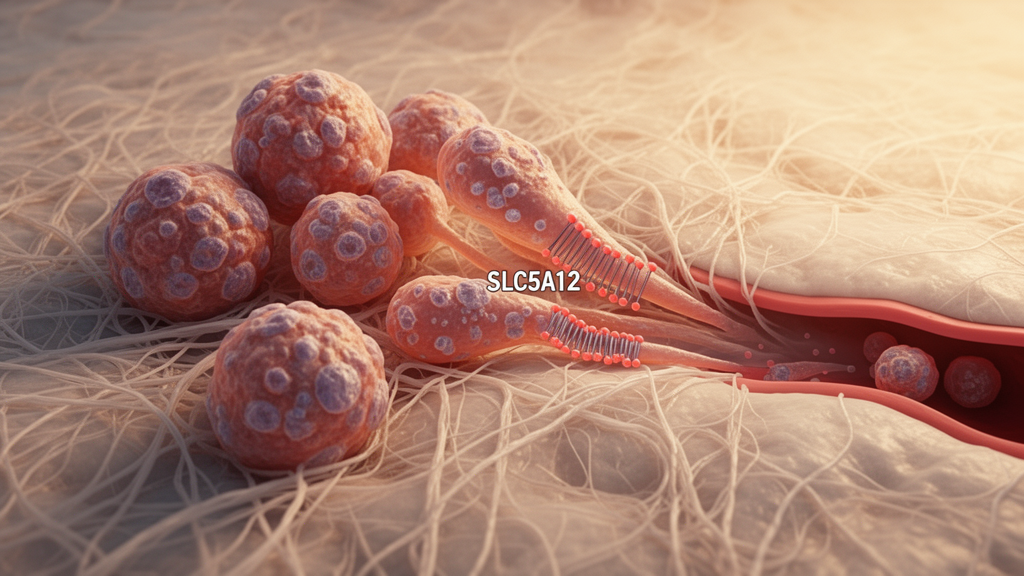
SLC5A12 marked an invasive epithelial state in head and neck squamous cell carcinoma (HNSCC), and experimental knockdown reduced tumor-cell proliferation, migration, invasion and xenograft growth. The multi-cohort study linked the gene to adverse prognostic features, while its proposed immune and drug-vulnerability effects remain computational predictions. The researchers integrated single-cell RNA-sequencing data from three HNSCC cohorts with TCGA-HNSC and five Gene Expression Omnibus cohorts.
Their analysis identified five epithelial states, including an “Invasive” population that increased with disease progression and had the highest inferred copy-number-variation burden. Invasive cells were enriched for malignant-cell and extracellular-matrix programs, marking a state associated with tissue remodeling and progression. Several analytical approaches converged on SLC5A12 as a feature of the invasive state.
Machine-learning, weighted gene co-expression network analysis, single-cell profiling and spatial analyses identified SLC5A12 as an invasive-state-associated prognostic feature. The evidence supports an association with progression and adverse outcome in the analyzed HNSCC datasets; it does not establish the same pattern in every patient or clinical setting. Cell-cell communication analysis predicted that invasive tumor cells could interact with regulatory T cells through the MIF–CD74/CXCR4 signaling axis.
This result places SLC5A12 within a computationally inferred association with immune remodeling, but the researchers did not directly validate the proposed communication. Similarly, analyses indicated that the invasive state carried a ferroptosis-associated transcriptional profile, while CellOracle simulations predicted that loss of SLC5A12 would weaken invasive and immunoregulatory programs. Loss-of-function assays provided the study’s main experimental support for a functional role.
Knocking down SLC5A12 reduced proliferation and clonogenicity in HNSCC cells, as well as their migration and invasion. The perturbation also increased apoptosis. These findings support a tumor-promoting role for SLC5A12 in the tested cellular models, but they do not demonstrate that reducing SLC5A12 would be safe or effective in people with HNSCC.
The effect extended to xenograft experiments, in which SLC5A12 knockdown was associated with reduced tumor growth. Together, the cellular and xenograft observations support a tumor-promoting role in preclinical settings, whereas the findings concerning ferroptosis sensitivity, immune regulation and virtual perturbation remain hypotheses requiring direct testing. Researchers also conducted structure-based virtual screening and molecular docking to search for compounds that might bind SLC5A12.
Ledipasvir, identified as ZINC000150338819, and elbasvir, identified as ZINC000150588351, were nominated as the top-ranked candidates. Molecular docking predicts potential binding interactions, but the analysis did not show that either compound inhibits SLC5A12 in cells, alters the invasive state or produces a therapeutic benefit in patients. Overall, the study defines SLC5A12 as both a marker and an experimentally supported contributor to invasive HNSCC cell behavior in preclinical models.
Its association with immune remodeling and ferroptosis-associated vulnerability was inferred computationally, while the proposed candidate compounds remain targets for further validation.
Subject of Research: SLC5A12-associated invasive epithelial states in head and neck squamous cell carcinoma
Article Title: SLC5A12 defines an invasive epithelial state associated with immune remodeling and therapeutic vulnerability in HNSCC
Article References: Tang, Y., Zhang, H., Zhang, P., Qu, H., & Wu, D. (2026). SLC5A12 defines an invasive epithelial state associated with immune remodeling and therapeutic vulnerability in HNSCC. Frontiers in Cell and Developmental Biology, 14, Article 1991399. https://doi.org/10.3389/fcell.2026.1991399
Image Credits: AI Generated
DOI: 10.3389/fcell.2026.1991399
Keywords: SLC5A12, head and neck cancer, HNSCC, single-cell RNA sequencing, tumor invasion, immune remodeling, ferroptosis, xenograft models, regulatory T cells, molecular docking, defines, invasive
Cite Scienmag News
Nathaniel Bowman. (October 22, 2026). SLC5A12 Marks and Supports an Invasive State in HNSCC. Scienmag. https://scienmag.com/slc5a12-marks-and-supports-an-invasive-state-in-hnscc/
Nathaniel Bowman. "SLC5A12 Marks and Supports an Invasive State in HNSCC." Scienmag, 22 October 2026, https://scienmag.com/slc5a12-marks-and-supports-an-invasive-state-in-hnscc/. Accessed 22 October 2026.
Nathaniel Bowman. "SLC5A12 Marks and Supports an Invasive State in HNSCC." Scienmag. October 22, 2026. https://scienmag.com/slc5a12-marks-and-supports-an-invasive-state-in-hnscc/


