


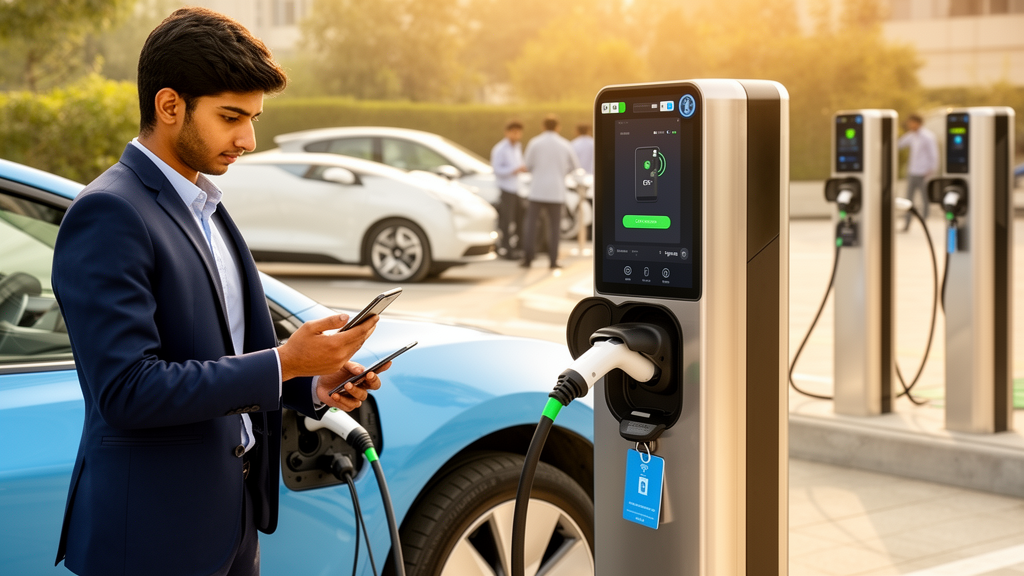
A survey of 535 electric-vehicle owners in India found that technology readiness had the strongest standardized association with intention to use smart electric-vehicle charging, according to a cross-sectional study published in Frontiers in Sustainable Cities. The result emerged from an integrated model combining technology readiness, selected acceptance factors from the Unified Theory of Acceptance and Use of Technology 2, and environmental concern. Technology readiness had a path coefficient of 0.241, followed by performance expectancy and effort expectancy, each at 0.207. Perceived value, environmental concern, and facilitating conditions were also positively and significantly associated with intention. The researchers emphasize that these are statistical associations rather than causal effects, and that the six predictors together explained 22.7% of the variation in intention.
Smart charging goes beyond plugging an electric vehicle into a conventional charger. It uses digital communication among vehicles, charging equipment, and electricity networks so charging can be scheduled or adjusted in response to grid conditions and electricity prices. The technology can direct charging toward off-peak periods and periods of renewable generation, potentially easing pressure on the grid and reducing charging costs. Some smart-charging arrangements can also support vehicle-to-grid operation, in which vehicle batteries supply electricity back to the network. These functions make consumer acceptance important because use may involve an application, automated equipment, smart meters, tariff information, and decisions about when a vehicle should charge.
The study focused on people who already owned and used electric vehicles, rather than prospective buyers. Participants were at least 18 years old and were recruited in Chennai, Bengaluru, Mumbai, Hyderabad, Delhi, and Kolkata between March and June 2026. Researchers distributed an anonymous questionnaire online through social media, electric-vehicle owner communities, professional networks, and vehicle forums, and approached owners offline at charging stations, public places, dealerships, service centers, and workplaces. A pilot study with 50 respondents was used to check clarity and reliability before minor questionnaire revisions were made. The final analysis included 535 complete responses, with every item assessed on a five-point scale from strongly disagree to strongly agree.
Partial least squares structural equation modeling was used to evaluate a model containing six predictors and one outcome: intention to use smart electric-vehicle charging when available. The predictors were technology readiness, performance expectancy, effort expectancy, facilitating conditions, price value, and environmental concern. Technology readiness captured comfort, willingness, confidence, and preparedness for new technologies. The acceptance factors represented perceived usefulness, ease of learning and use, access to supporting resources, and the balance between benefits and cost. Environmental concern was included as the ecological dimension of the framework. Statistical significance was tested with 5,000 bootstrap resamples, while reliability, convergent validity, discriminant validity, model fit, explained variance, predictive relevance, and effect sizes were assessed with additional measures.
All six proposed relationships were supported in the statistical model. Technology readiness was associated with intention at β = 0.241, t = 5.863, p < 0.001, with a 95% bootstrap confidence interval from 0.160 to 0.324. Performance expectancy had an identical coefficient of 0.207 to effort expectancy, with t values of 5.651 and 5.694, respectively; both had p values below 0.001. Price value was associated with intention at β = 0.164, environmental concern at β = 0.151, and facilitating conditions at β = 0.140, also with p values below 0.001. The measurement model performed adequately: Cronbach’s alpha values ranged from 0.861 to 0.886, average variance extracted values ranged from 0.705 to 0.739, and all Heterotrait-Monotrait ratios were below 0.85.
The numerical ranking did not translate into large independent effects. Technology readiness had the largest effect size, but its f² value was only 0.075, which the researchers classified as small. Effort expectancy and performance expectancy each had f² = 0.055, followed by price value at 0.035, environmental concern at 0.029, and facilitating conditions at 0.025. The model’s R² value of 0.227 therefore indicates a partial explanation of intention, leaving most of its variation associated with factors not included in the model. The researchers did not include possible influences such as government support, perceived risk, social influence or trust. The standardized root mean square residual was 0.040, below the cited recommendation of 0.08, while the predictive Q² value was 0.202.
The findings indicate that convenience with digital systems may be especially relevant to willingness to try smart charging, but they do not show that comfort with technology alone determines adoption. The strongest association is consistent with a system that asks users to manage automated processes, applications, charging schedules, and sometimes dynamic price signals. Performance expectancy covers the perceived benefits of automatic charging, convenience, improved energy management, and potentially lower electricity costs. Effort expectancy reflects whether users believe they can easily learn and operate the system. Price value asks whether the benefits appear commensurate with the cost, while facilitating conditions capture perceptions of equipment, reliable electricity, internet access, charging facilities, and technical support.
Environmental concern was also associated with intention, fitting with smart charging’s potential to support more efficient electricity use and renewable-energy integration. However, the study did not measure whether participants actually shifted charging to lower-demand or renewable-electricity periods, and it did not demonstrate reductions in emissions, grid stress, or household expenditure. Likewise, the positive facilitating-conditions result does not show that infrastructure improvements caused stronger intentions. The outcome was self-reported intention among existing owners, not observed use. The model’s predictive comparison found lower PLSpredict loss for all four intention indicators than for a linear-model benchmark, with average loss differences from −0.043 to −0.052 and p values no higher than 0.004, but the overall root mean square error was 0.898 and mean absolute error was 0.712.
Several features limit how broadly the results can be generalized. The design was cross-sectional, so it did not track changes in attitudes or behavior over time and cannot establish temporal ordering. The sample was drawn through non-probability methods and may not represent all electric-vehicle owners in India. Respondents were predominantly male, accounting for 67.3% of the sample, and 65.4% reported charging at home, making the results potentially less applicable to owners without private parking or private charging. The largest age group was 25–35 years, at 35.5%, and 43.0% reported monthly income between ₹50,001 and ₹100,000. The study also took place in six cities at a single point in time, when charging infrastructure, consumer awareness, and smart-grid development may differ across regions.
For policymakers, electricity providers, electric-vehicle manufacturers, and charging-service companies, the results point to several possible areas for attention without guaranteeing increased use. Consumer familiarization could address uncertainty surrounding automated charging and digital interfaces, while reliable electricity, suitable equipment, internet access, and technical support could strengthen perceived facilitating conditions. User-friendly applications and clearer pricing could improve expected usefulness, ease of use, and perceived value. Communicating potential environmental and energy-management benefits may also resonate with environmentally concerned owners. Yet the modest effect sizes, limited explained variance, and broad geographic and demographic gaps mean that the results are best treated as an association map rather than a prescription. Longitudinal research that observes actual smart-charging use, alongside models incorporating trust, risk, social influence, and policy support, would be needed to determine what helps owners move from intention to sustained behavior.
Subject of Research: Consumer intention to use smart electric-vehicle charging among electric-vehicle owners in India
Article Title: Determinants of consumers’ intention to adopt smart electric vehicle charging in India
Article References: Shunmathy, V., & Selvam, V. (2026). Determinants of consumers’ intention to adopt smart electric vehicle charging in India. Frontiers in Sustainable Cities, 8, 1963503. https://doi.org/10.3389/frsc.2026.1963503
Image Credits: AI Generated
DOI: 10.3389/frsc.2026.1963503
Keywords: smart EV charging, electric vehicles, India, consumer intention, technology readiness, UTAUT2, environmental concern, PLS-SEM, charging infrastructure, sustainable mobility, Determinants, consumers
Cite Scienmag News
Faith Mcneil. (October 22, 2026). Technology readiness most strongly linked to Indian smart EV charging intention. Scienmag. https://scienmag.com/technology-readiness-most-strongly-linked-to-indian-smart-ev-charging-intention/
Faith Mcneil. "Technology readiness most strongly linked to Indian smart EV charging intention." Scienmag, 22 October 2026, https://scienmag.com/technology-readiness-most-strongly-linked-to-indian-smart-ev-charging-intention/. Accessed 22 October 2026.
Faith Mcneil. "Technology readiness most strongly linked to Indian smart EV charging intention." Scienmag. October 22, 2026. https://scienmag.com/technology-readiness-most-strongly-linked-to-indian-smart-ev-charging-intention/


