


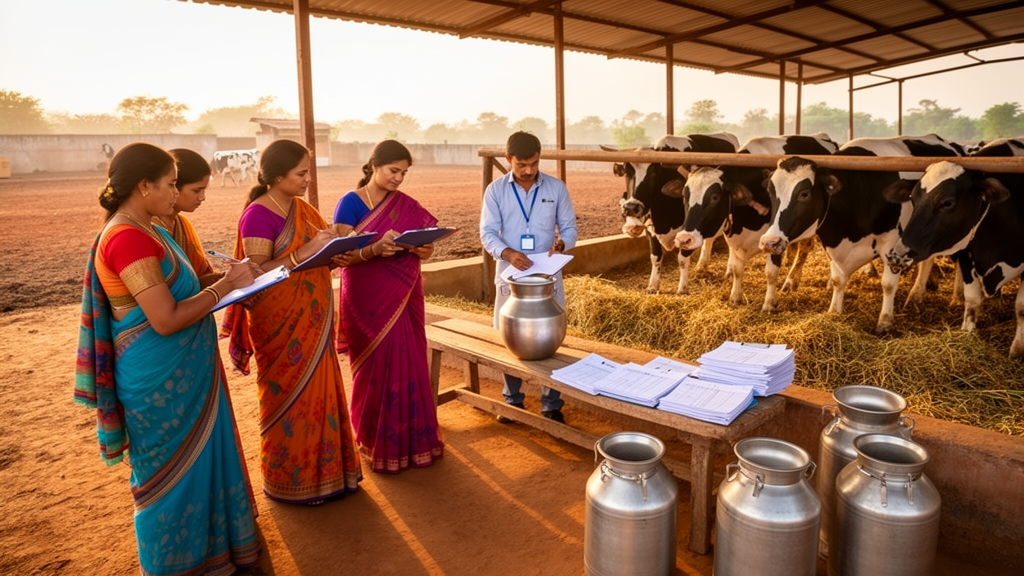
A cross-sectional survey of tribal women engaged in dairy farming in selected areas of North Gujarat found that Self-Help Group (SHG) members had higher measured adoption of recommended management practices and higher economic and social empowerment scores than non-members. Conducted in 2024–2025, the study included 80 SHG members and 80 non-members from Sabarkantha and Aravalli districts. The mean dairy-practice adoption score was 70.33 ± 13.83 among members, compared with 58.45 ± 5.11 among non-members, a statistically significant difference. These are group-level associations: membership was neither randomly assigned nor based on formal matching, so the survey does not establish that SHG participation caused the differences.
The researchers used an ex-post facto, cross-sectional design and multistage sampling. Sabarkantha and Aravalli districts were purposively selected because they had relatively high proportions of Scheduled Tribe members in the SHG population. Four talukas with concentrations of tribal SHG participation were also chosen purposively, while 16 eligible villages were selected randomly. Five SHG members and five non-members were then selected from each village and interviewed with structured, pre-tested questionnaires. This equal allocation supported a balanced comparison but did not match respondents on age, education, landholding, herd size, income or other characteristics. No a priori power calculation was performed, and the sample was not intended to represent all tribal women or dairy farmers in Gujarat statistically.
Adoption was measured with a 35-item index covering breeding, feeding, animal-shed management, healthcare, milking and other management practices. Each practice received equal weight and was scored as fully adopted, partially adopted or not adopted. The theoretical total ranged from 35, representing no adoption of any selected practice, to 105, representing full adoption of all 35. SHG members had higher mean scores in every management domain. Feeding recorded 22.45 ± 5.93 for members and 17.15 ± 2.93 for non-members; animal-shed scores were 10.00 ± 3.18 and 8.49 ± 1.59; healthcare scores were 10.53 ± 3.31 and 9.45 ± 1.69; milking scores were 10.40 ± 2.73 and 8.01 ± 1.82; and other-management scores were 8.05 ± 1.83 and 6.74 ± 1.47. Differences were significant at p < 0.01 for feeding, housing, milking and other management, and at p < 0.05 for healthcare.
Breeding was the only domain without a statistically significant aggregate difference: members scored 8.90 ± 2.46 and non-members 8.61 ± 1.56, with p = 0.379. Individual breeding practices nevertheless showed contrasts. Timely breeding within 12–14 hours after heat symptoms began was fully adopted by 22.5% of SHG members but only 3.75% of non-members, while regular monitoring of oestrous symptoms was reported by 43.75% and 35%, respectively. Non-adoption of improved breeds was common in both groups, affecting 56.25% of members and 58.75% of non-members. Thus, the higher aggregate score among members did not correspond to closure of the gap in access to superior animals or full reproductive-management adoption.
The largest visible contrasts appeared in feeding, hygienic milking and animal housing. Full adoption of green-fodder cultivation was reported by 22.5% of members, compared with 6.25% of non-members. Proper colostrum feeding was fully adopted by 30% and 6.25%, respectively, and provision of clean drinking water by 30% and 12.5%. In milking, full adoption of the full-hand method was recorded in 28.75% of members versus 10% of non-members; use of clean, washed utensils in 26.25% versus 12.5%; and milk filtering in 23.75% versus 7.5%. Recommended head-to-head or tail-to-tail housing was fully adopted by 26.25% of members and 8.75% of non-members, while an ideal byre with suitable height, slope and drainage was fully adopted by 30% and 16.25%, respectively.
Healthcare adoption was also higher overall among members, although important practices remained incompletely implemented. Daily grooming and bathing of animals was fully adopted by 28.75% of members and 3.75% of non-members, and mucus removal from newborn calves was adopted by 62.5% and 30%, respectively. Deworming was not adopted by 61.25% of non-members, while full adoption of timely vaccination remained low in both groups, at 15% among SHG members and 11.25% among non-members. When total scores were divided into low, medium and high categories using the sample mean and standard deviation, 35% of members were classified as high adopters, compared with 5% of non-members. Most non-members, 83.75%, occupied the medium category, as did 56.25% of members; low adoption accounted for 8.75% of the SHG sample.
Separate normalized indices showed the largest measured gap in social empowerment. The Social Empowerment Index averaged 69.40 ± 8.92 for SHG members and 37.77 ± 6.53 for non-members, a difference significant at p < 0.01. This index combined self-confidence, social awareness and recognition, skills, and access to public facilities and services. The Economic Empowerment Index, based on household assets, income, expenditure, savings, loan amount and housing type, averaged 65.49 ± 22.58 among members and 54.06 ± 21.21 among non-members, also a significant difference at p < 0.01. These index values describe the sampled groups. They do not show that membership increased empowerment, because the groups differed in education, landholding, income, dairy experience, housing, herd size and other characteristics.
Separate multiple linear regressions assessed socioeconomic associations with adoption after accounting for the other variables included in each model. Among SHG members, landholding was positively associated with adoption (unstandardized coefficient B = 3.007, p = 0.022), as was herd size (B = 11.061, p = 0.002). The model accounted for 41.7% of the observed variation in adoption, with an adjusted R² of 0.332 and an overall F-test of p < 0.001. Among non-members, dairy experience was positively associated with adoption (B = 1.995, p = 0.001), as was annual income (B = 1.528, p = 0.046). That model explained 36.3% of the variation, with an adjusted R² of 0.271 and an overall F-test of p < 0.001. These are adjusted statistical associations, not experimental effects, and residual differences between the groups cannot be excluded.
Respondents ranked practical barriers through the Garrett Ranking Technique, revealing both shared concerns and differences in perceived severity. The high cost of improved animal breeds ranked first among both groups, with mean Garrett scores of 62.36 for SHG members and 61.21 for non-members; insufficient knowledge of artificial insemination ranked third in each. The high cost of concentrates and mineral mixtures led among members (64.00), whereas the lack of green fodder in summer ranked first among non-members (64.58). Distance to veterinary hospitals was the leading healthcare constraint for members (62.00), while lack of knowledge about common contagious diseases led among non-members (57.00). Both groups ranked the non-remunerative price of milk first within milking constraints, with mean Garrett scores of 65.44 for members and 63.06 for non-members. Insufficient loans led among general constraints for members, while lack of animal-insurance knowledge led among non-members.
Financial records for the sampled SHGs showed average savings of ₹15,912.50, average lending of ₹29,637.50 and average outstanding credit of ₹2,348.75 during the 2024–2025 study period. The thrift-credit ratio was 0.54, the outstanding ratio was 0.08 and the recovery ratio was 72.75%, corresponding to ₹24,562.50 recovered from recorded demand of ₹33,762.50, including principal and interest. Overall, SHG respondents displayed higher measured dairy adoption and economic and social empowerment scores, while both groups reported shared gaps involving breeding, healthcare, input access and market returns. The strongest conclusion is descriptive: meaningful group-level differences existed in the selected areas, but their causes and durability cannot be determined. The survey covered only 160 respondents in purposively selected districts and talukas, relied on self-reported information and assessed the groups at one point in time, limiting broader generalization and causal interpretation.
Subject of Research: Dairy-management adoption and socioeconomic empowerment among tribal SHG and non-SHG women in North Gujarat
Article Title: Comparative assessment of dairy management practice adoption among SHG and non-SHG in tribal households of North Gujarat
Article References: Kumari, K., Dubey, L. R., & Vahoniya, D. R. (2026). Comparative assessment of dairy management practice adoption among SHG and non-SHG in tribal households of North Gujarat. Frontiers in Sociology, 11, Article 1928015. https://doi.org/10.3389/fsoc.2026.1928015
Image Credits: AI Generated
DOI: 10.3389/fsoc.2026.1928015
Keywords: dairy farming, tribal women, Self-Help Groups, North Gujarat, livestock livelihoods, women's empowerment, cross-sectional survey, animal husbandry, rural development, agricultural extension, Comparative, assessment
Cite Scienmag News
William Thompson. (October 22, 2026). Cross-Sectional Survey Links SHG Membership to Higher Dairy Adoption in North Gujarat. Scienmag. https://scienmag.com/cross-sectional-survey-links-shg-membership-to-higher-dairy-adoption-in-north-gujarat/
William Thompson. "Cross-Sectional Survey Links SHG Membership to Higher Dairy Adoption in North Gujarat." Scienmag, 22 October 2026, https://scienmag.com/cross-sectional-survey-links-shg-membership-to-higher-dairy-adoption-in-north-gujarat/. Accessed 22 October 2026.
William Thompson. "Cross-Sectional Survey Links SHG Membership to Higher Dairy Adoption in North Gujarat." Scienmag. October 22, 2026. https://scienmag.com/cross-sectional-survey-links-shg-membership-to-higher-dairy-adoption-in-north-gujarat/


