


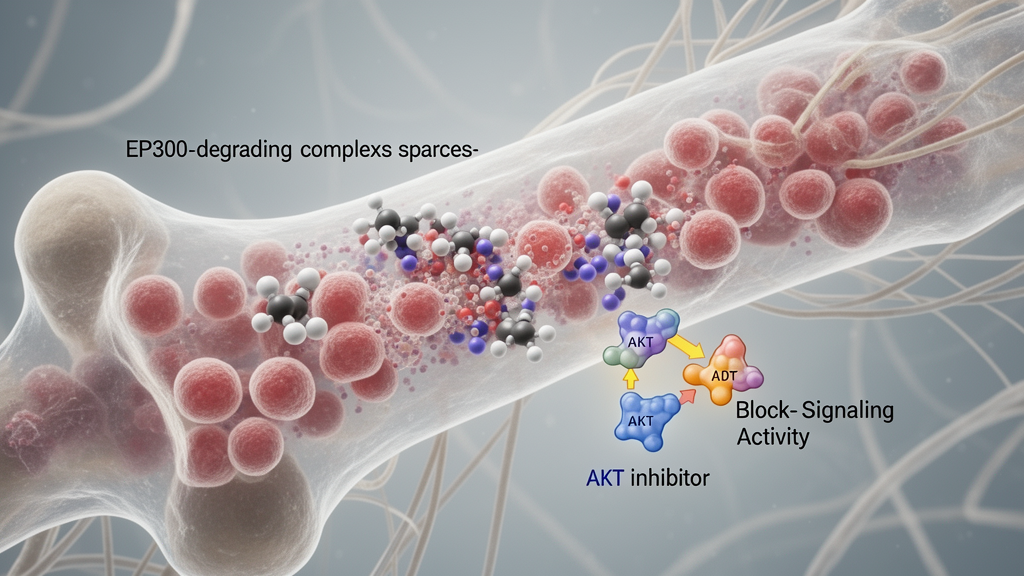
A combination of an experimental protein degrader and an AKT inhibitor slowed tumor growth and prolonged survival in preclinical models of osteosarcoma, according to a peer-reviewed study co-led by St. Jude Children’s Research Hospital. The treatment approach paired degradation of EP300, a protein that can help express oncogenes in cancers, with inhibition of AKT, a major signaling target. The results identify a potential vulnerability in a small but meaningful subset of pediatric bone tumors, but they do not establish clinical effectiveness or safety in people. The experiments involved cells, biochemical analyses and mouse xenografts containing patient-derived tumors, and the findings were published in the Journal of Experimental Medicine on October 20, 2026.
Osteosarcoma is a pediatric bone cancer with lower survival than many other cancers. Relapsed and metastatic disease have especially poor outcomes, and the study report notes that no new treatment for osteosarcoma has been approved in the last 40 years. The experimental strategy uses a PROTAC, a type of compound that marks a protein for destruction, to remove EP300 while an AKT inhibitor blocks the AKT signaling pathway. Food and Drug Administration-approved AKT inhibitors already exist, but the reported experiments did not test an approved AKT inhibitor as a clinical treatment for children with osteosarcoma. The work instead examined the combination as a preclinical therapeutic strategy.
The investigation built on previous work showing that EP300 could be targeted with a PROTAC. That approach had shown benefit in models of neuroblastoma, leading the researchers to explore whether EP300 degradation might also work in osteosarcoma. When they tested osteosarcoma samples, they found that a small but meaningful subset was disproportionately sensitive to EP300 degradation. The result did not indicate that all osteosarcomas depend strongly on EP300. Instead, it suggested that particular molecular features can make some tumors vulnerable to selectively reducing the protein, providing the starting point for identifying a rational combination treatment.
To determine what distinguished the responsive tumors, the scientists examined their genetics. Most osteosarcoma samples that were sensitive to EP300 degradation carried mutations that hyperactivated the AKT pathway. AKT is a central regulator of many cellular processes and is commonly dysregulated in cancer. The presence of AKT-hyperactivating mutations provided a mechanistic rationale for testing AKT inhibition alongside EP300 degradation: combining the two approaches could exploit the connection between an active AKT program and dependence on EP300. In mouse xenografts established from patient tumors, the paired drugs had a synergistic effect. The combination slowed tumor growth and increased survival in those models compared with the individual approaches or control conditions, supporting the idea that AKT hyperactivation may mark tumors sensitive to the combination.
“We found a compound combination that looks promising for a disease that is exceptionally challenging to treat and has not had a major therapeutic improvement for a long time,” said Adam Durbin, MD, PhD, of the St. Jude Department of Oncology and a co-corresponding author of the study. Durbin said the approach may have potential in patients with metastatic disease, who are among the least responsive to current therapies. That statement identifies a possible area of interest rather than a demonstrated clinical result. The reported experiments did not treat people with metastatic osteosarcoma, and the evidence for the combination came from laboratory models rather than a patient cohort. The study therefore shows preclinical activity while leaving its effectiveness in human disease unestablished.
The central biological finding was that dysregulated AKT signaling can reprogram osteosarcoma cells into a state of selective reliance on EP300. In the sensitive models, reducing the available EP300 protein impaired tumor-cell fitness more strongly than it did in resistant models. The effect was concentrated in a defined molecular subset rather than occurring uniformly across osteosarcoma samples. The researchers proposed that mutations associated with AKT hyperactivation may serve as a biomarker for sensitivity to the combination. The finding gives the experimental treatment a molecular rationale and suggests a way to define which tumors may be most responsive, but the potential of tumor genetics to guide treatment selection has not been validated in people.
Brian Abraham, PhD, of the St. Jude Department of Computational Biology and the other co-corresponding author, said the results connect an osteosarcoma’s genotype to a rationally selected therapy. He compared this strategy with precision interventions used in other diseases, including leukemias, where treatments can be selected according to a tumor’s genetic characteristics. The osteosarcoma study provides a strategic framework for making a similar genotype-to-therapy connection: AKT-pathway mutations may help identify tumors that are unusually dependent on EP300 and therefore vulnerable to combined degradation and inhibition. The current evidence does not yet show that genome sequencing can reliably predict an individual patient’s response, and it does not identify a clinical selection rule based on the mouse-model findings.
The researchers performed biochemical comparisons between sensitive and resistant tumors to investigate why AKT hyperactivation and EP300 degradation acted synergistically in the selected models. They found that sensitive cancers had a slower rate of global protein production than resistant counterparts. This distinction appeared to make EP300 degradation more consequential in sensitive cells. In resistant tumors, a higher overall level of protein production appeared to compensate for the loss of EP300, allowing malignant cells to “outrun” the degrader. The result indicates that the effectiveness of protein degradation can depend not only on the selected target but also on the cellular machinery that produces proteins. It does not imply that every resistant tumor follows the same biochemical mechanism, because the reported comparison was made within the study’s experimental models.
The protein-production finding has implications beyond osteosarcoma because pharmaceutical companies are developing PROTACs for many diseases. If diseased cells increase protein production sufficiently, they may overcome degradation of a selected target and contribute to treatment failure. Conversely, protein-production capacity may help identify circumstances in which a degrader is more likely to work. The study provides an early mechanistic example of this principle in osteosarcoma, linking the slower global protein production found in sensitive cancers with the effectiveness of EP300 degradation. It does not establish a universal biomarker for PROTAC sensitivity. The researchers’ suggestion that genome sequencing may eventually help identify a patient whose osteosarcoma is likely to respond remains a future prospect rather than a validated clinical test.
Overall, the experiments point to a genotype-guided strategy for a subset of osteosarcoma: recognize tumors with hyperactivated AKT signaling, then exploit their reliance on EP300 by combining protein degradation with AKT inhibition. The paired treatment reduced tumor growth and extended survival in patient-tumor mouse xenografts, while the biochemical analysis offered a possible explanation for the selective response. The scope of the evidence is important. The research was an experimental study based on cells, biochemical comparisons and mouse models, not a clinical trial, and the frequency of the sensitive molecular pattern in a broader human metastatic population was not established by the report. The results also do not define a clinical regimen or show how the combination would perform in people. Even with those limitations, the study identifies a testable therapeutic avenue for a pediatric cancer in which meaningful treatment improvements have been difficult to achieve.
Subject of Research: Preclinical testing of EP300 degradation and AKT inhibition in osteosarcoma models
Article Title: Combination therapy reveals potential vulnerability in aggressive osteosarcoma
Article References: Combination therapy reveals potential vulnerability in aggressive osteosarcoma. Original publication (Bibliographic details unavailable.)
Image Credits: AI Generated
DOI: Not provided
Keywords: osteosarcoma, EP300, AKT signaling, PROTAC, protein degradation, pediatric cancer, targeted therapy, tumor genetics, drug synergy, xenograft models, Combination, therapy
Cite Scienmag News
Nathaniel Bowman. (October 20, 2026). EP300 Degradation and AKT Inhibition Slow Osteosarcoma in Preclinical Models. Scienmag. https://scienmag.com/ep300-degradation-and-akt-inhibition-slow-osteosarcoma-in-preclinical-models/
Nathaniel Bowman. "EP300 Degradation and AKT Inhibition Slow Osteosarcoma in Preclinical Models." Scienmag, 20 October 2026, https://scienmag.com/ep300-degradation-and-akt-inhibition-slow-osteosarcoma-in-preclinical-models/. Accessed 20 October 2026.
Nathaniel Bowman. "EP300 Degradation and AKT Inhibition Slow Osteosarcoma in Preclinical Models." Scienmag. October 20, 2026. https://scienmag.com/ep300-degradation-and-akt-inhibition-slow-osteosarcoma-in-preclinical-models/


