


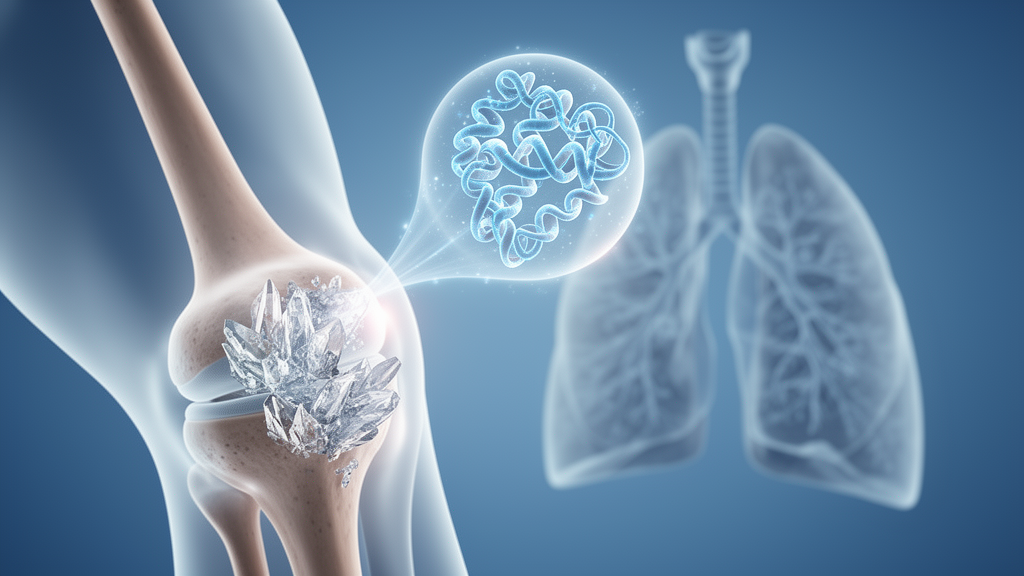
When the COVID-19 pandemic first swept across the globe, clinicians quickly noticed that patients carrying certain chronic conditions fared markedly worse than others. Hypertension, type 2 diabetes, and obesity were soon confirmed as high-risk factors for severe disease, but one inflammatory ailment attracted particular scrutiny: gout. This painful arthritis, triggered by the deposition of monosodium urate crystals in joints, shares a striking feature with severe COVID-19 — a hyperinflammatory state driven by the NLRP3 inflammasome and potent cytokines such as interleukin-1 beta. Now, a team of researchers led by Haowen Ma and Yuna Niu, publishing in the journal Results in Chemistry, has traced this clinical overlap down to a single molecular hub: the matrix metalloproteinase MMP1, which they propose as both a common link between the two diseases and a direct drug target for colchicine.
The study began with a large-scale computational sweep through publicly available blood transcriptome data. Using the limma statistical framework, the team compared gene expression in severe COVID-19 patients against healthy controls, drawing on dataset GSE171110, which comprised 44 patient samples and 10 controls. A parallel analysis of the gout dataset GSE160170, with six patients and six controls, applied the same thresholds: an adjusted p-value below 0.05 and a log2 fold change of at least 1. The COVID-19 cohort yielded 3,520 differentially expressed genes, while the gout cohort produced 1,860. Intersecting the two lists revealed just 19 genes shared by both inflammatory disorders — a compact transcriptional module that the authors interpret as the core molecular signature driving the convergent inflammatory response.
Functional enrichment analysis of these 19 shared genes pointed strongly toward the immune system. Gene Ontology terms highlighted B cell proliferation, immunoglobulin biosynthesis, cytokine activity, and cytokine receptor binding. This B-cell signal is particularly intriguing. In severe COVID-19, aberrant B cell activation and autoantibody production have been recognized as key drivers of immunopathology and lung damage. Gout, by contrast, has traditionally been viewed as a disease of innate immunity, driven by neutrophils and macrophages responding to urate crystals. Yet emerging evidence implicates B cells and autoantibody responses in chronic tophaceous gout as well. The convergence on humoral immunity in both diseases suggests a shared mechanism that has been underappreciated until now. KEGG pathway analysis further linked the shared gene set to autoimmune conditions including rheumatoid arthritis, asthma, and inflammatory bowel disease, underscoring the systemic nature of the overlapping inflammatory program.
To distill the 19 shared genes down to actionable targets, the researchers constructed a protein-protein interaction network using the STRING database at a high-confidence threshold of 0.7. The resulting network contained 19 nodes and 41 edges, with CXCL8, JUN, and IL10 showing the highest connectivity. Applying the CytoNCA plugin in Cytoscape, the team evaluated five centrality metrics — degree, closeness, eigenvector, local average connectivity, and betweenness — and identified six genes that ranked highest across all measures: CXCL8, MPO, JUN, MMP1, IL4, and IL10. These hub genes were significantly upregulated in both disease cohorts compared with healthy controls, and correlation heatmaps revealed strong positive co-expression among them in each dataset, suggesting they operate as a synergistic regulatory unit rather than isolated players.
Enrichment analysis of the six hub genes reinforced their relevance to both pathologies. Gene Ontology terms included positive regulation of MHC class II biosynthetic process, myeloid leukocyte activation, and regulation of isotype switching — processes central to adaptive immunity and implicated in the dysregulated humoral responses of severe COVID-19. KEGG pathway analysis tied the hub genes to the IL-17 signaling pathway, T cell receptor signaling, and rheumatoid arthritis. The IL-17 axis, in particular, has been independently implicated in both gout pathogenesis and COVID-19-associated hyperinflammation, positioning these six genes as convergent nodes within a shared inflammatory network.
The pivotal moment came when the team intersected these six hub genes with the predicted protein targets of colchicine, the ancient anti-inflammatory drug long used to treat acute gout attacks and recently repurposed for COVID-19 with encouraging results in trials such as GRECCO-19. Using the SwissTargetPrediction platform, the researchers generated a list of 100 putative colchicine targets from its PubChem entry. Only one of the six hub genes appeared on that list: MMP1. This single overlap suggested that colchicine’s therapeutic benefit in both diseases might flow, at least in part, through direct engagement of this matrix metalloproteinase — a mechanism not previously described.
To test this hypothesis computationally, the team performed molecular docking between colchicine and the MMP1 protein structure obtained from the Protein Data Bank. The docking simulation, run with AutoDock Vina, revealed a stable binding conformation with a calculated binding energy of −6.4 kcal/mol, a value within the range typically considered favorable for drug-target interactions. Colchicine formed conventional hydrogen bonds with the ASN-180 and ALA-182 residues of MMP1, at distances of 2.3 and 2.6 angstroms respectively, and was further anchored by a network of hydrophobic contacts within the catalytic pocket. Because these hydrogen bonds sit within the enzyme’s catalytic domain, the authors propose that colchicine binding may directly interfere with MMP1’s proteolytic activity, thereby modulating extracellular matrix remodeling and inflammatory cell migration.
Docking alone cannot guarantee that a ligand remains bound under physiological conditions, so the team followed up with a 100-nanosecond all-atom molecular dynamics simulation using GROMACS 2023 and the AMBER99SB-ILDN force field. The root mean square deviation values equilibrated within the first 10 nanoseconds and maintained a stable plateau thereafter, indicating a steady conformational state. Root mean square fluctuation analysis showed consistently low local motion across most residues, and the radius of gyration declined gradually over the first 60 nanoseconds before stabilizing around 1.46 nanometers, reflecting progressive compaction of the complex. The number of intermolecular hydrogen bonds remained steady at one to two throughout the trajectory, and comparison of snapshots at 0 and 100 nanoseconds showed no substantial dissociation or deformation of colchicine within the binding pocket. Together, these results support a durable and specific interaction between the drug and its newly identified target.
Beyond colchicine, the researchers explored a dual screening strategy for additional therapeutic candidates targeting the six hub genes. Among the top 10 predicted small molecules were simvastatin, which has established anti-inflammatory properties and has been reported to attenuate NLRP3 inflammasome activation; ciprofloxacin, a fluoroquinolone with immunomodulatory effects; and nimesulide, a selective COX-2 inhibitor that could theoretically ease gout flares, though its hepatotoxicity profile warrants caution. The team also reviewed traditional Chinese medicine formulations reported to act on the hub genes, identifying six prescriptions including Ma Xing Shi Gan Decoction, Yi-Fei-Jian-Pi-Tang, and Taodan Granules. Yi-Fei-Jian-Pi-Tang showed the broadest targeting spectrum, modulating five of the six hub genes, while Taodan Granules targeted three. The authors caution that several computational hits, such as nickel sulfate and electrocorundum, are environmental agents rather than drugs, and that all predictions require rigorous experimental validation before clinical translation.
Perhaps the most striking finding came from single-cell RNA sequencing analysis of peripheral blood mononuclear cells, drawing on datasets GSE188172 and GSE211783 and encompassing more than 94,000 cells across severe COVID-19 patients, gout patients, and healthy controls. After quality control and batch correction using Harmony integration, the team annotated eight major immune cell subpopulations and found that MMP1 expression was significantly upregulated in COVID-19 patients, with the elevation localized predominantly to B cells and plasma cells rather than myeloid compartments. This B-cell-restricted pattern was further accentuated in ventilated COVID-19 patients compared with non-ventilated cases, implying a positive correlation between MMP1 expression in B cells and disease severity. In gout patients, by contrast, MMP1 showed a more distributed expression across monocytes and macrophages, consistent with the innate immune-driven pathology of crystal-induced inflammation. The authors suggest that while MMP1 serves as a shared molecular hub at the transcriptomic level, its cellular sources and functional roles may be disease-context-dependent, and that therapeutic targeting may ultimately require cell-type-specific strategies. Taken together, the findings position MMP1 as a promising candidate for patients facing the double burden of gout and severe COVID-19, while underscoring the substantial gap that remains between computational prediction and clinical application.
Subject of Research: Shared molecular pathways between gout and severe COVID-19, focusing on MMP1 as a common hub gene and drug target
Article Title: MMP1 serves as a common link and drug target between gout and severe COVID-19 infection
Article References: Ma, H., Geng, Y., Liu, M., Feng, T., Lv, Y., Wang, H., & Niu, Y. (2026). MMP1 serves as a common link and drug target between gout and severe COVID-19 infection. Results in Chemistry, 31, Article 103967. https://doi.org/10.1016/j.rechem.2026.103967
Image Credits: AI Generated
DOI: 10.1016/j.rechem.2026.103967
Keywords: MMP1, gout, severe COVID-19, colchicine, molecular docking, molecular dynamics simulation, single-cell RNA sequencing, NLRP3 inflammasome, hub genes, bioinformatics, inflammation, drug repurposing
Cite Scienmag News
Juliet Wilcox. (October 16, 2026). MMP1 Emerges as a Shared Molecular Link Between Gout and Severe COVID-19. Scienmag. https://scienmag.com/mmp1-emerges-as-a-shared-molecular-link-between-gout-and-severe-covid-19/
Juliet Wilcox. "MMP1 Emerges as a Shared Molecular Link Between Gout and Severe COVID-19." Scienmag, 16 October 2026, https://scienmag.com/mmp1-emerges-as-a-shared-molecular-link-between-gout-and-severe-covid-19/. Accessed 16 October 2026.
Juliet Wilcox. "MMP1 Emerges as a Shared Molecular Link Between Gout and Severe COVID-19." Scienmag. October 16, 2026. https://scienmag.com/mmp1-emerges-as-a-shared-molecular-link-between-gout-and-severe-covid-19/


