


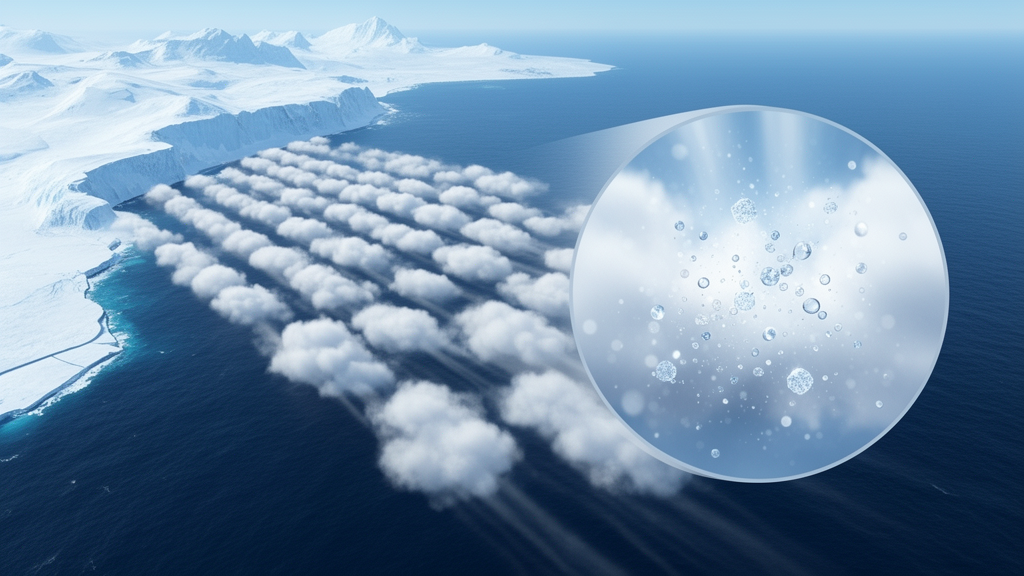
When frigid Arctic air pours over open ocean, it triggers some of the most dynamic cloud formations on the planet. These cold-air outbreak clouds, which begin as orderly stratocumulus streets and evolve into scattered cumulus downwind, are natural laboratories for studying mixed-phase cloud processes. Now, a team of researchers led by Xinyi Huang at the University of Leeds has revealed that the processes controlling these clouds interact with each other in ways that traditional modelling approaches completely miss. The findings, published in Atmospheric Chemistry and Physics, suggest that the standard practice of perturbing one model parameter at a time may provide dangerously incomplete information about what controls these clouds.
The research focused on a cold-air outbreak event over the Labrador Sea on 24 October 2022, coinciding with two research flights during the M-Phase aircraft campaign. During such events, air masses flow from cold, dry high-latitude continents or ice-covered regions toward the warm, open ocean. This transition destabilises the marine boundary layer and drives strong convection that forms extensive mixed-phase clouds, where liquid droplets and ice crystals coexist at temperatures normally below 0 degrees Celsius. These clouds are critical for understanding cloud-phase feedback in a warming climate, yet global climate models generally represent their microphysics poorly, leaving uncertainties in both the direction and magnitude of this feedback.
Rather than the conventional one-at-a-time sensitivity approach, the team employed perturbed parameter ensembles and Gaussian process emulators, a Bayesian machine learning method that statistically learns the relationship between model inputs and outputs. They perturbed six cloud microphysics parameters simultaneously: the cloud droplet number concentration, the ice-nucleating particle concentration, the efficiencies of three secondary ice production processes, and a mixed-phase overlap factor controlling the spatial coexistence of liquid and ice within model grid boxes. The emulators were trained on 66 simulations of the Met Office Unified Model coupled with the Cloud AeroSol Interacting Microphysics scheme, using a maximin Latin hypercube sampling design to cover the six-dimensional parameter space efficiently.
The perturbed ranges were grounded in observations wherever possible. The droplet number concentration ranged from 5 to 75 per cubic centimetre, matching satellite retrievals from MODIS and in-situ measurements from the cloud droplet probe onboard the research aircraft. The ice-nucleating particle concentration was perturbed across six orders of magnitude, from 0.000017 to 17 per litre at minus 15 degrees Celsius, reflecting the enormous uncertainty in this quantity, which cannot be constrained by satellite retrievals. The secondary ice production parameters covered the Hallett-Mossop process, ice-ice collisional breakup, and droplet shattering, while the mixed-phase overlap factor ranged from 0 to 1.
The results show that these parameters have strongly non-linear joint effects on cloud properties. In the stratocumulus region, the droplet number concentration and ice-nucleating particle concentration most strongly control the cloud radiative properties, particularly the top-of-atmosphere albedo and liquid water path. In the cumulus region, the droplet number concentration maintains its strong influence, but the mixed-phase overlap factor becomes the second strongest controller, reflecting the deeper clouds and increased ice formation downwind. The three secondary ice production processes showed relatively weak effects on albedo and liquid water path in both regions, though their influence on ice water path was more pronounced in the cumulus region.
The most striking finding concerns how the sensitivity of cloud properties to one parameter depends entirely on the values of the others. The sensitivity of cloud albedo to increases in ice-nucleating particle concentration varied between near zero and strongly negative across the sampled parameter space. When the droplet number concentration was below approximately 20 per cubic centimetre, the liquid water path was largely insensitive to ice-nucleating particle concentration, but it became highly sensitive when droplet numbers exceeded 50 per cubic centimetre. The magnitude and even the sign of cloud responses to secondary ice production parameters depended on the droplet and ice-nucleating particle settings, sometimes causing increases and sometimes decreases in cloud cover.
The team quantified this dependence by performing 729 separate one-at-a-time tests across the parameter space, using the trained emulators to explore how individual parameter sensitivities shifted depending on the starting point. The response of liquid water path to perturbing the droplet number concentration ranged from +31 to +65 grams per square metre in the stratocumulus region, while the response to ice-nucleating particle concentration ranged from -73 to -29 grams per square metre. In the cumulus region, the response to the mixed-phase overlap factor ranged from -39 to -15 grams per square metre. These wide distributions demonstrate that a single sensitivity test anchored at one set of parameter values provides an overly confident and potentially misleading estimate of how these clouds respond to changes in aerosols or ice formation.
The study also revealed the problem of equifinality, where many different combinations of parameter values produce the same cloud property. When comparing modelled albedo to satellite observations from CERES, more than 70,000 model variants out of one million produced the observed value in the stratocumulus region, and more than 90,000 in the cumulus region. This means that constraining a single parameter by matching one observed cloud property is insufficient, and multiple observed variables are needed to narrow the plausible parameter space.
The implications for climate modelling are significant. Because the cloud-phase feedback depends on how mixed-phase clouds respond to warming, and because these responses are controlled by interacting aerosol and ice processes, models that represent these processes in isolation may misestimate the feedback. The strong sensitivity of the studied clouds to droplet number concentration highlights the importance of accurately representing cloud condensation nuclei in models. Yet the finding that cloud sensitivity to droplet number depends on ice-nucleating particle concentration means that improved measurements of ice-nucleating particles, which are sparse and cannot be obtained from satellites, are also essential for constraining the properties of mixed-phase cold-air outbreak clouds.
The authors acknowledge that their approach, using fixed droplet and temperature-dependent ice-nucleating particle profiles rather than fully aerosol-interactive schemes, omits potentially important feedbacks associated with aerosol processing. They also note that their conclusions are specific to this case study and may differ in other cold-air outbreak events with different environmental conditions. Future work should investigate how different meteorological environments interact with these microphysical parameters, and should extend the analysis to include boundary-layer mixing and cloud fraction schemes. Nevertheless, this study demonstrates the power of model emulation for systematically identifying non-linear joint effects that cannot be revealed through traditional sensitivity testing, and underscores the necessity of exploring the full parameter space to understand the factors controlling mixed-phase clouds in a changing climate.
Subject of Research: Interacting effects of droplet number and ice formation processes on mixed-phase cold-air outbreak clouds
Article Title: Interacting effects of droplet number and ice formation processes on mixed-phase cold-air outbreak clouds
Article References: Huang, X., Field, P. R., Herbert, R. J., Murray, B. J., van den Heuvel, F., Grosvenor, D. P., Sansom, R. W. N., & Carslaw, K. S. (2026). Interacting effects of droplet number and ice formation processes on mixed-phase cold-air outbreak clouds. Atmospheric Chemistry and Physics, 26(20), 14577-14616. https://doi.org/10.5194/acp-26-14577-2026
Image Credits: AI Generated
DOI: 10.5194/acp-26-14577-2026
Keywords: cold-air outbreaks, mixed-phase clouds, cloud microphysics, aerosol-cloud interactions, ice nucleating particles, secondary ice production, perturbed parameter ensembles, Gaussian process emulators, cloud-phase feedback, Labrador Sea, stratocumulus, cumulus
Cite Scienmag News
Russell Cooper. (October 16, 2026). Droplets and Ice Interact to Shape Cold-Air Outbreak Clouds. Scienmag. https://scienmag.com/droplets-and-ice-interact-to-shape-cold-air-outbreak-clouds/
Russell Cooper. "Droplets and Ice Interact to Shape Cold-Air Outbreak Clouds." Scienmag, 16 October 2026, https://scienmag.com/droplets-and-ice-interact-to-shape-cold-air-outbreak-clouds/. Accessed 16 October 2026.
Russell Cooper. "Droplets and Ice Interact to Shape Cold-Air Outbreak Clouds." Scienmag. October 16, 2026. https://scienmag.com/droplets-and-ice-interact-to-shape-cold-air-outbreak-clouds/


