


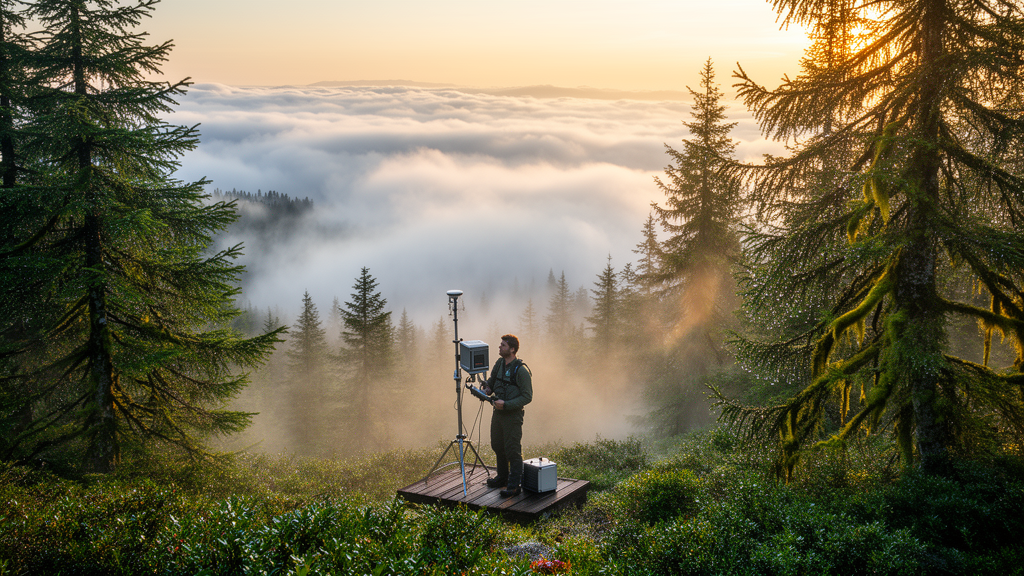
High on a forested mountaintop in southeastern China, the air tells two stories at once. One belongs to the dense subtropical forest below, exhaling isoprene and monoterpenes that react within seconds of being released. The other belongs to distant cities and industrial zones, whose polluted air masses drift upward and across the region. A new study published in Atmospheric Chemistry and Physics has now disentangled these competing influences with unprecedented molecular detail, and in doing so has revealed a third, often overlooked actor: the clouds that routinely swallow the mountain itself.
An international team led by Yi Zhang and Yele Sun of the Institute of Atmospheric Physics, Chinese Academy of Sciences, spent autumn 2023 measuring the atmosphere at the Shanghuang Eco-Environmental Observatory, a mountaintop station in Zhejiang Province sitting 1,128 meters above sea level. Their instrument of choice was an iodide-adduct chemical ionization time-of-flight mass spectrometer, a device capable of sniffing out individual oxygenated organic molecules, or OOMs, in real time. These molecules are the chemical middlemen of the atmosphere: they are born when volatile organic compounds from plants and human activities are attacked by oxidizing radicals, and many of them eventually condense into the microscopic particles known as secondary organic aerosols, which influence both air quality and climate.
The scale of the measurement was extraordinary. Over one month of observations, the researchers identified 1,503 distinct iodide-adduct ions in the mass range of 170 to 500 Th. The two dominant chemical families were CHO compounds, containing only carbon, hydrogen and oxygen, which included 701 species and accounted for nearly half of the total measured mixing ratio, and CHON compounds, which additionally carry nitrogen atoms, comprising 583 species and contributing 29 percent of the total. Among the CHO compounds were small carboxylic acids such as formic and acetic acid alongside recognizable isoprene and terpene oxidation products. The CHON fraction included amides, nitrophenols, and a suite of organic nitrates formed from the oxidation of biogenic hydrocarbons in nitrogen-rich air.
Volatility analysis revealed a crucial asymmetry between these two families. Both were dominated by intermediate-volatility organic compounds, at 88 percent for CHO and 72 percent for CHON species, while low-volatility compounds contributed less than 4 percent. Yet the nitrogen-bearing CHON molecules were consistently less volatile than their CHO counterparts, because nitro and nitrate ester functional groups substantially depress vapor pressure, with a single nitro group lowering saturation vapor pressure by roughly a third of an order of magnitude. This means nitrogen-containing oxidation products have a stronger tendency to move from the gas phase into airborne particles, making them disproportionately important for secondary organic aerosol formation even when their absolute concentrations are modest.
To trace where these molecules came from, the team applied positive matrix factorization, a statistical technique that deconvolves the mass spectra into chemically meaningful source profiles. Of the resolved factors, nine proved atmospherically relevant: five tied to biogenic oxidation, spanning fresh daytime isoprene oxidation, morning and afternoon mixed isoprene-monoterpene processing, and a nighttime factor dominated by organic nitrates, plus four linked to anthropogenic emissions and regional transport. The biogenic factors correlated strongly with local isoprene concentrations, with a correlation coefficient of 0.75, and wind regression confirmed they originated from nearby forested source regions, while the anthropogenic factors showed clear transport signatures from the northwest.
The findings drew a sharp line between warm and cool weather. During warm periods, when mean temperatures hovered around 20 degrees Celsius, biogenic oxidation dominated the OOM budget, contributing 68 to 79 percent of the total. During cooler periods below 15 degrees Celsius, when plant emissions weaken and air masses arriving from polluted regions dominate, anthropogenic and transport-related factors swelled to as much as 63 percent of the budget. Kinetic calculations reinforced the mechanistic picture: isoprene reacted overwhelmingly with hydroxyl radicals, at a rate roughly 15 times faster than its reaction with ozone, whereas monoterpenes were processed almost equally by hydroxyl radicals and ozone during the day, and by nitrate radicals at night.
The nighttime chemistry proved particularly striking. Biogenic organic nitrates peaked around 20:00 local time, coinciding with evening maxima in ozone and nitrogen dioxide, the precursors of nitrate radicals. The resolved nighttime factor closely matched laboratory flow-tube spectra produced by reacting monoterpenes with nitrate radicals, with shared signature compounds such as C10H15NO5 and C10H15NO6. This agreement between field observations and controlled experiments provides some of the strongest field evidence yet that nitrate-radical-driven oxidation of forest terpenes is a major, and often underappreciated, pathway for producing nitrogen-containing organic molecules in mountain atmospheres.
But the study’s most consequential results concern clouds. Using a ground-based counterflow virtual impactor to identify cloud events automatically, the researchers compared organic nitrate concentrations before, during and after clouds enveloped the summit. Isoprene-derived organic nitrates plummeted by 75 percent during cloud periods, while monoterpene-derived nitrates fell by only 46 percent. As a result, the relative share of monoterpene nitrates within the organic nitrate pool jumped from 23 percent to 40 percent. The explanation lies in differing fates: isoprene nitrates are more water-soluble and hydrolyze rapidly once dissolved in cloud droplets, whereas monoterpene nitrates survive aqueous processing longer, and monoterpenes also react with nitrate radicals up to two orders of magnitude faster than isoprene, replenishing their nitrates when cloudy skies suppress daytime photochemistry.
Sulfur-containing molecules told a parallel story. The factor representing organosulfur compounds, including species consistent with organosulfates formed in aerosol liquid water and cloud droplets, increased during cloud events and rose with ambient relative humidity, consistent with aqueous and multiphase chemistry rather than gas-phase photochemistry alone. Meanwhile, volatility distributions shifted: under cloudy conditions the intermediate-volatility fraction of CHON compounds swelled to 82 percent from 68 percent in clear air, suggesting that clouds preferentially scavenge lower-volatility compounds while aqueous fragmentation generates smaller, more volatile products released back to the gas phase.
The researchers are careful to note that clouds never act alone; temperature, radiation, precursor availability and air-mass origin all change simultaneously during cloud events, so the observed shifts reflect coupled processes rather than cloud effects in isolation. Even so, the implications are broad. Models of secondary organic aerosol formation that treat mountain and forest environments as simple photochemical reactors may systematically misjudge both the amount and the composition of aerosol-forming molecules whenever clouds pass through. As the authors conclude, cloud processing does not merely wash molecules out of the sky; it actively reshapes which molecules remain, favoring some chemical pathways over others and altering the balance between natural and pollution-derived chemistry in the air we breathe.
Subject of Research: Cloud and meteorological effects on the molecular evolution of atmospheric oxygenated organic molecules in a forested mountain environment
Article Title: Molecular evolution of oxygenated organic molecules in a cloud-influenced forested mountain environment
Article References: Zhang, Y., Zhou, W., Xu, W., Li, Y., Zhang, Y., Zhang, Z., Su, B., Zhang, N., Aruffo, E., Wang, J., Di Carlo, P., Liu, L., Pan, X., Wang, Z., Worsnop, D. R., & Sun, Y. (2026). Molecular evolution of oxygenated organic molecules in a cloud-influenced forested mountain environment. Atmospheric Chemistry and Physics, 26(20), 14637-14653. https://doi.org/10.5194/acp-26-14637-2026
Image Credits: AI Generated
DOI: 10.5194/acp-26-14637-2026
Keywords: oxygenated organic molecules, secondary organic aerosol, cloud chemistry, biogenic volatile organic compounds, organic nitrates, chemical ionization mass spectrometry, positive matrix factorization, nitrate radical oxidation, isoprene, monoterpenes, wet scavenging, aqueous-phase chemistry
Cite Scienmag News
Bethany Barker. (October 16, 2026). Clouds Rewrite the Chemistry of Forest Air, Mountain Study Reveals. Scienmag. https://scienmag.com/clouds-rewrite-the-chemistry-of-forest-air-mountain-study-reveals/
Bethany Barker. "Clouds Rewrite the Chemistry of Forest Air, Mountain Study Reveals." Scienmag, 16 October 2026, https://scienmag.com/clouds-rewrite-the-chemistry-of-forest-air-mountain-study-reveals/. Accessed 16 October 2026.
Bethany Barker. "Clouds Rewrite the Chemistry of Forest Air, Mountain Study Reveals." Scienmag. October 16, 2026. https://scienmag.com/clouds-rewrite-the-chemistry-of-forest-air-mountain-study-reveals/


