


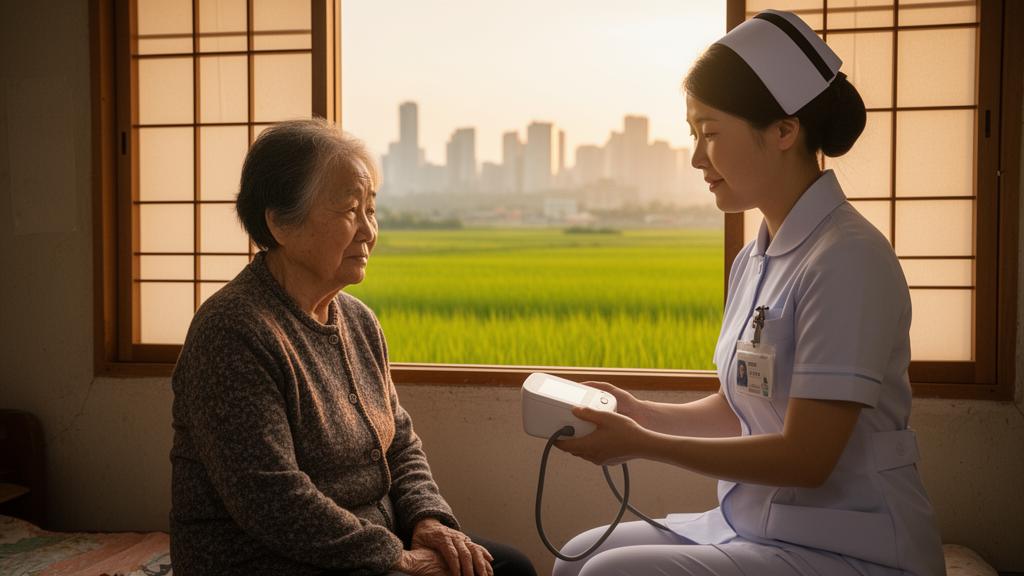
Most older adults want one thing above all: to stay in their own homes as they age. That preference has become a central policy goal in countries around the world, and Korea has responded by steadily expanding home-based care services within its national social security system. But a new longitudinal study suggests that the promise of aging in place is being fulfilled unevenly across the country, with utilization of home-based care services clustering in specific regions and shifting in distinct ways over more than a decade of observation.
The research, published in BMC Geriatrics by a team from Yonsei University College of Nursing, drew on data from the National Health Insurance Service Senior Cohort covering the years 2008 to 2019. The dataset follows a large sample of older Koreans through the country’s health and long-term care systems, allowing researchers to calculate annual home-based care utilization rates expressed as users per 1,000 older adults in each administrative region. By tracking these rates year after year and then subjecting them to sophisticated spatial and spatiotemporal statistics, the team produced one of the most detailed pictures to date of how home-based care uptake has evolved across Korea’s provinces and metropolitan areas.
One of the study’s key technical contributions lies in how it disentangled three different strands of home-based care. Hospital-based home health nursing care is reimbursed under the National Health Insurance Service and is delivered through hospitals and home health agencies. Community-based home care and community-based home nursing care, by contrast, are covered by the Long-Term Care Insurance for older adults, a separate social insurance program that funds personal care and nursing support delivered in the community. Because these services operate under different financing mechanisms, different delivery models, and different eligibility rules, the researchers analyzed trends for each category separately rather than lumping them together, a methodological choice that proved essential for revealing the distinct regional patterns described below.
The headline temporal finding is unambiguous: community-based services surged. Utilization rates for community-based home care and community-based home nursing care increased significantly between 2008 and 2019, reflecting both the maturation of Korea’s long-term care insurance system and the growing willingness of older adults and their families to draw on publicly funded support at home. Hospital-based home health nursing care, meanwhile, showed only a non-significant upward trend over the same period, suggesting that this insurance-reimbursed service has not expanded at anything like the pace of its community-based counterparts.
But the raw trends only tell half the story. To probe the geography of home-based care, the team applied Global Moran’s I, a statistic that measures whether values across a map are more clustered than would be expected by chance. The results were striking. Spatial clustering of hospital-based home health nursing care utilization intensified over time, reaching a Global Moran’s I of 0.696 with a p-value of 0.001 in 2019, a value indicating strongly non-random concentration. In plain terms, by the end of the study period, whether an older Korean lived in a region with high or low hospital-based home nursing utilization depended heavily on where in the country they lived, and that dependence had grown stronger with each passing year.
Hotspot analysis using the Getis–Ord Gi* statistic pinpointed exactly where those concentrations lie. High-utilization hotspots for hospital-based home health nursing care were concentrated in Seoul, the surrounding province of Gyeonggi-do, and Chungcheongnam-do, a province on Korea’s west coast. This corridor encompasses the capital region and adjacent areas, home to the densest health infrastructure in the country. The spatiotemporal analysis, which combined the Mann–Kendall trend test with Sen’s slope estimator to detect statistically reliable directional changes in each region, revealed significant increases in hospital-based home health nursing care utilization in Incheon, Gyeonggi-do, Chungcheongnam-do, Seoul, and Gangwon-do, a mountainous province along the eastern seaboard.
The community-based services told a different regional story. Incheon and Jeollabuk-do showed significant increases in community-based home nursing care, while Gyeongsangbuk-do, a large province in the southeast, exhibited a significant decrease, a divergence that highlights how service uptake can move in opposite directions in different parts of the country even under a single national insurance program. Community-based home care, the broadest and most heavily used of the three services, showed significant increases in every region of the country with a single exception: Jeju, the island province south of the peninsula, was the only region where the increase was not statistically significant.
What makes these findings technically important is that all of these services are provided under Korea’s social security system, meaning that financing is national while utilization is demonstrably regional. The researchers emphasize that regional differences in utilization rates were observed across service types despite this uniform provision, a pattern that points to geographic factors beyond funding as the drivers of uptake. Supply-side explanations are plausible: the density of home health agencies, the availability of community care providers, and the distribution of long-term care facilities vary across regions, and hospital-based home nursing in particular depends on hospitals and agencies choosing to operate the service. Demand-side factors matter too, including regional differences in the age structure of the older population, family caregiving capacity, and awareness of available services.
The policy implications reach well beyond Korea’s borders. Supporting aging in place has become a major goal in many countries confronting rapidly aging populations, and the Korean experience offers a cautionary lesson: expanding home-based care within a national social security system does not automatically translate into equitable access. The authors argue that their findings underscore the need for regionally tailored service delivery models and policy interventions that account for geographic differences in home-based care utilization. In practice, that could mean targeted supply expansion in regions lagging behind, outreach programs in areas where eligible older adults are not drawing on services, and delivery models adapted to the specific infrastructure and demographics of each province.
For a country like Korea, where the older population is growing faster than almost anywhere else in the developed world, the stakes of getting this right are enormous. The study’s longitudinal design, spanning twelve years of national cohort data and three distinct service categories, provides the evidentiary foundation for that effort. If the goal is to let older adults remain home as they age, the research makes clear that the map matters: where an older Korean lives continues to shape which home-based services they can realistically access, and closing that geographic gap is now the central challenge for the next phase of home-based care policy.
Subject of Research: Regional trends in home-based care utilization among older adults in Korea: a longitudinal study using the national health insurance service senior cohort
Article Title: Regional trends in home-based care utilization among older adults in Korea: a longitudinal study using the national health insurance service senior cohort
Article References: Regional trends in home-based care utilization among older adults in Korea: a longitudinal study using the national health insurance service senior cohort. (n.d.). https://doi.org/10.1186/s12877-026-08502-7
Image Credits: AI Generated
DOI: 10.1186/s12877-026-08502-7
Keywords: Regional, trends, home-based, care, utilization, older, adults, Korea, longitudinal, national, health, insurance
Cite Scienmag News
Ophelia Keating. (October 16, 2026). Korea’s Home Care Revolution Leaves Some Regions Behind, Landmark 12-Year Study Reveals. Scienmag. https://scienmag.com/koreas-home-care-revolution-leaves-some-regions-behind-landmark-12-year-study-reveals/
Ophelia Keating. "Korea’s Home Care Revolution Leaves Some Regions Behind, Landmark 12-Year Study Reveals." Scienmag, 16 October 2026, https://scienmag.com/koreas-home-care-revolution-leaves-some-regions-behind-landmark-12-year-study-reveals/. Accessed 16 October 2026.
Ophelia Keating. "Korea’s Home Care Revolution Leaves Some Regions Behind, Landmark 12-Year Study Reveals." Scienmag. October 16, 2026. https://scienmag.com/koreas-home-care-revolution-leaves-some-regions-behind-landmark-12-year-study-reveals/


