


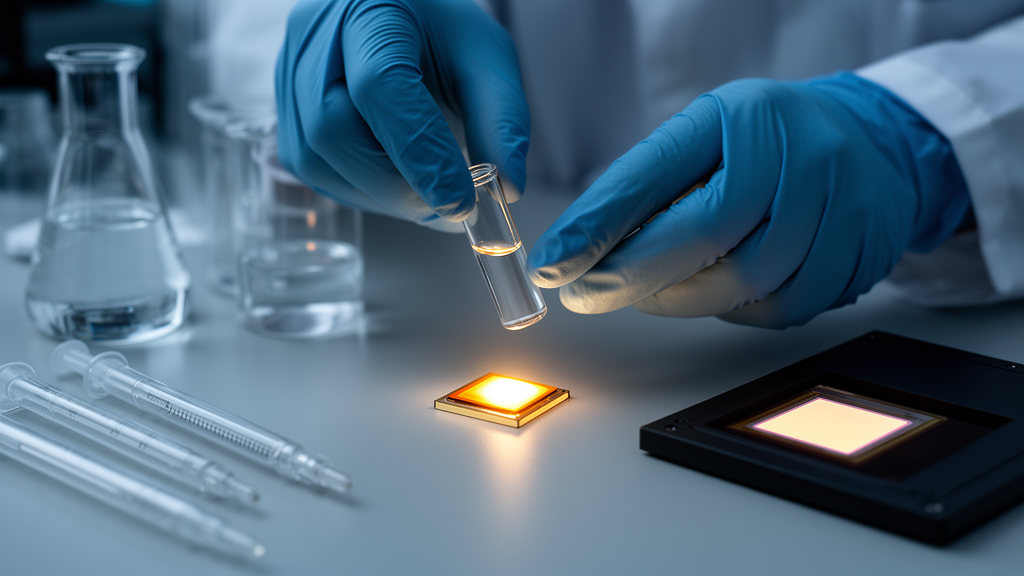
Chemists at Emory University have uncovered a previously overlooked reaction pathway that unfolds inside the solution used to fabricate perovskite light-emitting diodes, and by steering that chemistry they have pushed the devices to a peak quantum efficiency of 37 percent, a substantial leap beyond the 20 to 30 percent range that has defined most of the field’s progress to date. The work, published in the journal Nature, offers what the researchers describe as a chemistry-driven strategy for additive design that could keep driving improvements in a class of hybrid semiconductors prized for their low cost, flexibility and suitability for applications ranging from biomedical sensing to automated facial recognition.
Letian Dou, senior author of the paper and professor of chemistry at Emory University, where he joined the faculty last year as the Paul and Phyllis Fireman Professor of Chemistry after a career at Purdue University, frames the advance in simple terms. Most previous work on perovskite LEDs has yielded quantum efficiency, the measure of how well a device converts electricity into light, within a range of 20 to 30 percent. The new approach brings that figure closer to 40 percent, and the team reports a peak of 37 percent. For a technology whose commercial promise has been constrained by exactly this kind of performance ceiling, the jump is significant.
The discovery began as a laboratory mystery. Sung-Doo Baek, first author of the paper, who carried out the work as a postdoctoral fellow in the Dou lab, noticed something odd while producing perovskite LEDs for experimentation and testing. The basic formulation for making these devices includes an additive, first reported in 2018, that delivers a baseline efficiency of 20 to 25 percent. Yet a batch made in the Dou lab somehow reached around 30 percent. Something in the routine of the lab, rather than the recipe itself, appeared to be responsible.
Baek’s first hypothesis pointed toward the nitrogen glove box, the sealed, clear-walled enclosure filled with purified nitrogen gas in which the ultrathin films are spin-coated onto a substrate, protecting the material from oxygen and moisture while a researcher works through gloves attached to the box. Although oxygen is generally considered harmful to perovskite materials, a handful of studies had suggested it could occasionally be beneficial, so a slow leak seemed a plausible culprit. That turned out to be a false trail, Baek says. Instead, he turned his attention to the hidden chemistry of the solution itself, a stage of the process that, as he points out, no one knew what was happening during.
To make a perovskite LED, metal halide salts along with various additives are heated so that they dissolve into a solvent. The solution is then spin-coated in ultrathin layers onto a substrate, and the resulting film is heated to evaporate the solvent and allow the chemicals to crystallize into the perovskite structure. The team kept tweaking the process of making the solution, producing the LEDs and comparing their efficiencies. After months of painstaking experimentation, a pattern emerged: differences in how long the solutions were heated led to variations in efficiency, and twenty minutes of heating turned out to be the sweet spot.
Comparative analyses then revealed how the chemistry transforms during the solution phase. Optimal heating favors the formation of a linear compound that boosts the efficiency of the LED while simultaneously suppressing the formation of a ring compound that harms it. The researchers went further, synthesizing and purifying the linear compound and developing a method of targeted reaction-pathway control to selectively harness its power. Applying that control raised the efficiency of a perovskite LED to the reported peak of 37 percent. Yu-Ting Yang, a PhD candidate in the Dou lab and co-first author of the paper, says what surprised her most is that even a detail that appears trivial, one you think isn’t really important, can have such a major effect, a lesson she describes as learning the importance of paying close attention.
The advance matters because of where perovskite LEDs sit in the broader landscape of lighting and display technology. Starting in the 2010s, LEDs made from inorganic semiconductors such as gallium nitride began largely replacing incandescent lightbulbs in households. Incandescent bulbs work by heating a metal filament and waste roughly 90 percent of their energy, whereas an inorganic LED converts energy directly into light by passing electric current through a semiconductor to excite electrons, using only 8 to 10 watts to produce the same amount of light as a 60-watt incandescent bulb. Those inorganic devices are efficient, stable and long lasting, but they can be difficult to assemble into large-area displays or to shrink into extremely small pixels, and their rigidity limits their use in flexible devices.
LEDs made with organic molecules, by contrast, are thinner, more flexible and more designable, and they are known for producing brilliant colors in displays, but they remain more expensive to produce and less efficient and durable than their inorganic counterparts. Hybrid LEDs built from metal-halide perovskite, a material that combines organic and inorganic molecules, aim to capture the best of both worlds. The Dou lab focuses on developing lightweight, flexible, low-cost, highly durable hybrid LEDs that are efficient in the near-infrared region, the light found just past what is visible to the human eye.
That near-infrared focus connects the work to a set of applications with real commercial and scientific weight. Dou notes that the facial recognition feature on a cell phone relies on infrared light, which avoids shining a beam of blue light into a user’s eye, and that the same region of the spectrum is used in night-vision cameras, such as those used to monitor a sleeping baby. In biomedicine, the longer wavelengths of infrared light can provide clear, non-invasive imaging of tissues for applications ranging from tracking immune responses to detecting abnormal tissue cells. Improving the efficiency of the emitters that produce this light is a step toward moving perovskite LEDs closer to their potential for commercial use.
The team, whose co-authors include scientists from Emory, Purdue University, the University of Michigan at Ann Arbor and Princeton University, says the work sets the stage for a new chemistry-driven strategy for additive design to drive further improvements. Dou says the lab is working to keep improving both the efficiency and the operational lifetime of perovskite LEDs, and also wants to move toward applications by demonstrating the relevance of the technology in biomedical research, with hopes of forming collaborations within Emory School of Medicine. The research was funded by the U.S. National Science Foundation and the U.S. Department of Energy, and the findings appear in Nature under the title describing how hidden reaction pathways inform additive engineering for perovskite LEDs.
Subject of Research: Reaction-pathway control in solution-processed metal-halide perovskite light-emitting diodes
Article Title: A lightbulb moment: Chemists find way to boost efficiency of hybrid LEDs
Article References: A lightbulb moment: Chemists find way to boost efficiency of hybrid LEDs. (n.d.). Original publication
Image Credits: AI Generated
DOI: Not provided
Keywords: perovskite LEDs, quantum efficiency, metal-halide perovskite, near-infrared light, additive engineering, reaction pathways, solution processing, biomedical imaging, facial recognition, optoelectronics, Emory University, Nature journal
Cite Scienmag News
Bethany Barker. (October 16, 2026). Hidden chemistry in the solution pushes perovskite LEDs toward 40 percent efficiency. Scienmag. https://scienmag.com/hidden-chemistry-in-the-solution-pushes-perovskite-leds-toward-40-percent-efficiency/
Bethany Barker. "Hidden chemistry in the solution pushes perovskite LEDs toward 40 percent efficiency." Scienmag, 16 October 2026, https://scienmag.com/hidden-chemistry-in-the-solution-pushes-perovskite-leds-toward-40-percent-efficiency/. Accessed 16 October 2026.
Bethany Barker. "Hidden chemistry in the solution pushes perovskite LEDs toward 40 percent efficiency." Scienmag. October 16, 2026. https://scienmag.com/hidden-chemistry-in-the-solution-pushes-perovskite-leds-toward-40-percent-efficiency/


