


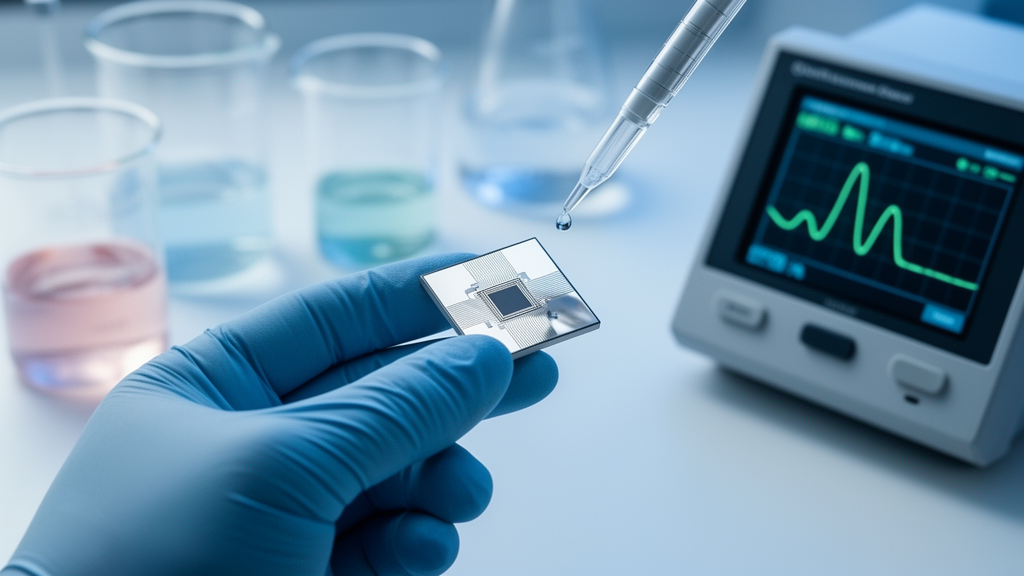
A comprehensive review published in Results in Chemistry surveys how chemically modified glassy carbon electrodes are transforming the detection of pharmaceuticals and environmental pollutants, achieving detection limits in the low-nanomolar range with equipment that costs a fraction of a conventional chromatography laboratory. The review, authored by Melaku Metto, synthesizes recent advances in metal-organic complex and conducting-polymer modifiers and argues that these platforms could reshape pharmaceutical quality control, food safety testing, and clinical diagnostics, provided researchers close several well-defined validation gaps.
The driving problem is the relentless spread of emerging contaminants. Industrialization, agricultural intensification, and rising pharmaceutical consumption have dispersed antibiotics such as sulfamethoxazole and ciprofloxacin, proton pump inhibitors like esomeprazole, and organophosphorus pesticides into water bodies, soils, food, and biological fluids at concentrations from nanograms to micrograms per liter. These compounds raise concerns ranging from antibiotic resistance to endocrine disruption and genotoxicity. Conventional techniques such as high-performance liquid chromatography and gas chromatography-mass spectrometry deliver excellent accuracy, but they demand expensive instrumentation, trained personnel, laborious sample preparation, and substantial organic solvent consumption, and they are poorly suited to on-site analysis.
Electrochemical sensors address many of these constraints by converting chemical information into electrical signals through oxidation or reduction reactions at the electrode-electrolyte interface. A typical three-electrode cell comprises a working electrode where the target redox reaction occurs, a reference electrode such as Ag/AgCl maintaining a stable potential, and a platinum counter electrode completing the circuit. In voltammetric techniques, the peak current follows the Randles-Sevcik relationship, scaling with the number of electrons transferred, electrode area, analyte concentration, diffusion coefficient, and scan rate. Cyclic voltammetry serves mainly as a qualitative diagnostic for reversibility and electron-transfer kinetics, while differential pulse and square wave voltammetry suppress capacitive background current and deliver the nanomolar detection limits that make trace analysis practical. Electrochemical impedance spectroscopy characterizes the interface itself, revealing charge-transfer resistance and surface-area changes upon modification.
The review identifies glassy carbon electrodes as the substrate of choice because of their wide potential window from about minus 1.0 to plus 1.5 volts versus Ag/AgCl, low background current, chemical inertness, and affordability. Bare electrodes, however, suffer from a small electroactive surface area of roughly 0.07 to 0.12 square centimeters, sluggish electron transfer, fouling, and poor selectivity. Modification strategies therefore center on two material families. Transition-metal complexes of manganese, copper, cobalt, and ruthenium offer well-defined redox centers and efficient electron mediation, while conducting polymers such as polypyrrole, polyaniline, polythiophene, poly(cytosine), and polythiourea combine high conductivity, chemical stability, film-forming ability, and dense functional groups for analyte interaction.
The standout results come from copper-phenanthroline chemistry. A poly([Cu(H2O)2P2]I2)-modified glassy carbon electrode detected the antibiotic trimethoprim down to 3.91 nanomolar over a linear range of 0.5 to 160 micromolar, with a relative standard deviation of 1.67 percent and spike recoveries of 97.50 to 103.75 percent in blood serum, urine, and cow’s milk. The same modifier detected esomeprazole at 28.90 nanomolar with 0.59 percent RSD, quantifying the drug in four commercial tablet brands at 96.05 to 107.90 percent of labeled content. A tetranuclear copper complex bridged by 4,4′-bipyridine achieved simultaneous detection of sulfamethoxazole and trimethoprim, with detection limits of 27.94 and 21.56 nanomolar respectively, RSD values as low as 0.11 percent, and more than 97 percent signal retention after 15 days.
A manganese(II) resorcinolato complex extended the approach to the DNA bases adenine and guanine, detecting both simultaneously with limits of 66.54 and 9.1 nanomolar and validating the method in urine, serum, and DNA extracts with recoveries of 96 to 104 percent. On the polymer side, a poly(cytosine)-modified electrode boosted the guanine oxidation signal 7.5-fold relative to bare glassy carbon, reaching 6.10 nanomolar with less than 1 percent RSD, and directly quantified endogenous guanine at 1.40 micromolar in DNA extracts without interference from other bases. Impedance measurements explain these gains: modification cut charge-transfer resistance from 5140 ohms to roughly 440 to 500 ohms, corresponding to about a hundred-fold enhancement in the heterogeneous electron-transfer rate constant, and tripled the electroactive area.
Mechanistic analysis underpins the performance claims. Scan-rate studies consistently showed diffusion-controlled oxidation, with log current versus log scan-rate slopes of 0.45 to 0.62 near the theoretical value of 0.5 for pure diffusion. Tafel analysis and pH-dependence data revealed one-electron, one-proton rate-determining steps for trimethoprim, esomeprazole, sulfamethoxazole, and adenine, while guanine oxidizes through a two-electron pathway, with near-Nernstian slopes of 56 to 66 millivolts per pH unit confirming coupled proton-electron transfer. The copper systems outperform the manganese platform because the Cu(II)/Cu(I) couple is more accessible and reversible, and the pi-acidic phenanthroline ligand field delocalizes charge more effectively than the resorcinolate environment.
The review is candid about limitations. Stability data stop at 14 to 21 days, far short of commercial shelf-life requirements. Only one study reported sensor-to-sensor reproducibility, and without stating the number of electrodes tested. None of the sensors was actually validated in environmental water samples; nanomolar limits measured in buffer or serum do not guarantee performance in wastewater, where natural organic matter and variable ionic strength alter fouling and selectivity. Electrode fouling under continuous protein exposure remains untested, simultaneous detection is capped at two analytes, and the claimed equivalence to USP HPLC methods lacks formal statistical comparison. Multistep synthesis of the copper complexes also adds a scale-up burden absent from the single-monomer poly(cytosine) system.
Looking forward, the review charts several converging trends. Graphene and reduced graphene oxide offer surface areas up to 2630 square meters per gram; carbon nanotubes, gold and platinum nanoparticles, metal-organic frameworks, and MXenes promise further signal amplification and preconcentration. Screen-printed electrodes and smartphone-connected handheld potentiostats point toward decentralized field testing, while wearable and microfluidic platforms could enable continuous biomarker monitoring. Artificial intelligence adds another layer: partial least squares regression and convolutional neural networks could resolve overlapping voltammetric peaks and automate interpretation, though the author cautions that large, standardized electrochemical datasets essentially do not exist, making overfitting a central risk that demands leave-one-electrode-out validation and external test sets.
The bottom line is a field at an inflection point. Modified glassy carbon electrodes now routinely deliver nanomolar detection, sub-2.5 percent precision, and validated performance across serum, urine, milk, DNA extracts, and tablets, with recoveries consistently between 95 and 106 percent. Converting these laboratory successes into deployed technology will require matrix-matched validation in real environmental waters, standardized reproducibility protocols with stated sample sizes, formal statistical benchmarking against pharmacopeial methods, open voltammetric datasets for machine learning, and scalable, low-complexity modifier synthesis. If those gaps close, the review concludes, the convergence of materials science, electrochemistry, and data science could yield sensing systems that bring laboratory-grade contaminant surveillance out of the lab and into the field.
Subject of Research: Modified electrochemical sensors for pharmaceutical and environmental pollutant detection
Article Title: A comprehensive review on modified electrochemical sensors for pharmaceutical and environmental pollutant detection: Recent advances and future perspectives
Article References: A comprehensive review on modified electrochemical sensors for pharmaceutical and environmental pollutant detection: Recent advances and future perspectives. (n.d.). https://doi.org/10.1016/j.rechem.2026.103966
Image Credits: AI Generated
DOI: Not provided
Keywords: electrochemical sensors, glassy carbon electrode, metal-organic complexes, conducting polymers, pharmaceutical detection, environmental pollutants, sulfamethoxazole, trimethoprim, square wave voltammetry, nanomolar detection limits, electropolymerization, sensor validation
Cite Scienmag News
Bethany Barker. (October 16, 2026). Modified Electrochemical Sensors Push Detection of Drugs and Pollutants to Nanomolar Levels. Scienmag. https://scienmag.com/modified-electrochemical-sensors-push-detection-of-drugs-and-pollutants-to-nanomolar-levels/
Bethany Barker. "Modified Electrochemical Sensors Push Detection of Drugs and Pollutants to Nanomolar Levels." Scienmag, 16 October 2026, https://scienmag.com/modified-electrochemical-sensors-push-detection-of-drugs-and-pollutants-to-nanomolar-levels/. Accessed 16 October 2026.
Bethany Barker. "Modified Electrochemical Sensors Push Detection of Drugs and Pollutants to Nanomolar Levels." Scienmag. October 16, 2026. https://scienmag.com/modified-electrochemical-sensors-push-detection-of-drugs-and-pollutants-to-nanomolar-levels/


