


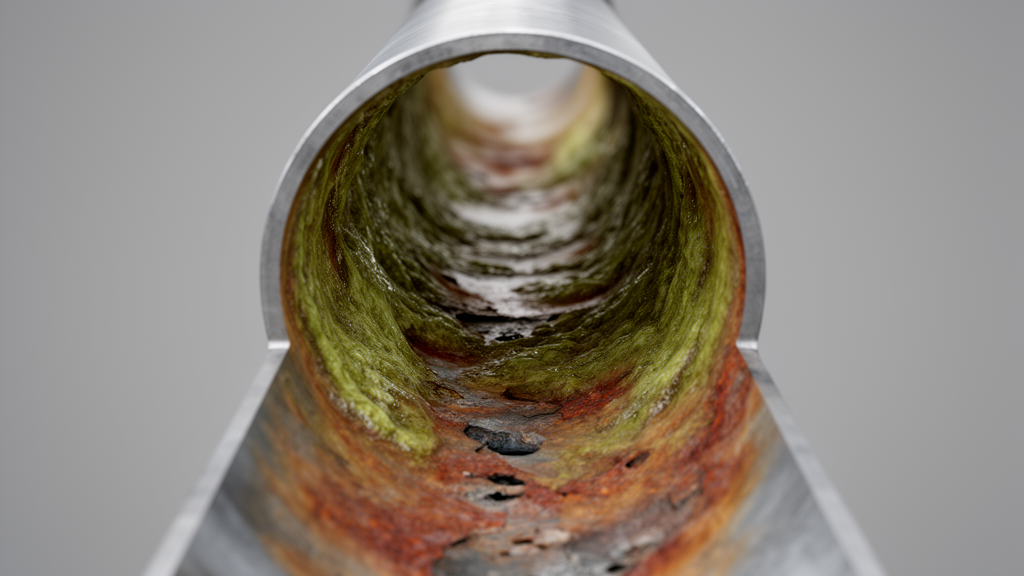
Deep inside the miles of pipes that carry drinking water to homes, schools, and hospitals, an invisible ecosystem is at work. Microorganisms colonize the inner surfaces of distribution pipes and secrete a sticky, protective layer known as a biofilm, which anchors them firmly to the pipe wall. Over months and years, these microbial communities thicken and diversify, and they can gradually erode pipe systems while creating conditions that foster harmful pathogens. Now, a researcher at the University of Central Florida has received federal support to untangle how these hidden microbial layers interact with pipe materials, disinfectants, and corrosion-control additives, with the goal of protecting both aging infrastructure and public health.
Woo Hyoung Lee, a professor in the Department of Civil, Environmental and Construction Engineering at UCF, will lead the investigation into the critical challenges affecting drinking water infrastructure. Working with a team of researchers from the University of Florida, Lee will explore the interactions among biofilms, pipe materials, disinfectants, and corrosion-control chemicals to mitigate corrosion and improve public health outcomes in the future. The project is supported by a $300,000 grant from the U.S. National Science Foundation, and its central ambition is to bridge the gap between what happens at the microscopic scale of the pipe surface and what water utilities observe across an entire distribution system.
The scientific problem at the heart of the project is deceptively simple to state but extraordinarily difficult to measure. Biofilms are not uniform coatings; they are stratified microbial structures in which chemistry changes dramatically over distances measured in micrometers. Lee explains that researchers do not fully understand how conditions such as disinfectant concentration, pH, dissolved oxygen, and other chemical species vary across a biofilm at microscopic scales, or how these microscale gradients influence corrosion and metal release over time. A disinfectant molecule entering the outer edge of a biofilm may be consumed long before it penetrates to the pipe wall, leaving zones where corrosion proceeds unchecked while the bulk water still tests as adequately disinfected.
Our project aims to understand the microscale interactions among biofilms, disinfectants, corrosion-control additives, and pipe materials that govern corrosion, metal release, and disinfectant stability in drinking water distribution systems, Lee says. Ultimately, we hope to connect what is happening at the microscopic pipe surface to changes that utilities observe at the larger distribution-system scale. That connection matters because utilities currently manage water quality largely through bulk measurements at treatment plants and sampling points, which can mask the localized chemical conditions where corrosion and pathogen growth actually begin.
As water travels through miles of distribution pipes laden with biofilms, its chemistry can change continuously, Lee notes. To maintain water quality along that journey, utilities rely on disinfectants such as chlorine and chloramine, and on corrosion-control strategies such as the addition of orthophosphate, a chemical that forms a protective mineral scale on pipe interiors. However, these management approaches are not chemically neutral. They can alter microbial activity, water chemistry, and pipe-surface conditions, potentially affecting both corrosion rates and the release of metals such as lead, copper, and iron into the water that reaches consumers.
Understanding these interactions is important because actions taken to address one challenge, such as microbial control or corrosion prevention, may also affect other chemical and biological processes within the distribution system, Lee says. A utility that boosts chloramine dosing to suppress microbial regrowth, for example, may inadvertently change the oxidation state of the pipe surface, destabilize protective scales, or shift the composition of the biofilm community in ways that alter metal release. Conversely, corrosion-control additives can influence how disinfectants decay as water moves through the network, changing how much residual protection reaches the far ends of the system. These coupled feedbacks mean that single-variable fixes can produce unintended consequences elsewhere in the network.
To resolve these coupled processes at their natural scale, Lee and his team will deploy specialized microelectrodes capable of measuring chemical gradients within biofilms and at pipe surfaces. These microsensors can profile disinfectant concentration, pH, and dissolved oxygen with spatial resolution that conventional water-quality monitoring simply cannot achieve, revealing the steep chemical gradients that exist within fractions of a millimeter of the pipe wall. The team will complement these measurements with advanced imaging techniques to characterize biofilm structure and growth, capturing how the three-dimensional architecture of microbial communities evolves under different treatment regimes.
A third pillar of the project brings modern computation to bear on the problem. The researchers will use data-driven and machine-learning approaches to integrate the chemical, biological, and materials data streams generated by the microelectrode and imaging work. By fusing these heterogeneous datasets, the team aims to build predictive relationships that link microscale biofilm chemistry to system-scale outcomes such as disinfectant decay, corrosion rates, metal release, and overall water quality throughout drinking water distribution systems. Machine-learning models trained on these high-resolution measurements could eventually help utilities anticipate how a change in treatment strategy will propagate through their networks before problems appear at the tap.
The practical payoff of this fundamental research could be substantial for water utilities and the public they serve. The findings could help utilities make more informed decisions regarding disinfection strategies, corrosion-control practices, and distribution-system operation. This research could help utilities better understand how changes in disinfection or corrosion-control strategies may affect microbial growth, corrosion, and metal release, Lee says. Rather than addressing these challenges independently, our work seeks to show how they are interconnected. In the long term, this knowledge could help utilities optimize treatment strategies, maintain water quality throughout the distribution system, extend the service life of infrastructure, reduce operational and maintenance costs, and ultimately provide safer and more reliable drinking water to the public.
The stakes extend far beyond engineering efficiency. Corrosion of drinking water infrastructure has been implicated in some of the most consequential public health episodes in recent memory, when disruptions to corrosion control allowed lead to leach from service lines into household water. Biofilms, meanwhile, can shelter opportunistic pathogens from disinfectants, making them persistent reservoirs of microbial risk. By illuminating the microscopic conversations among microbes, metals, and treatment chemicals that unfold continuously inside every distribution pipe, the UCF-led project promises to give water utilities a far more complete picture of the systems they manage, and to turn the invisible chemistry of the pipe wall into actionable knowledge for protecting drinking water at its most vulnerable point of delivery.
Subject of Research: Microscale interactions between biofilms, disinfectants, and pipe materials affecting corrosion and water quality in drinking water distribution systems
Article Title: UCF researcher to investigate challenges affecting drinking water infrastructure
Article References: UCF researcher to investigate challenges affecting drinking water infrastructure. (n.d.). Original publication
Image Credits: AI Generated
DOI: Not provided
Keywords: drinking water, biofilms, pipe corrosion, disinfectants, water distribution systems, microelectrodes, machine learning, corrosion control, water quality, infrastructure, public health, National Science Foundation
Cite Scienmag News
Bethany Barker. (October 16, 2026). Hidden Biofilms Inside Water Pipes Drive Corrosion and New UCF Research Aims to Decode Them. Scienmag. https://scienmag.com/hidden-biofilms-inside-water-pipes-drive-corrosion-and-new-ucf-research-aims-to-decode-them/
Bethany Barker. "Hidden Biofilms Inside Water Pipes Drive Corrosion and New UCF Research Aims to Decode Them." Scienmag, 16 October 2026, https://scienmag.com/hidden-biofilms-inside-water-pipes-drive-corrosion-and-new-ucf-research-aims-to-decode-them/. Accessed 16 October 2026.
Bethany Barker. "Hidden Biofilms Inside Water Pipes Drive Corrosion and New UCF Research Aims to Decode Them." Scienmag. October 16, 2026. https://scienmag.com/hidden-biofilms-inside-water-pipes-drive-corrosion-and-new-ucf-research-aims-to-decode-them/


