


Model Indicates Industrial Iron Contributes to North Pacific Ice-Nucleating Particles
Atmospheric transport modeling reveals that aged crystalline iron particles from industrial emissions contribute up to forty percent of winter ice-nucleating ...
Atmospheric transport modeling reveals that aged crystalline iron particles from industrial emissions contribute up to forty percent of winter ice-nucleating ...

Nine years of spectral measurements over the Antarctic Plateau demonstrate that polar clouds are dominated by optically thin ice layers ...

Multi-year thermal infrared spectroscopy reveals that Antarctic clouds are colder, thinner, and contain smaller liquid droplets and higher ice proportions ...

An analysis of 25 laboratory studies reveals that mineral dust ice nucleation varies by up to six orders of magnitude ...

Aircraft observations from the CAESAR campaign document a closed-to-open cell cloud transition over the Nordic Seas, revealing how high aerosol ...

A study using high-resolution simulations found that aerosol number concentration and ice crystal shape are critical in determining the fate ...
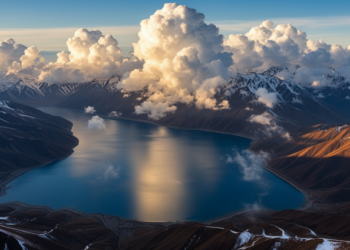
Idealized large-eddy simulations show that alpine lakes lower the barrier to convection on the Tibetan Plateau while downstream mountains lift ...
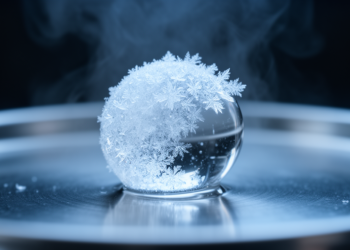
A particle-based modelling study shows homogeneous freezing of supercooled droplets proceeds gradually over a range of temperatures, with early ice ...
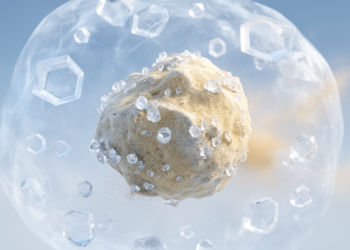
Laboratory experiments show that Tengger Desert dust freezes supercooled droplets efficiently, with ammonium sulfate aging raising median freezing temperatures by ...
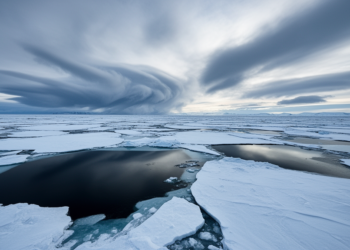
A 14-year analysis from the North Slope of Alaska confirms that sea ice openings feed moisture into coupled wintertime mixed-phase ...


Embark on a thrilling journey of discovery with Scienmag.com—your ultimate source for cutting-edge breakthroughs. Immerse yourself in a world where curiosity knows no limits and tomorrow’s possibilities become today’s reality!