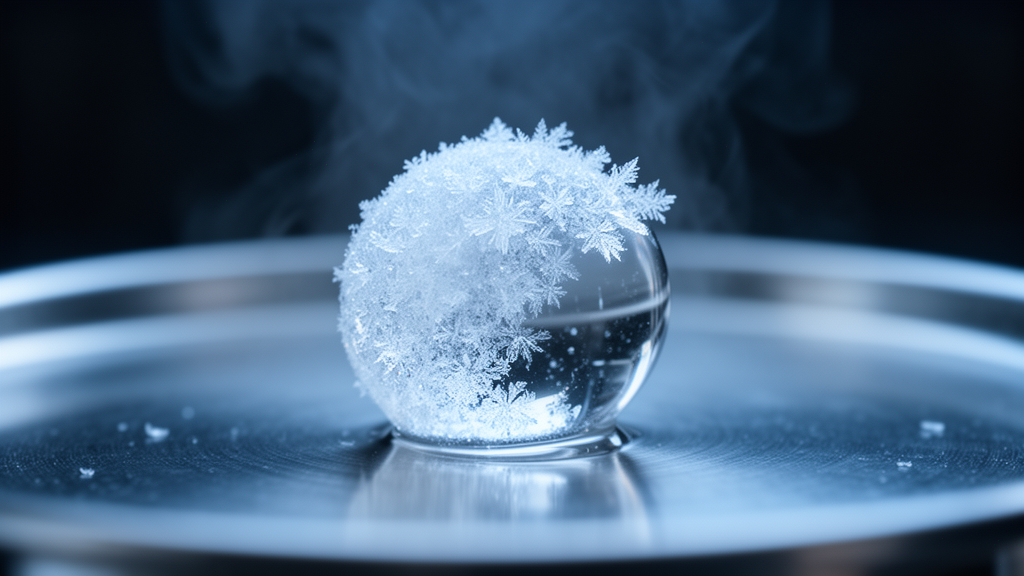
When supercooled cloud droplets turn to ice, most atmospheric models treat the process as a switch: once the temperature drops below roughly 235 Kelvin, or about minus 38 degrees Celsius, every micrometre-sized droplet freezes instantly. A new modelling study argues that this convenient shortcut misrepresents what actually happens. Using an open-source particle-based microphysics model, researchers implemented homogeneous freezing as a stochastic, time-dependent process and found that droplets freeze gradually across a range of temperatures, with the first ice crystals appearing at temperatures close to 240 K, several degrees warmer than the classical threshold.
The study, published in Geoscientific Model Development, was carried out by Tim Lüttmer and Peter Spichtinger of the Institute for Atmospheric Physics at Johannes Gutenberg University Mainz, together with Sylwester Arabas of AGH University of Krakow. They extended PySDM, a Python package that simulates populations of super-particles, each representing many real droplets or ice crystals, and demonstrated the new capabilities with version 3.0 of the model. The work is a model description paper: it presents idealised simulations in an adiabatically ascending air parcel, not observations of real clouds.
Homogeneous freezing matters because it governs how mixed-phase clouds, which contain both liquid droplets and ice, glaciate into pure ice clouds such as cirrus in the upper troposphere. Cirrus formed from freezing liquid droplets, the so-called liquid-origin pathway, differs in ice mass and crystal size from cirrus that forms directly from vapour, and those differences feed into radiative properties, precipitation and cloud evolution. In classical nucleation theory, the homogeneous nucleation rate Jhom describes how many critical ice embryos form per unit droplet volume per unit time, and it rises by more than five orders of magnitude between 240 and 235 K, an extremely sharp temperature dependence.
Rather than freezing all droplets at once below a threshold, the new implementation treats freezing as a Poisson process. At every time step, the probability that a droplet freezes depends on its volume, the elapsed time interval, and Jhom. A key consequence of this time dependence is that even small droplets, or droplets in states where the nucleation rate is low, will eventually freeze if given enough time. In the model, a Monte Carlo draw decides each super-particle’s fate at each step, and once freezing is initiated, all real droplets represented by that super-particle freeze together.
The researchers compared two parameterisations of the nucleation rate. The first, JHOM-T, depends only on temperature and represents the latest fit for pure water droplets, based on the work of Koop and Murray in 2016. The second, JHOM-DWA, reformulates that rate as a function of water activity, following Spichtinger and colleagues in 2023, and is also applicable to submicrometre aqueous solution droplets relevant for cirrus formation. The two formulations coincide at water saturation by construction, but they diverge strongly when the air becomes slightly supersaturated or subsaturated with respect to water, because the water-activity-based rate is highly sensitive to small deviations from saturation near 235 K.
In simulations without vapour deposition on ice, frozen droplets act as passive tracers and all droplets eventually freeze. Freezing occurred over a range from roughly 239 to 235 K, with the first events near 238 K. Faster updrafts pushed freezing temperatures lower, because droplets had less time to trigger a freezing event before reaching colder temperatures; for strong updrafts of 5 to 10 metres per second, representative of deep convection, some freezing temperatures fell below the classical 235 K threshold. Larger droplets froze at warmer temperatures, since the freezing probability scales with droplet volume: across the tested range of cloud condensation nuclei concentrations, the process rate for the largest droplets was about 90 times that of the smallest.
The picture changed dramatically when vapour deposition on ice was switched on, enabling the Wegener-Bergeron-Findeisen process, in which ice crystals grow at the expense of evaporating liquid droplets. Because the parcel was strongly supersaturated with respect to ice in the freezing temperature range, this driving force was exceptionally large. A few early-freezing droplets grew rapidly, depleted vapour, and drove the remaining liquid droplets to evaporate before they could freeze. Typically more than 90 percent of droplets evaporated without freezing, and the resulting ice number concentrations were far lower than a threshold formulation would predict, which in the absence of pre-existing ice or ice-nucleating particles overestimates the ice produced.
The choice of nucleation-rate parameterisation proved consequential. With deposition on ice active, the temperature-based JHOM-T rate produced substantially higher ice number concentrations than JHOM-DWA across the whole updraft range, which spanned more than 1.5 orders of magnitude in ice number with increasing updraft speed. The JHOM-DWA simulations showed broader freezing-temperature distributions and generally lower frozen fractions, because once subsaturation with respect to water developed, the water-activity-based rate dropped sharply for the remaining droplets, delaying further freezing. The authors caution that applying JHOM-DWA to micrometre-sized cloud droplets in mixed-phase conditions requires care, particularly in models that explicitly predict water saturation ratio rather than assuming saturation adjustment.
Statistical convergence also depended on the experimental design. Without vapour deposition on ice, 1000 super-particles sufficed to resolve the stochastic freezing events robustly; with deposition active, 10000 were needed for statistically robust freezing-temperature histograms, because the Wegener-Bergeron-Findeisen process amplifies the sensitivity to rare early freezing events. Notably, bulk quantities such as the final ice number concentration were already robust with 1000 super-particles. Switching from a monodisperse to a lognormal droplet size distribution broadened the freezing-temperature range slightly and produced two distinct modes in the distribution without deposition, but with deposition active the differences between monodisperse and lognormal spectra were largely smoothed out.
The authors emphasise the limitations of their highly idealised setup: a single air parcel with constant updraft, no turbulent mixing, no sedimentation, no coalescence, and no ice-nucleating particles or pre-existing ice. They argue the ice-free conditions are still relevant in situations such as rising cloud tops with high droplet concentrations. Their broader conclusion is that the widely used threshold formulation is defensible in one sense, since by 235 K most droplets have indeed frozen or evaporated, but it can either overestimate or underestimate the resulting ice number concentration depending on whether ice is already present. Representing homogeneous freezing stochastically, they suggest, is essential for capturing how mixed-phase clouds finally glaciate.
Subject of Research: Stochastic representation of homogeneous freezing of supercooled cloud droplets in an idealised particle-based microphysics model
Article Title: Stochastic homogeneous freezing of supercooled droplets in mixed-phase clouds in particle-based idealised microphysics framework (exemplified with PySDM v3.0)
Article References: Lüttmer, T., Arabas, S., & Spichtinger, P. (2026). Stochastic homogeneous freezing of supercooled droplets in mixed-phase clouds in particle-based idealised microphysics framework (exemplified with PySDM v3.0). Geoscientific Model Development, 19(20), 10185-10202. https://doi.org/10.5194/gmd-19-10185-2026
Image Credits: AI Generated
DOI: 10.5194/gmd-19-10185-2026
Keywords: homogeneous freezing, supercooled droplets, mixed-phase clouds, PySDM, ice nucleation, Wegener-Bergeron-Findeisen process, cirrus clouds, cloud microphysics, nucleation rate, air parcel model, glaciation, super-particles
Cite Scienmag News
Cecilia Raines. (October 28, 2026). Cloud Droplets Freeze Gradually, Not at a Single Threshold, Model Study Shows. Scienmag. https://scienmag.com/cloud-droplets-freeze-gradually-not-at-a-single-threshold-model-study-shows/
Cecilia Raines. "Cloud Droplets Freeze Gradually, Not at a Single Threshold, Model Study Shows." Scienmag, 28 October 2026, https://scienmag.com/cloud-droplets-freeze-gradually-not-at-a-single-threshold-model-study-shows/. Accessed 30 October 2026.
Cecilia Raines. "Cloud Droplets Freeze Gradually, Not at a Single Threshold, Model Study Shows." Scienmag. October 28, 2026. https://scienmag.com/cloud-droplets-freeze-gradually-not-at-a-single-threshold-model-study-shows/