


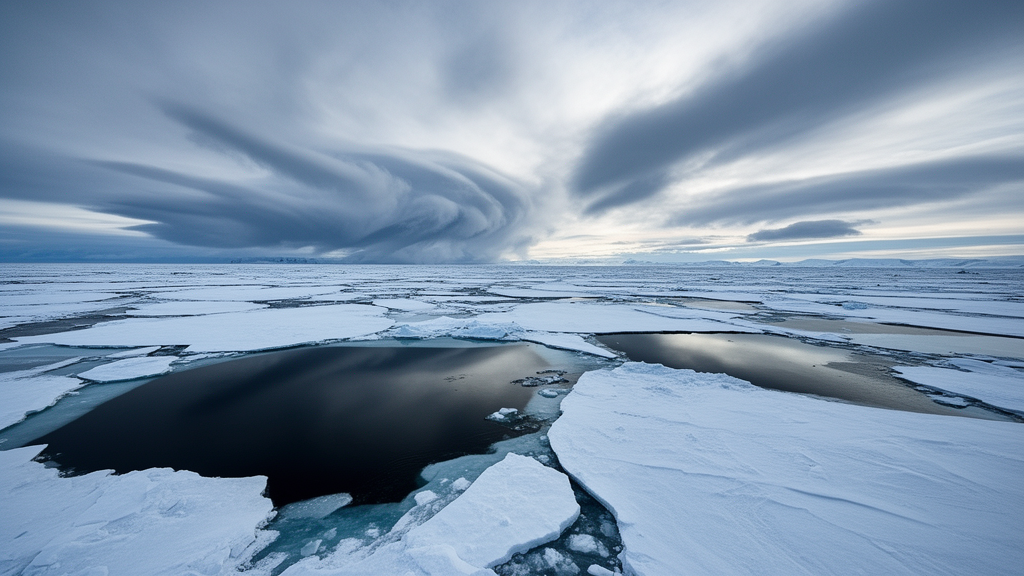
In the polar night, when the sun stays below the horizon for months, clouds over the Arctic exert a positive cloud radiative effect, trapping outgoing longwave radiation and enhancing surface warming in a way that contributes to sea ice decline. A new study published in Atmospheric Chemistry and Physics by Pablo Saavedra Garfias and Heike Kalesse-Los of Leipzig University has now traced how these wintertime mixed-phase clouds respond to the state of the sea ice beneath them, using fourteen consecutive winter seasons of observations from the North Slope of Alaska. The findings confirm, on a multi-year basis, a physical mechanism first identified during the MOSAiC expedition in the central Arctic, and they reveal long-term trends and cyclical patterns in cloud behaviour that short campaigns could never capture.
Arctic mixed-phase clouds are peculiar objects: they contain both supercooled liquid droplets and ice crystals coexisting at temperatures well below freezing. During the polar night they warm the surface and contribute to sea ice decline, and the strength of that effect depends sensitively on microphysical properties such as liquid water path, ice water path, and the effective sizes of droplets and ice particles. Because climate models still struggle to represent the thermodynamic phase partitioning and water paths of these clouds, long-term ground-based observations are among the most valuable constraints available for model evaluation. The Arctic itself is warming two to four times faster than the global average, a phenomenon known as Arctic amplification, and uncertainty in its magnitude persists largely because models cannot accurately simulate the sensitivity of sea ice loss to rising global temperatures.
The study draws on data from the U.S. Department of Energy’s Atmospheric Radiation Measurement (ARM) North Slope of Alaska site in Utqiaǵvik, covering winters from 1 November to 30 April between 2011 and 2024. The researchers combined the Ka-band zenith-pointing cloud radar, a Vaisala CL31 ceilometer, a dual-frequency microwave radiometer, and radiosonde profiles to characterize cloud properties using the Cloudnet target classification algorithm. Sea ice conditions came from the AMSR2 satellite sensor, which provides daily sea ice concentration at roughly 3.1 kilometre resolution over the Chukchi-Beaufort region surrounding the site. The team also had to correct for a known observational blind spot: low-level liquid clouds below the radar’s lowest detection range, which account for roughly 22.5 to 26 percent of observations at the site, were handled by extrapolating radar reflectivity down to the lidar’s lowest liquid detection altitude of 10 metres.
A central methodological innovation, adapted from the team’s earlier MOSAiC work, is the identification of the specific upstream sea ice sector that actually influences a given cloud. Rather than averaging sea ice concentration over the entire surrounding region, the authors define a narrow conical sector, six degrees wide and extending 50 kilometres upwind, aligned with the direction of maximum water vapour transport in the atmospheric boundary layer. This matters because sea ice conditions in the full semi-circle around the station can differ substantially from those in the upwind cone; using large-scale averages risks ill-posed correlations between ice and cloud properties.
The water vapour transport itself serves as a conveyor belt linking the ice surface to the cloud. When the vertical gradient of water vapour transport reaches a local maximum within the cloud mixing layer, the cloud is classified as coupled to the sea ice system; otherwise it is decoupled. This distinction proved decisive. For coupled clouds, liquid water path increased clearly as sea ice concentration decreased, levelling off at median values of roughly 80 to 120 grams per square metre when ice concentration fell below about 30 percent. Decoupled clouds showed no significant relationship with sea ice concentration at all, echoing the MOSAiC result and extending its validity to ice concentrations as low as 5 percent.
The physical explanation lies in enhanced latent and sensible heat fluxes from leads and polynyas, which promote convection and the release of sea salt aerosols. When these plumes couple to overlying clouds, they drive up the cloud water content. Consistent with this, the effective radii of both droplets and ice particles increased as sea ice concentration decreased in coupled cases, a dependence that the MOSAiC study had not detected. Cloud geometry responded too: coupled clouds grew shallower as the ice thinned, while the temperature lapse rate within the cloud layer shifted from occasionally inverted conditions over nearly complete ice cover toward a moist adiabatic profile over open water, indicating cooling with height and stronger convective mixing. Ice water path showed no consistent change with sea ice concentration overall, though coupled cases under high-pressure systems displayed a strong positive correlation with decreasing ice concentration.
Weather systems added another layer of structure. The authors classified observations by local surface pressure, distinguishing high- and low-pressure regimes, and found that cloud properties depended on both coupling status and the prevailing pressure system. High-pressure conditions favoured decoupled clouds, occurring 56.3 percent of the time over the study period. Under low-pressure systems, coupled clouds consistently showed lower liquid-layer cloud base heights than their decoupled counterparts across all ice concentrations, a difference that only appeared at high ice concentrations under high-pressure regimes.
The long-term time series revealed statistically significant trends, and here the choice of statistical method proved critical. A conventional moving-average regression and a harmonic model that accounts for cyclical signals sometimes disagreed, particularly for decoupled clouds whose properties oscillate on short periods. The most striking results concern coupled clouds under low-pressure systems: the abstract reports a coupled liquid water path increase of 35.0 plus or minus 0.9 grams per square metre per decade, a cloud base height rise of 44.0 plus or minus 0.7 metres per decade, and a cloud top temperature warming of 2.2 plus or minus 0.7 kelvin per decade. The moving-average method alone yielded a coupled liquid water path trend of 24.3 plus or minus 0.7 grams per square metre per decade under low pressure and 4.4 plus or minus 0.7 grams per square metre per decade under high pressure. Decoupled clouds, by contrast, showed no significant trend in liquid water path or cloud top temperature, while their cloud base height declined under low-pressure conditions.
Perhaps the most intriguing finding is the cyclical character of the cloud time series. Liquid water path peaks aligned with strong El Niño events in 2016 and 2023, while minima coincided with the La Niña years from 2020 to 2022. By fitting the data to harmonic models whose frequencies were drawn from Fourier analysis of the El Niño-Southern Oscillation, Pacific Decadal Oscillation, and Arctic Oscillation indices, the authors found that most cloud parameters are best explained by ENSO periods of 5.4 and 10.8 years and PDO periods of 6.5 and 10.8 years, with shorter Arctic Oscillation contributions of 2.3 to 2.9 years. Coupled clouds oscillated on longer cycles than decoupled ones. The authors are careful to note that while the evidence supports a link to these climate modes, establishing a direct causal connection remains non-trivial.
The implications reach beyond cloud physics. Analyses of surface skin temperature suggest that continued warming in the Western Arctic is attributable to low-pressure conditions over open or partially open water, whereas under high-pressure systems with nearly complete ice cover, cloud radiative effects on surface temperature actually decreased. The authors argue that Arctic climate models must capture this full complexity, incorporating not only small-scale moisture transport from leads to clouds but also weather patterns, large-scale circulation, and Arctic-lower latitude teleconnections. Limitations remain, including the lack of vertically resolved aerosol measurements at the site and the use of local pressure as a proxy for synoptic systems. Even so, the study demonstrates the value of sustained, high-quality Arctic monitoring networks, and it hands modellers a robust observational benchmark against which to test how well their simulations reproduce the interplay between sea ice and the clouds that warm it.
Subject of Research: Long-term modulation of wintertime Arctic mixed-phase clouds by sea ice conditions and climate oscillations
Article Title: Western Arctic wintertime mixed-phase clouds: Observed modulation by sea ice conditions, long-term variabilities and trends
Article References: Saavedra Garfias, P., & Kalesse-Los, H. (2026). Western Arctic wintertime mixed-phase clouds: Observed modulation by sea ice conditions, long-term variabilities and trends. Atmospheric Chemistry and Physics, 26(20), 14843-14865. https://doi.org/10.5194/acp-26-14843-2026
Image Credits: AI Generated
DOI: 10.5194/acp-26-14843-2026
Keywords: Arctic, mixed-phase clouds, sea ice, North Slope of Alaska, liquid water path, MOSAiC, ENSO, Pacific Decadal Oscillation, Arctic amplification, cloud radiative effect, water vapour transport, ARM
Cite Scienmag News
Bethany Barker. (October 24, 2026). Fourteen Winters of Alaskan Data Reveal How Sea Ice Openings Feed Arctic Wintertime Clouds. Scienmag. https://scienmag.com/fourteen-winters-of-alaskan-data-reveal-how-sea-ice-openings-feed-arctic-wintertime-clouds/
Bethany Barker. "Fourteen Winters of Alaskan Data Reveal How Sea Ice Openings Feed Arctic Wintertime Clouds." Scienmag, 24 October 2026, https://scienmag.com/fourteen-winters-of-alaskan-data-reveal-how-sea-ice-openings-feed-arctic-wintertime-clouds/. Accessed 24 October 2026.
Bethany Barker. "Fourteen Winters of Alaskan Data Reveal How Sea Ice Openings Feed Arctic Wintertime Clouds." Scienmag. October 24, 2026. https://scienmag.com/fourteen-winters-of-alaskan-data-reveal-how-sea-ice-openings-feed-arctic-wintertime-clouds/


