


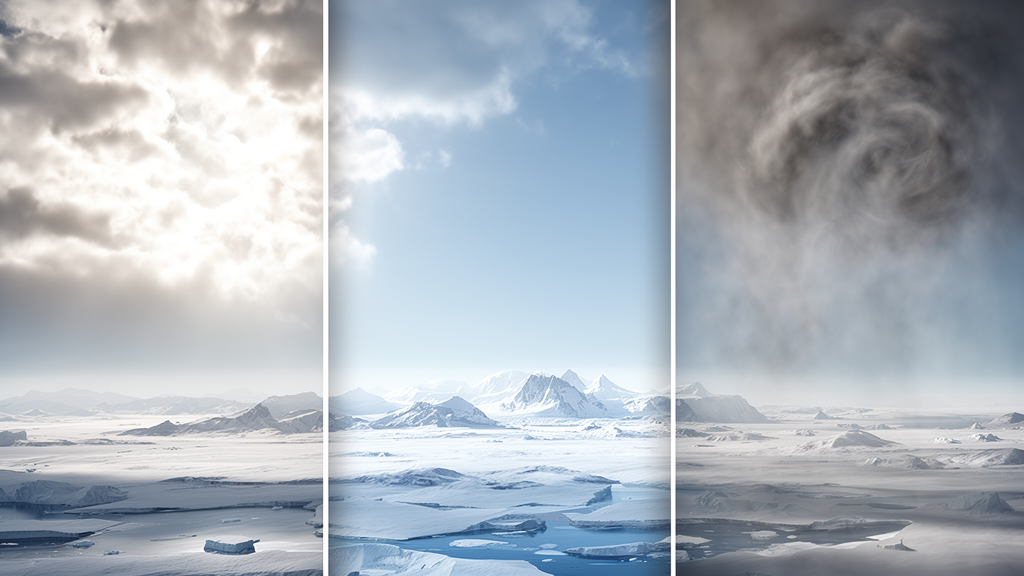
The Arctic is not a single uniform system when it comes to the tiny airborne particles that seed cloud droplets. A study published in the journal Nature Geoscience, led by researchers at the University of Helsinki’s Institute for Atmospheric and Earth System Research (INAR) in cooperation with several research institutes including the Finnish Meteorological Institute, shows that the region can be divided into three distinct regimes based on aerosol–cloud interaction: the High Arctic, the Maritime Arctic and the Continental Arctic. The High Arctic stands out from the other two because of its permanent ice cover, which affects the formation of aerosols in the air.
The particles in question are minute aerosols, some of which originate from trace gases in the atmosphere. As these particles grow, they can become cloud condensation nuclei, meaning particles on whose surface water vapour condenses into droplets. Understanding how many such nuclei exist, and where they come from, is central to predicting how Arctic clouds will behave as the region warms, yet the significance of aerosols formed from atmospheric trace gases has remained a key open question in a field where Arctic clouds count among the biggest unresolved problems in climate science.
The study’s estimates point in different directions depending on geography. As the climate becomes warmer, the number of naturally formed aerosols and cloud condensation nuclei is likely to increase in the ice-covered High Arctic. In contrast, a decline is likely in the open waters of the Maritime Arctic. In the Continental Arctic, the outcome depends less on global warming than on changes in human-generated air pollution in the coming decades. This geographic split is the study’s central finding, and it marks the first time that differences of this kind have been distinguished within the Arctic.
The researchers reached these conclusions by drawing on more than two decades of data on the size distribution of aerosols, compiled from eight measuring stations and several research expeditions across the Arctic. The aerosol data were paired with satellite observations and analysed using methods developed specifically for the study. The technical challenge underlying the field’s slow accumulation of knowledge is considerable: detecting newly formed nanometre-sized particles is difficult, and operating measuring equipment in the demanding conditions of the Arctic poses its own problems. Although the relevance of aerosols for cloud formation has been known for decades, knowledge of how the particles themselves form has accumulated more slowly for precisely these reasons.
The authors are careful to note that the study does not yet provide a definitive answer to how aerosols shape the Arctic climate. “The question is not just about whether the Arctic will get cloudier. You also have to ask where and how much?” says lead author Doctoral Researcher Samuel Chua of the University of Helsinki. The distinction matters because any projection of a cloudier Arctic future depends on where aerosol populations rise or fall, not simply on an Arctic-wide average.
According to the researchers, the work also underlines the value of sustained observation. “This study really emphasises the importance of continuous, long-term aerosol records at northern locations, such as the Finnish stations in Värriö and Pallas in Lapland,” says Professor Katrianne Lehtipalo from the University of Helsinki and the Finnish Meteorological Institute. “Only with a solid foundation of observational data can we build and use modern analytical tools, including AI-assisted satellite analyses.” The study was based on data and statistical analysis, and the article, titled “Contrasting aerosol–cloud feedbacks across a warming Arctic,” was published in Nature Geoscience.
Subject of Research: Aerosol–cloud interactions and the regional formation of cloud condensation nuclei across the Arctic
Article Title: Creation of cloud-forming aerosols varies across the Arctic
Article References: Creation of cloud-forming aerosols varies across the Arctic. Original publication (Bibliographic details unavailable.)
Image Credits: AI Generated
DOI: Not provided
Keywords: Arctic, aerosols, cloud condensation nuclei, aerosol-cloud interaction, climate change, Nature Geoscience, University of Helsinki, High Arctic, Maritime Arctic, Continental Arctic, long-term measurements, satellite observations
Cite Scienmag News
Russell Cooper. (October 24, 2026). Arctic split into three aerosol regimes with contrasting cloud-forming futures. Scienmag. https://scienmag.com/arctic-split-into-three-aerosol-regimes-with-contrasting-cloud-forming-futures/
Russell Cooper. "Arctic split into three aerosol regimes with contrasting cloud-forming futures." Scienmag, 24 October 2026, https://scienmag.com/arctic-split-into-three-aerosol-regimes-with-contrasting-cloud-forming-futures/. Accessed 24 October 2026.
Russell Cooper. "Arctic split into three aerosol regimes with contrasting cloud-forming futures." Scienmag. October 24, 2026. https://scienmag.com/arctic-split-into-three-aerosol-regimes-with-contrasting-cloud-forming-futures/


