


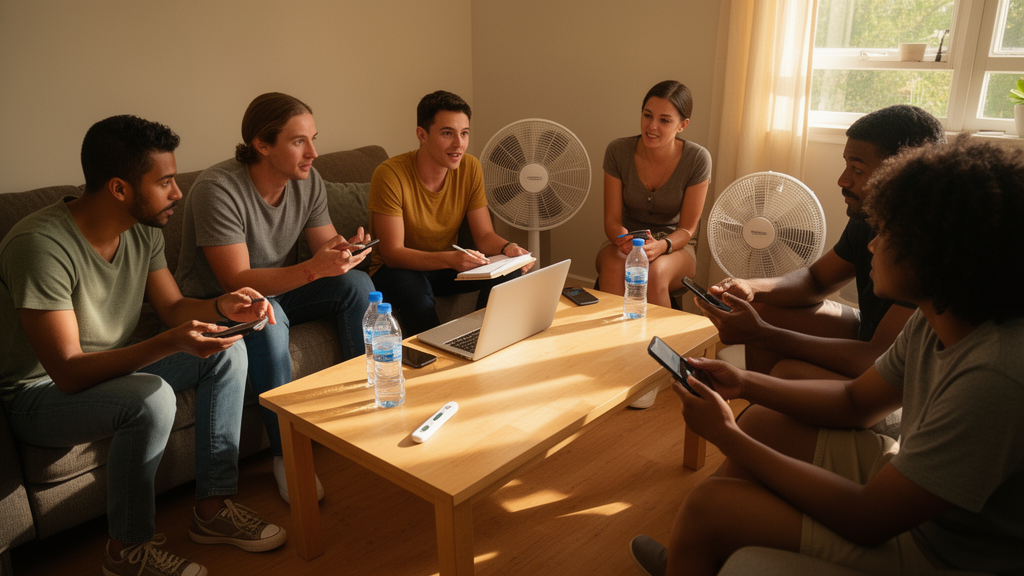
Two years ago, environmental health scientist Robbie M. Parks of Columbia University Mailman School of Public Health and Nathaniel Matthews-Trigg, director of climate and disaster resilience at Americares, founded an online community on Reddit called r/heat_prep, where members share information and advice about coping with extreme temperatures. Today the community has more than 20,000 members, and a new article in the Journal of Climate Change and Health details its growth, its concerns, and its potential to model how public health communicators might talk about climate change-related extreme heat and other health threats.
Parks, Matthews-Trigg and co-authors analyzed the most popular posts from r/heat_prep and administered a survey to its users. They found that engagement peaked during the Northern Hemisphere warm season, with posts centered on practical advice, personal experiences and improvised cooling strategies. Most survey respondents reported frequent heat discomfort along with associated physical and mental health effects, and they preferred Reddit for heat-related information over traditional channels. Community discussions highlighted low-cost adaptations, peer-driven innovation and emotional support delivered through humor and collective sense-making.
“As climate change intensifies extreme heat, lived experiences of hazardous conditions are increasingly documented in large online communities, which form global spaces where people discuss, experiment, and crowd-source strategies for responding to heat-related challenges,” the authors write. Across the content analyses and survey responses, a recurring pattern emerged: a disconnect between official heat-health guidance and the advice some people actively seek as temperatures rise.
According to the researchers, public health messaging around heat is often “technical, generalized, or conditional, which can limit its perceived usefulness and drive people toward online communities.” Institutions like the U.S. Centers for Disease Control and Prevention tend to emphasize a standard set of personal actions, such as staying in air-conditioned spaces, while offering limited guidance for people who cannot afford cooling, live in poorly insulated housing, or face disabilities or health-related constraints. To fill this gap, the authors argue, some people seek strategies better suited to their lived realities and material constraints.
On r/heat_prep, users share practical “hacks,” validate each other’s concerns and collectively evaluate solutions. One widely circulated thread compared low-cost shading materials for sun-exposed windows, showing how films, reflective blankets and cardboard shields could reduce indoor heat gain. Other posts recommended placing frozen water bottles in front of box fans to enhance cooling, or lining curtains with foil to reflect incoming solar radiation.
“Unlike largely unidirectional official heat communication, Reddit enables dialogue, peer feedback, and iterative problem-solving, bridging expert guidance and lived experiences,” the authors write. This interactive structure stands in contrast to the one-way flow of most institutional heat advisories, and it appears to be a central reason users turn to the platform when official messaging falls short of their needs.
The authors acknowledge that misinformation can spread on Reddit, but they note that active moderation can prevent it. They suggest that public health agencies team up with moderators “to seed accurate, accessible information directly into these spaces” through pinned posts and expert question-and-answer sessions, for example via Ask Me Anything events. Beyond correcting the record, the researchers see a second role for communities like r/heat_prep: they can function as an informal early warning system, revealing confusion, unmet needs and practical constraints that formal health communication may miss.
The article’s first author is Gabriela Imbert of Columbia University’s Graduate School of Arts and Sciences, with Parks as senior author. Additional authors include Kim R. van Daalen of the University of Cambridge and Matthews-Trigg. The authors declare that they have no known competing financial interests or personal relationships that could have appeared to influence the work reported in the paper. The study, based on survey research among community members, was published in the Journal of Climate Change and Health on 1 October 2026.
Subject of Research: Online community heat preparedness and health communication
Article Title: Can Reddit help strengthen health communications on extreme heat?
Article References: Can Reddit help strengthen health communications on extreme heat?. Original publication (Bibliographic details unavailable.)
Image Credits: AI Generated
DOI: Not provided
Keywords: Reddit, extreme heat, public health, climate change, heat preparedness, health communication, Columbia University, online communities, r/heat_prep, misinformation, help, strengthen
Cite Scienmag News
Sloane Callahan. (October 23, 2026). Reddit community r/heat_prep reveals gaps in official heat-health guidance. Scienmag. https://scienmag.com/reddit-community-r-heat_prep-reveals-gaps-in-official-heat-health-guidance/
Sloane Callahan. "Reddit community r/heat_prep reveals gaps in official heat-health guidance." Scienmag, 23 October 2026, https://scienmag.com/reddit-community-r-heat_prep-reveals-gaps-in-official-heat-health-guidance/. Accessed 23 October 2026.
Sloane Callahan. "Reddit community r/heat_prep reveals gaps in official heat-health guidance." Scienmag. October 23, 2026. https://scienmag.com/reddit-community-r-heat_prep-reveals-gaps-in-official-heat-health-guidance/


