

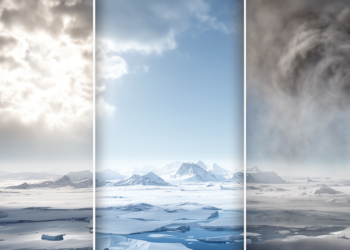
Arctic split into three aerosol regimes with contrasting cloud-forming futures
A two-decade analysis of Arctic aerosol measurements identifies three distinct regimes with contrasting trajectories for cloud-forming particles as the region ...
A two-decade analysis of Arctic aerosol measurements identifies three distinct regimes with contrasting trajectories for cloud-forming particles as the region ...

Measurements at a suburban site upwind of Delhi show new particle formation on 86 percent of valid summer days but ...
A diagnostic energy-budget method derived cloud-base water-vapor supersaturation from aircraft observations and broadly matched independent cloud-condensation-nuclei spectra over the Amazon ...
Five weeks of eddy covariance measurements over the High Arctic show that sea ice normally removes aerosol particles but can ...
An analysis of 149 tethered balloon flights during the DOE TRACER campaign over Houston reveals how marine, mixed, and urban ...
A new regional climate modeling study shows that replacing the fixed one-day aging timescale for black carbon with a dynamic, ...
Quantum chemical simulations by Danish researchers show that three atmospherically observed tricarboxylic acids, especially the flexible pinyl diaterpenylic ester, can ...
An eight-year synthesis of in situ measurements provides the first direct evidence that the Great Barrier Reef enriches the air ...
A landmark analysis of two decades of Arctic aerosol observations shows that warming will increase cloud-seeding particles in the ice-covered ...
Nearly three years of measurements at the Zeppelin Observatory on Svalbard reveal that the ratio of solar radiation to the ...

Embark on a thrilling journey of discovery with Scienmag.com—your ultimate source for cutting-edge breakthroughs. Immerse yourself in a world where curiosity knows no limits and tomorrow’s possibilities become today’s reality!