


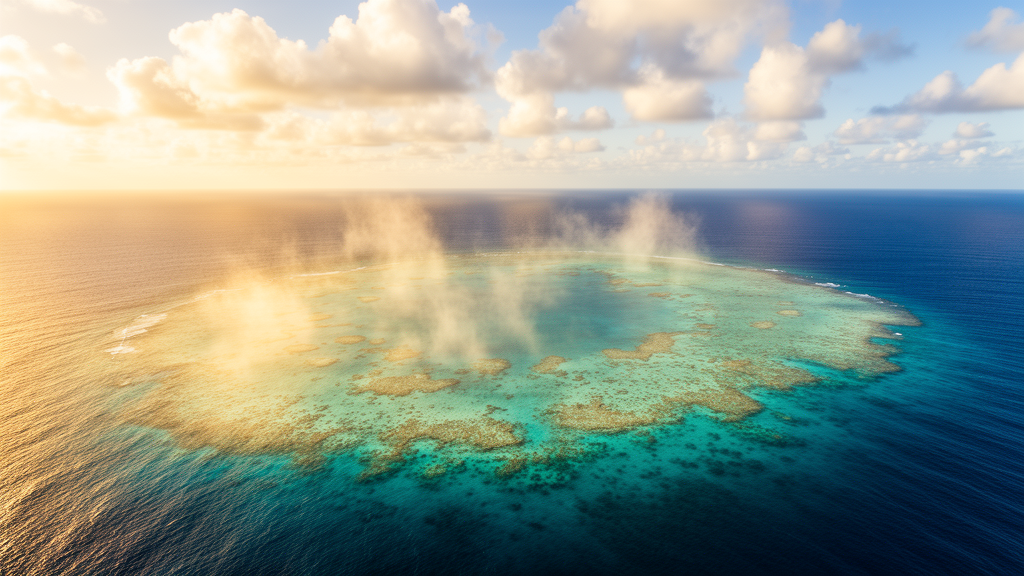
The Great Barrier Reef has long been celebrated as the largest living structure on Earth, a kaleidoscope of coral cays and lagoons stretching more than 2,300 kilometres along the Queensland coast. Now a team of Australian atmospheric scientists has shown that the reef is doing something far more subtle than sheltering fish and drawing tourists: it is quietly seeding the sky above it. In a study published in the journal Aerosol Research, researchers led by Juha Sulo of Queensland University of Technology present the first direct observational evidence that air masses passing over coral reefs carry measurably more ultrafine aerosol particles, and that these locally produced particles make a detectable contribution to the population of cloud condensation nuclei, the tiny specks on which cloud droplets form.
The finding matters because clouds over remote oceans are among the largest sources of uncertainty in climate science. Aerosol particles scatter sunlight directly and, indirectly, alter the brightness, lifetime, and extent of clouds by determining how many droplets a given amount of water vapour can condense onto. Combined aerosol-radiation and aerosol-cloud interactions are estimated to exert a net effective radiative forcing of roughly minus 1.3 watts per square metre on the global energy budget, masking about a third of the continental warming caused by greenhouse gases. In pristine marine environments, where particle concentrations are low, even modest local sources can exert a proportionally large climatic influence. Until now, however, nobody had quantified what the reef itself contributes to the air above it.
To close that gap, the team synthesised in situ measurements from multiple field campaigns conducted over eight years, spanning stationary platforms such as Heron Island and shipborne transects aboard the RV Investigator. The campaigns ranged from the Reef to Rainforest study in 2016 to a series of expeditions since 2021 conducted under the Reef Restoration and Adaptation Program’s Cooling and Shading Subprogram, which investigates ways to shield corals from bleaching by reducing downwelling solar radiation. The researchers harmonised the datasets to a 15-minute resolution and characterised particle number concentrations across a combined size range of 10 to 5,000 nanometres using condensation particle counters, scanning mobility particle sizers, and aerodynamic particle sizers, alongside cloud condensation nuclei counters operating at 0.5 percent supersaturation.
The baseline picture that emerged is of a clean coastal atmosphere. Total particle concentrations over the reef typically ranged between 100 and 800 particles per cubic centimetre, higher than the sub-200 values typical of remote marine air but consistent with a Southern Hemisphere coastal environment influenced by a mix of sources. Mode values were remarkably stable across campaigns: around 500 particles per cubic centimetre for total concentration, 250 per cubic centimetre for cloud condensation nuclei, and 120 per cubic centimetre for accumulation-mode particles between 80 and 1,000 nanometres. A Hoppel minimum, the telltale dip in the size distribution between Aitken and accumulation modes that signals cloud processing, appeared in 92 percent of the size distributions, indicating that most air reaching the reef had recently cycled through cloud.
The crucial discovery came from tracing where the air had been. Using 72-hour back trajectories computed with NOAA’s HYSPLIT model, the team calculated the fraction of time each air mass had spent over reef coordinates versus open ocean or the Australian continent. The result was unambiguous: when the Aitken-mode fraction of the particle population, covering particles between 20 and 80 nanometres, was enriched, the air masses had predominantly travelled over the reef rather than the open ocean. The effect held in both the central and southern reef, whether measurements were taken on a coral cay or at sea, and the longer an air mass lingered over reef waters, the more its small-particle fraction grew. Trajectories during these enrichment episodes also flew at lower altitudes, always within the marine mixing layer, maximising exposure to surface emissions.
To quantify how these small particles influence cloud formation, the researchers built a gradient boosting regression model, an ensemble machine-learning method that predicts cloud condensation nuclei concentrations from aerosol size distributions, composition proxies, and meteorological conditions. The model performed impressively, explaining over 90 percent of the variance in the test set. Accumulation-mode particle concentration emerged as the strongest predictor, followed by Aitken-mode concentration, which provided additional predictive information beyond what accumulation-mode abundance alone could explain. Sea surface temperature and the critical activation diameter also played statistically significant roles, while local meteorology contributed surprisingly little.
The team then applied a counterfactual modelling framework, asking what would happen to predicted cloud condensation nuclei concentrations if Aitken-mode particles were reduced to the first percentile of their observed distribution while everything else stayed constant. The answer: Aitken-mode particles contribute up to 6 percent of cloud condensation nuclei over the reef, with confidence intervals between roughly 4.6 and 5.9 percent. That may sound modest, but in clean marine air, where the CCN-accumulation-mode relationship weakens and composition and growth processes matter more, a six percent contribution from a biological source is far from trivial. The researchers suggest the mechanism resembles what atmospheric scientists call silent new particle formation, a low-intensity process largely invisible in standard surface plots that can only be teased out through statistical modelling and trajectory analysis.
The chemistry adds another layer of intrigue. The hygroscopicity parameter kappa, which describes how readily particles take up water, varied dramatically between campaigns. Measurements from December 2021 showed values often exceeding 0.7, pointing to a substantial inorganic fraction, while the 2023 campaign on Heron Island, the only one conducted directly on a coral cay, yielded kappa values mostly below 0.2, indicating predominantly organic particles. That stark contrast suggests local biogenic emissions, likely including the volatile organic compounds and dimethyl sulfide that corals and reef algae are known to release, play a key role in particle growth over coral cays. This connects to the decades-old CLAW hypothesis, which proposed a feedback loop in which warmer oceans emit more dimethyl sulfide, generating more particles, brighter clouds, and ultimately cooler surfaces. The new data do not confirm that loop, but they show reef emissions genuinely feeding the particle population.
Not everything over the reef comes from below. The highest cloud condensation nuclei concentrations were associated with air masses that had spent considerable time over the Australian continent, arriving depleted in Aitken-mode particles but loaded with accumulation-mode aerosols and lacking a Hoppel minimum, signatures of long-range continental transport rather than marine production. Roughly two-thirds of air masses had experienced precipitation in the preceding 24 hours, which scavenged particles and lowered concentrations. The 2016 campaign, conducted during an exceptionally strong El Nino, recorded the highest concentrations of all, though the authors caution that the available data do not permit direct attribution to that climate mode.
The implications extend beyond curiosity. Coral reef contributions to aerosols are not explicitly represented in climate models, and this study offers a novel constraint for regional modelling and a foundation for incorporating reef biogenic processes into Earth system models. It also carries practical weight for the Reef Restoration and Adaptation Program: because cloud condensation nuclei concentrations over the reef are sensitive to air mass history and aerosol dynamics, the effectiveness of any future marine cloud brightening or cooling intervention will vary considerably in space and time. The authors argue that consistent long-term atmospheric monitoring at fixed locations is essential, both for understanding the reef’s natural aerosol processes and for evaluating whether humanity can realistically borrow the reef’s own cloud-seeding trick to help it survive a warming century. The same analytical approach, they note, could be extended to other biologically active marine systems that may be similarly underappreciated regional sources of cloud-forming particles.
Subject of Research: Coral reef emissions of aerosol particles and cloud condensation nuclei over the Great Barrier Reef
Article Title: Coral reef exposure increases aerosol and cloud condensation nuclei over the Great Barrier Reef
Article References: Sulo, J., Okuljar, M., Alroe, J., Li, Z., Horchler, E. J., Cravigan, L., Miljevic, B., Harrison, L., Harrison, D., & Ristovski, Z. (2026). Coral reef exposure increases aerosol and cloud condensation nuclei over the Great Barrier Reef. Aerosol Research, 4(2), 413-427. https://doi.org/10.5194/ar-4-413-2026
Image Credits: AI Generated
Keywords: Great Barrier Reef, coral reefs, aerosols, cloud condensation nuclei, new particle formation, Aitken mode, marine atmosphere, dimethyl sulfide, climate modelling, HYSPLIT back trajectories, gradient boosting, aerosol-cloud interactions
Cite Scienmag News
Russell Cooper. (October 9, 2026). Great Barrier Reef Itself Seeds the Air With Cloud-Forming Particles, Eight-Year Study Finds. Scienmag. https://scienmag.com/great-barrier-reef-itself-seeds-the-air-with-cloud-forming-particles-eight-year-study-finds/
Russell Cooper. "Great Barrier Reef Itself Seeds the Air With Cloud-Forming Particles, Eight-Year Study Finds." Scienmag, 9 October 2026, https://scienmag.com/great-barrier-reef-itself-seeds-the-air-with-cloud-forming-particles-eight-year-study-finds/. Accessed 9 October 2026.
Russell Cooper. "Great Barrier Reef Itself Seeds the Air With Cloud-Forming Particles, Eight-Year Study Finds." Scienmag. October 9, 2026. https://scienmag.com/great-barrier-reef-itself-seeds-the-air-with-cloud-forming-particles-eight-year-study-finds/


