

Monday, October 26, 2026
Science
No Result
View All Result
  • Login
  • HOME
  • SCIENCE NEWS
  • CONTACT US
  • HOME
  • SCIENCE NEWS
  • CONTACT US
No Result
View All Result
Scienmag
No Result
View All Result
Home Science News Technology and Engineering

SnSb-silicon oxide anode sustains storage at temperatures down to −40 °C

October 26, 2026
in Technology and Engineering
Denise Maddox
By Denise Maddox Scienmag Editorial Profile - Mechanical Engineering
Reading Time: 2 mins read
0
SnSb-silicon oxide anode sustains storage at temperatures down to −40 °C

SnSb-silicon oxide anode sustains storage at temperatures down to −40 °C

65
SHARES
587
VIEWS
Share on FacebookShare on Twitter
ADVERTISEMENT

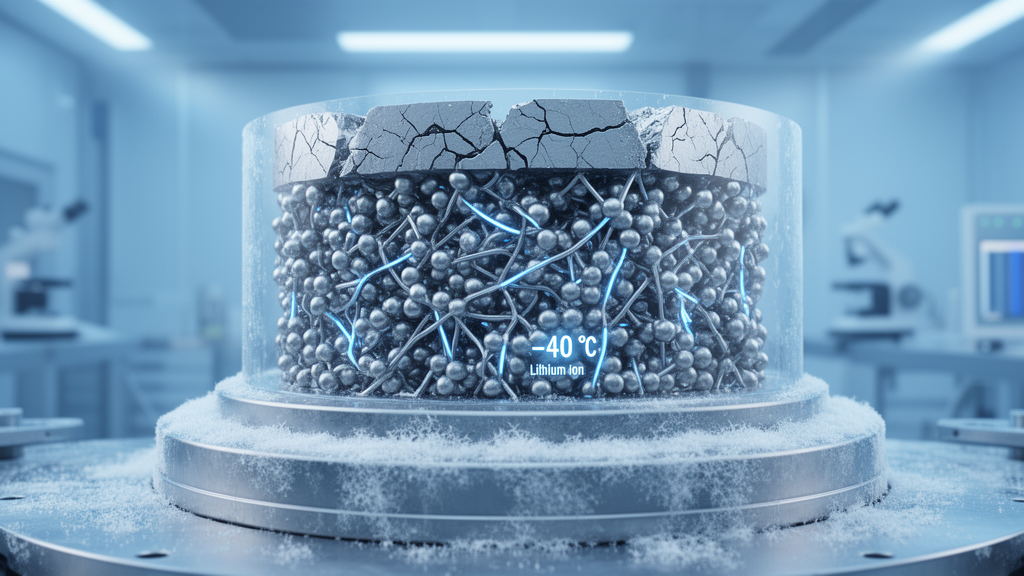
A laboratory composite anode combining silicon oxide, carbon and a tin-antimony alloy retained approximately 1,000 milliamp-hours per gram after 500 charge-discharge cycles and continued to store lithium at temperatures as low as −40 °C. The optimized material, designated SSNC-10, therefore combined long-cycle performance with low-temperature adaptability in electrode-level tests reported in the Journal of Materials Science.

Silicon oxide, or SiOx, has attracted attention as an anode material because of its high theoretical specific capacity. Its practical deployment, however, is constrained by low initial Coulombic efficiency, poor electronic conductivity and unsatisfactory rate capability. The researchers addressed these limitations by fabricating a hierarchical SiOx/C-SnSb@NC composite through in situ alloying and nitrogen-doped carbon encapsulation. Its design combines a homogeneously dispersed SnSb bimetallic-alloy network with a protective carbon layer in an attempt to modify both the electrical and structural behavior of the electrode.

According to the study, the SnSb network improves electronic conductivity and alleviates electrode polarization. The researchers also report that the stepwise lithiation behavior of SiOx and SnSb works collaboratively to buffer volume expansion and suppress structural pulverization and interfacial side reactions. Together, these effects are credited with producing the composite’s improved cycling performance. SSNC-10 maintained a reversible capacity of about 1,000 mAh g−1 after 500 cycles at a current density of 0.5 A g−1, demonstrating sustained lithium storage under the reported laboratory test conditions.

The same optimized electrode also showed measurable performance in cold environments. It maintained a stable reversible capacity of 450 mAh g−1 after 100 cycles at −20 °C. It delivered considerable capacities of 300 mAh g−1 and 190 mAh g−1 at −30 °C and −40 °C, respectively. These results establish that SSNC-10 remained electrochemically active across the reported subzero range, although the supplied abstract does not specify details such as the corresponding current densities for each low-temperature measurement. The work is an electrode-material study rather than a demonstration in a complete commercial battery cell, and the available evidence does not provide full-cell energy density, calendar-aging performance, temperature-cycling results or manufacturing-scale assessment. Within that scope, the authors present the composite as a feasible structural design for high-capacity, low-temperature-tolerant and long-cycle silicon-based anodes intended for lithium-ion battery applications.

Subject of Research: Laboratory development of a SnSb-decorated SiOx/C@NC anode for long-cycle and low-temperature lithium storage.

Article Title: SnSb alloy decorated SiOx/C@NC anodes for robust lithium storage and low-temperature adaptability

Article References: Xu, X., Tu, W., Xu, S., Sun, S., Ruan, X., Yu, S., Zhang, H., & Wang, Y. (2026). SnSb alloy decorated SiOx/C@NC anodes for robust lithium storage and low-temperature adaptability. Journal of Materials Science, 61(40), 31097-31114. https://doi.org/10.1007/s10853-026-13642-7

Image Credits: AI Generated

DOI: 10.1007/s10853-026-13642-7

Keywords: lithium-ion batteries, silicon oxide anode, SnSb alloy, nitrogen-doped carbon, low-temperature operation, lithium storage, electrode materials, cycling stability, SnSb, alloy, decorated, SiOx

Cite Scienmag News

Denise Maddox. (October 26, 2026). SnSb-silicon oxide anode sustains storage at temperatures down to −40 °C. Scienmag. https://scienmag.com/snsb-silicon-oxide-anode-sustains-storage-at-temperatures-down-to-%e2%88%9240-c/


Denise Maddox. "SnSb-silicon oxide anode sustains storage at temperatures down to −40 °C." Scienmag, 26 October 2026, https://scienmag.com/snsb-silicon-oxide-anode-sustains-storage-at-temperatures-down-to-%e2%88%9240-c/. Accessed 26 October 2026.

Denise Maddox. "SnSb-silicon oxide anode sustains storage at temperatures down to −40 °C." Scienmag. October 26, 2026. https://scienmag.com/snsb-silicon-oxide-anode-sustains-storage-at-temperatures-down-to-%e2%88%9240-c/

Tags: alloycycling stabilitydecoratedelectrode materialslithium storagelithium-ion batterieslow-temperature operationnitrogen-doped carbonsilicon oxide anodeSiOxSnSbSnSb alloy
Share26Tweet16
Previous Post

Benzo[a]pyrene Damages Mouse Ovaries and Expands Cancer Stem-Like Progenitor Populations

Next Post

Soil salinity varies by depth across Hetao Irrigation District

Related Posts

Research report: Preparation of N,P-synergistic flame-retardant phase change materials and their application for thermal management of lithium-ion batteries
Technology and Engineering

Research report: Preparation of N,P-synergistic flame-retardant phase change materials and their application for thermal management of lithium-ion batteries

October 26, 2026
Research report: External-catalyst-free transcarbamoylation in hydroxyurethane-modified epoxy vitrimer: enabling ultra-tough, rapidly welding, and self-healing carbon fiber/epoxy composites
Technology and Engineering

Research report: External-catalyst-free transcarbamoylation in hydroxyurethane-modified epoxy vitrimer: enabling ultra-tough, rapidly welding, and self-healing carbon fiber/epoxy composites

October 26, 2026
Lab study links XPS charge neutralization to shifts on a graphite anode
Technology and Engineering

Lab study links XPS charge neutralization to shifts on a graphite anode

October 26, 2026
Smartphone AI app guides strawberry nitrogen fertigation from leaf photos alone
Technology and Engineering

Smartphone AI app guides strawberry nitrogen fertigation from leaf photos alone

October 26, 2026
Research report: Bayesian optimization-driven exploration of process–structure–property relationship for polyethylene composite films
Technology and Engineering

Research report: Bayesian optimization-driven exploration of process–structure–property relationship for polyethylene composite films

October 26, 2026
High-speed impactor tests mirror passenger airbag door opening only in early phase
Technology and Engineering

High-speed impactor tests mirror passenger airbag door opening only in early phase

October 26, 2026
Next Post
Soil salinity varies by depth across Hetao Irrigation District

Soil salinity varies by depth across Hetao Irrigation District

  • Mothers who receive childcare support from maternal grandparents show more optimized

    Mothers who receive childcare support from maternal grandparents show more parental warmth, finds NTU Singapore study

    27656 shares
    Share 11059 Tweet 6912
  • University of Seville Breaks 120-Year-Old Mystery, Revises a Key Einstein Concept

    1061 shares
    Share 424 Tweet 265
  • Bee body mass, pathogens and local climate influence heat tolerance

    682 shares
    Share 273 Tweet 171
  • Researchers record first-ever images and data of a shark experiencing a boat strike

    546 shares
    Share 218 Tweet 137
  • Groundbreaking Clinical Trial Reveals Lubiprostone Enhances Kidney Function

    531 shares
    Share 212 Tweet 133
Science

Embark on a thrilling journey of discovery with Scienmag.com—your ultimate source for cutting-edge breakthroughs. Immerse yourself in a world where curiosity knows no limits and tomorrow’s possibilities become today’s reality!

RECENT NEWS

  • Soil salinity varies by depth across Hetao Irrigation District
  • SnSb-silicon oxide anode sustains storage at temperatures down to −40 °C
  • Benzo[a]pyrene Damages Mouse Ovaries and Expands Cancer Stem-Like Progenitor Populations
  • PLOS One retracts Cissus tuberosa study after table, image and data concerns

Categories

  • Agriculture
  • Anthropology
  • Archaeology
  • Athmospheric
  • Biology
  • Biotechnology
  • Blog
  • Bussines
  • Cancer
  • Chemistry
  • Climate
  • Earth Science
  • Editorial Policy
  • Marine
  • Mathematics
  • Medicine
  • Pediatry
  • Policy
  • Psychology & Psychiatry
  • Science Education
  • Science News
  • Social Science
  • Space
  • Technology and Engineering

Subscribe to Blog via Email

Enter your email address to subscribe to this blog and receive notifications of new posts by email.

Join 5,151 other subscribers

© 2025 Scienmag - Science Magazine

Welcome Back!

Login to your account below

Forgotten Password?

Retrieve your password

Please enter your username or email address to reset your password.

Log In
No Result
View All Result
  • HOME
  • SCIENCE NEWS
  • CONTACT US

© 2025 Scienmag - Science Magazine

Discover more from Science

Subscribe now to keep reading and get access to the full archive.

Continue reading