


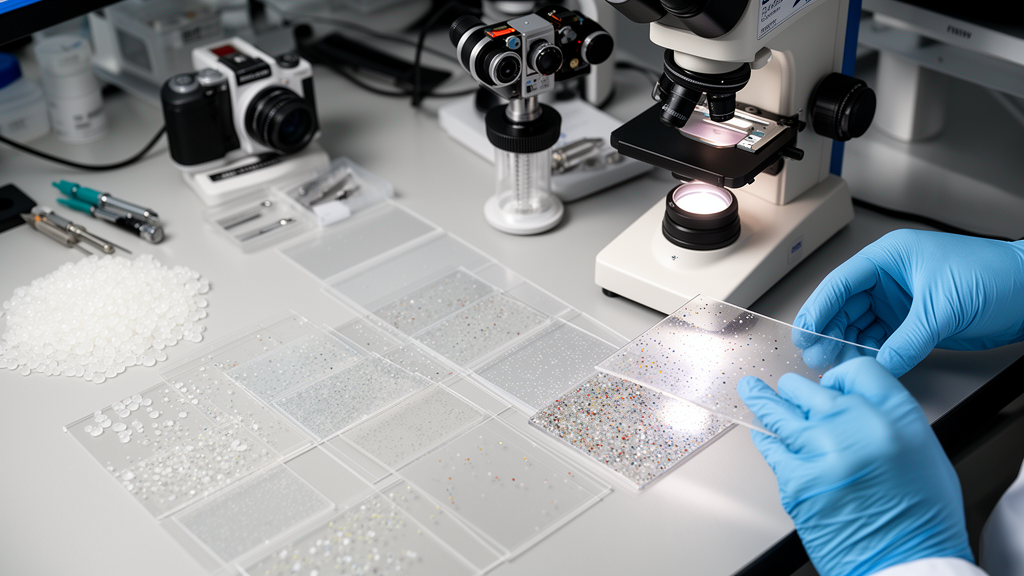
Researchers used multi-objective Bayesian optimization to tune polyethylene composite films for two competing mechanical goals: high tensile strength and substantial elongation at break. The films combined ultra-high-molecular-weight polyethylene with a small amount of thermally reduced graphene oxide, or TrGO. By changing the temperature and ratio of a hot-drawing process, the team mapped a trade-off between the material’s ability to bear load and its capacity to deform.
Their experiments identified a Pareto front linking the properties, while structural measurements connected the differences to molecular alignment, crystallinity and crystallite growth. This experimental materials study focused on two processing variables that affect the arrangement of polyethylene chains: drawing temperature, from 80 to 110 degrees Celsius, and drawing ratio, from 20 to 120. The temperature interval provided enough chain mobility for plastic deformation without melting the polymer.
A minimum drawing ratio of 20 supported uniform film formation on the custom drawing machine, while ratios above 120 caused severe filament splitting and loss of film integrity. The researchers therefore explored a constrained processing window rather than the full theoretical combination of temperatures and ratios. The starting cast film was prepared from xylene containing 1.5 weight percent ultra-high-molecular-weight polyethylene, 0.1 weight percent TrGO relative to the polyethylene and 0.1 weight percent of the antioxidant butylated hydroxytoluene, or BHT.
These materials were ultrasonically dispersed, heated with magnetic stirring to form a uniform gel, cast onto a substrate and dried. The cast material was then cut into strips and hot-drawn. TrGO had been used in earlier work to increase polyethylene strength, but the central challenge here was determining how two drawing parameters could jointly tune strength and deformability with fewer experiments than an exhaustive search would require.
Testing every combination in the two-dimensional processing space would have involved more than 800 conditions. Instead, the optimization search used 25 experiments: 10 initial conditions selected by Latin hypercube sampling and 15 additional conditions chosen iteratively. The researchers trained separate Gaussian-process models to predict tensile strength and elongation at break.
Both models used a radial basis function kernel, with the length-scale hyperparameter estimated by maximizing marginal log-likelihood, and leave-one-out cross-validation was used to assess the surrogate models. A noisy expected hypervolume improvement acquisition function incorporated experimental uncertainty and selected the next condition to test. After each experiment, the new results were added to the training set, the Gaussian-process models were updated and the acquisition function was optimized to recommend another fabrication condition.
The researchers also used grid predictions and non-dominated sorting to construct a Pareto front between tensile strength and elongation at break. Convergence was monitored with hypervolume, defined in the study as the area enclosed by the predicted front and the reference point at zero for both properties. The relative change in hypervolume fell below 2 percent after the 12th iteration, and the optimization was stopped at the 15th iteration.
The final front extended from a low-strength, high-elongation regime to a high-strength, low-elongation regime. The modeled pattern showed that high tensile strength was concentrated near a drawing ratio of about 100, where stretching aligned and reorganized substantial portions of the polymer chains. High elongation tended to occur at ratios below 25.
Across the investigated range, drawing ratio had a stronger effect than drawing temperature. The initial 10 measurements produced a leave-one-out R-squared of 0.92 for the elongation model, but this fell to 0.70 after 15 new experiments were added. The researchers cautioned that the decline did not necessarily signify model degradation: the expanded dataset explored a wider input space and exposed greater variability in low-drawing-ratio samples that was less apparent in the initial measurements.
Film geometry helped explain why the two properties behaved differently at different processing settings. At low drawing ratios, the film edges acted as free boundaries during stretching, creating an imbalance in transverse stress and neck-in. The center could therefore receive more drawing than the edges, leaving a thickness gradient across the film and producing substantial variation in elongation among specimens taken from different lateral positions.
Tensile strength was less affected because the measured force was normalized by cross-sectional area. At high drawing ratios, chain orientation approached saturation and transverse contraction was suppressed, reducing differences in effective drawing ratio and thickness across the width. At those settings, however, localized microstructural damage could increase variation in tensile-strength measurements.
Four films representing different portions of the modeled trade-off were examined alongside the original cast material. Polarized optical microscopy showed that stronger drawing produced greater optical anisotropy and a stronger birefringence signal. Cast film was comparatively isotropic, with randomly oriented chains, and measured about 120 micrometers thick.
The drawn films were more transparent and only 2 to 5 micrometers thick, reflecting both reduced thickness and a more ordered microstructure. Rotating a drawn specimen to 45 degrees relative to the incident polarization produced stronger brightness contrast, supporting the interpretation that drawing had induced preferential chain orientation. Polarized Raman spectroscopy provided a quantitative measure of that alignment.
The investigators examined the polyethylene band near 1,130 reciprocal centimeters, which is sensitive to chain orientation. The cast film showed little dependence on polarization or sample angle, whereas every drawn film reached maximum band intensity near 0 and 180 degrees under parallel polarization, consistent with alignment along the drawing axis. The second-order orientation parameter, which approaches zero for random chains and one for strong alignment, rose from values near zero in the cast film to substantially positive values in all drawn samples.
After temperature and drawing ratio were rescaled to the interval from zero to one, their regression coefficients were 0.08 and 0.14, respectively, suggesting that drawing ratio was the more influential factor within the tested processing window. X-ray diffraction showed a marked change in the crystalline structure. The cast film had weak crystalline peaks and a pronounced amorphous background, corresponding to a measured crystallinity of 23.5 percent.
Drawing made the polyethylene diffraction peaks sharper and more intense, and crystallinity reached a maximum of 99.2 percent. Total crystallinity changed little among the already highly crystalline drawn films, indicating that this measure was close to saturation across the selected conditions. Crystallite size, however, increased clearly with drawing ratio.
At a fixed ratio, a higher drawing temperature also increased the intensity of the (200) peak relative to the (110) peak, indicating temperature-assisted preferential crystallization along the (200) plane. These structural measurements provided a mechanistic link to the mechanical trends. Tensile strength was positively associated with the second-order orientation parameter and with crystallite size, especially the size associated with the (200) plane.
Greater chain alignment allows load to be transferred more efficiently along the polymer’s covalent backbone, while the growth of larger crystalline domains accompanied the observed strength increase. Elongation at break was negatively associated with crystallite size. Films drawn at lower temperatures and ratios retained less orientation, finer domains and more deformable regions, allowing greater chain mobility during deformation.
The ratio of the two crystalline diffraction peaks did not show a monotonic relationship with either mechanical property, so plane-selective crystallization was a structural finding rather than a stand-alone predictor of performance. The researchers assessed the final modeled front with four additional experiments selected from regions not previously used during optimization. These held-out results fell slightly toward the lower-left of the front, consistent with a mild optimistic bias in a frontier assembled from model-selected observations.
The work is a compact experimental demonstration of an iterative machine-learning strategy, not a universal processing rule. Its findings apply to the tested polyethylene–TrGO formulation, 2-millimeter-wide specimens and controlled hot-drawing window. Because the films were ultrathin and had limited dimensions, the researchers used metal-tab specimens rather than standardized tensile-test geometry.
Within those constraints, the study shows that uncertainty-aware optimization can efficiently map a strength–deformability landscape and relate processing conditions to molecular orientation, crystalline structure and macroscopic film performance.
Subject of Research: Machine-learning optimization of strength and elongation in polyethylene composite films
Article Title: Bayesian optimization-driven exploration of process–structure–property relationship for polyethylene composite films
Article References: Gu, Z., Yang, K., Paulsen, B. D., Rosenberger, M. R., Chang, H., Moon, S., & Luo, T. (2026). Bayesian optimization-driven exploration of process–structure–property relationship for polyethylene composite films. Journal of Materials Science, 61(40), 30875-30889. https://doi.org/10.1007/s10853-026-13627-6
Image Credits: AI Generated
DOI: 10.1007/s10853-026-13627-6
Keywords: polyethylene composites, Bayesian optimization, machine learning, hot drawing, tensile strength, elongation at break, polymer orientation, crystallinity, graphene oxide, materials design, Bayesian, optimization-driven
Cite Scienmag News
Neil Sanderson. (October 26, 2026). Research report: Bayesian optimization-driven exploration of process–structure–property relationship for polyethylene composite films. Scienmag. https://scienmag.com/research-report-bayesian-optimization-driven-exploration-of-process-structure-property-relationship-for-polyethylene-composite-films/
Neil Sanderson. "Research report: Bayesian optimization-driven exploration of process–structure–property relationship for polyethylene composite films." Scienmag, 26 October 2026, https://scienmag.com/research-report-bayesian-optimization-driven-exploration-of-process-structure-property-relationship-for-polyethylene-composite-films/. Accessed 26 October 2026.
Neil Sanderson. "Research report: Bayesian optimization-driven exploration of process–structure–property relationship for polyethylene composite films." Scienmag. October 26, 2026. https://scienmag.com/research-report-bayesian-optimization-driven-exploration-of-process-structure-property-relationship-for-polyethylene-composite-films/


