


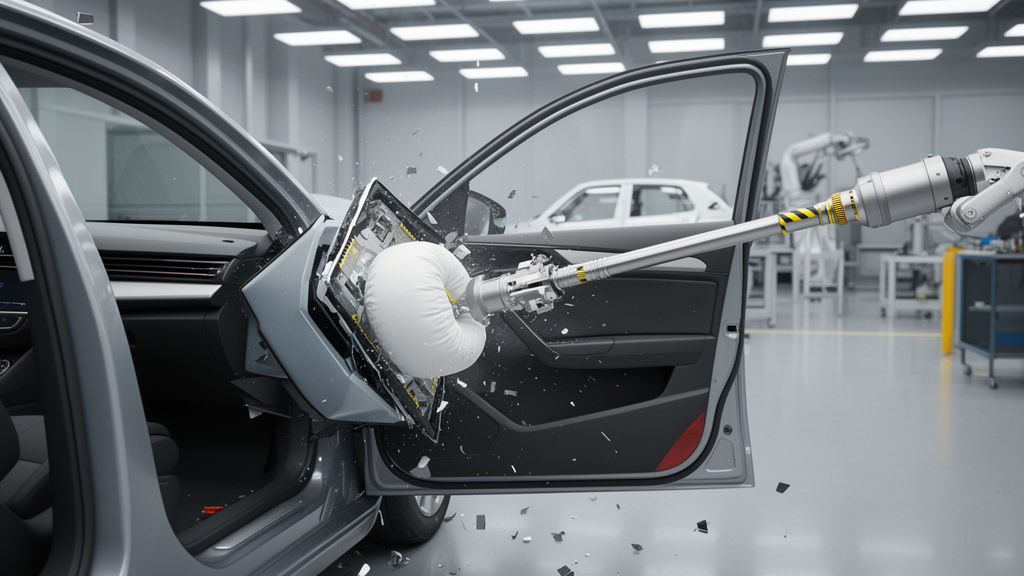
Passenger airbags have saved an estimated 70,059 lives in the United States since their introduction up to 2019, yet the engineering behind the flap of trim that hides them remains surprisingly difficult to get right. Before a crash ever happens, the passenger airbag must sit concealed beneath a smooth instrument panel surface that also satisfies head impact rules such as FMVSS 201 and UN R21. Within milliseconds of deployment, that surface must tear open in a controlled way so the cushion can inflate reliably, without shedding particles or debris, across temperatures from minus 35 to 85 degrees Celsius. A new laboratory study has now put one of the industry’s standard shortcuts to the test, asking whether a simple mechanical impactor can genuinely stand in for a live airbag blast when engineers develop and validate the computer simulations that design these doors.
The instrument panel, or IP, is the dashboard structure that houses the steering column, displays and, on the passenger side, the airbag module. The airbag housing is screwed or hooked to a chute inside the panel, and the visible surface is pre-weakened along a groove so that it tears at a defined location and force. This weakening can be molded in during injection molding or added afterwards by milling, an ultrasonic knife or laser scoring, with laser scoring the most widely used method. Modern vehicles often hide the door beneath an intact second layer, and the hinge that holds it, whether a slack fabric loop, a tension-controlled fabric reserve, a kink-hinge, steel plates or a tether, must let the door open without detaching and endangering occupants. Door shapes vary too, from single U-doors to symmetrical H-doors and double Y-doors.
To verify that such systems will work, manufacturers fire complete airbag modules mounted on rigid test stands, and they also run impactor tests in which a solid body punctures the panel instead of an actual airbag. Impactor tests have been performed at velocities of 2, 4, 6.2 and 6.7 metres per second in earlier studies, and there is no standardized speed. Their appeal is isolation: removing the gas generator and the cushion lets researchers study the opening mechanism alone. The catch, as the authors of the new work point out, is that nobody had previously demonstrated that impactor tests actually reproduce the behavior seen in real deployment tests, leaving their applicability uncertain. The team therefore set out to find which impactor velocity best matches deployment, how far the resemblance extends, and how the suitability of the surrogate should be assessed.
The experiments used segments from two vehicles, labeled Instrument Panel A and Instrument Panel B, both covered with a thermoplastic olefin bilaminate consisting of a polypropylene foam layer and a thermoformed TPO skin, a material growing in popularity for interiors. Instrument Panel A was cut from a complete assembly and featured symmetrical H-doors hinged by a free mesh loop of webbed polyester molded into the chute, with laser-scored pre-weakening. Instrument Panel B was a segment-tool part replicating the geometry around the airbag, also with H-doors but using a tension-controlled fabric hinge, and it was tested with two different airbag modules: a single-stage toroidal hybrid generator, and a faster single-stage tubular active gas generator running on an H2/O2 mixture. All tests were conducted at room temperature.
In the deployment tests, each panel segment was screwed to a stiff steel frame on a crash wall with the airbag housing attached exactly as in the vehicle, and an LED triggered by the firing current marked the ignition moment on video. In the impactor tests, the same frame held the panel without any airbag hardware, and a milled aluminum impactor, 218 millimetres wide with a convex face of 300 and 70 millimetre radii, was towed into the panel at constant speeds ranging from 9.3 to 18.8 metres per second, the maximum the sled could achieve, with velocity deviations below 0.5 percent. Two Phantom VEO 640 high-speed cameras recorded everything at 10,000 frames per second, one tracking eight small aluminum targets glued to the doors and one capturing a speckle pattern for digital image correlation of strains on the TPO skin. Three uniaxial force transducers on the impactor, each rated at 5 kilonewtons, recorded opening forces alongside a laser displacement sensor.
The velocity sweep produced a clear answer for Instrument Panel A: the higher the impactor speed, the closer the door rotation and tearing velocity came to the deployment test, with 18.8 metres per second best matching the deployment behavior, including a characteristic second rise in tearing velocity about 1.7 milliseconds after first movement. At that speed, the impactor test reproduced the deployment kinematics closely up to a door opening angle of about 50 degrees, with a root-mean-square error of 5.5 degrees in door angle. Initial tearing began at 1.633 milliseconds after first movement in the deployment tests and 1.533 milliseconds in the impactor tests, with the center split line fully open after 2.5 and 2.833 milliseconds respectively. Beyond that point the paths diverged, with the angle error rising to 16.9 degrees and the tearing velocity error jumping from 7.5 to 28.0 metres per second between 2.5 and 4 milliseconds.
The reason for the divergence is geometric. During the early phase the impactor loads the doors in a way that mimics the inflating cushion, but at larger angles the rigid impactor pushes almost tangentially and stops accelerating the doors, whereas the airbag cushion wraps around the open doors and continues to drive them upward and sideways. The impactor also shoves the doors primarily upward, so their trajectories drift further in the vertical direction than in deployment. Interestingly, the impactor tests were more repeatable than the live deployments, whose scattering the authors attribute to variations in inflator characteristics and the partly uncontrolled cushion folding process. For Instrument Panel B, the picture was more complicated: the impactor test resembled deployment with the slower hybrid generator but could not match the faster active generator, and the tension-controlled hinge mechanism, which always activated in deployment, never activated in the impactor tests, likely because the missing airbag module removed structural stiffness from the fixture.
Digital image correlation added a materials-level view. Strains concentrated at the pre-weakened split line, the failure mode was almost purely uniaxial tension, and the strain rates were extraordinary: on average up to 2,289 per second in deployment tests of Instrument Panel A and 2,769 per second in the impactor test, and as high as 6,991 per second on average for Instrument Panel B with the fast active generator, with peak values reaching 7,427 per second. The authors argue that such rates justify characterizing the TPO skin material at high strain rates, for example with a Split Hopkinson bar, when building simulation models. The force-displacement curves from the impactor were highly reproducible, showing a first peak as the skin tore, then a second peak in Instrument Panel A attributed to the still-intact outer split line, and a plateau in Instrument Panel B, where molded and laser-scored pre-weakening lines produced measurably different opening forces.
The study’s practical message is nuanced. The impactor test is a valid surrogate only for the early phase of deployment, up to roughly 50 degrees of door opening, and its suitability depends on the specific hinge type, panel design and gas generator, so a kinematics comparison using door angle over time, plus a check of tearing velocity, should be repeated whenever those elements change significantly. The authors also flag their own limitations: the results constitute an assessment of similarity rather than an independent validation of the 18.8 metre-per-second speed, which was the fastest their rig could reach; the fixture for Instrument Panel B did not replicate vehicle boundary conditions; and all tests ran at room temperature, leaving hot and cold behavior for future work. Within those bounds, the impactor test offers engineers controlled, repeatable opening-force data for validating simulation models of the instrument panel, a capability that could shorten development cycles and reduce the physical testing that dominated the field before numerical simulation took over.
Subject of Research: Surrogate impactor testing of passenger airbag instrument panel door opening behavior
Article Title: Instrument panel door opening behavior: comparing passenger airbag deployment tests and impactor tests
Article References: Mogk, J., Weber, S., Luu, M., Gstrein, G., Baumann, G., Schneider, B., & Klug, C. (2026). Instrument panel door opening behavior: comparing passenger airbag deployment tests and impactor tests. Results in Engineering, 32, Article 113695. https://doi.org/10.1016/j.rineng.2026.113695
Image Credits: AI Generated
DOI: 10.1016/j.rineng.2026.113695
Keywords: airbag deployment, instrument panel, impactor test, door kinematics, strain rate, digital image correlation, TPO bilaminate, simulation validation, automotive safety, restraint systems, Instrument, panel
Cite Scienmag News
Denise Maddox. (October 26, 2026). High-speed impactor tests mirror passenger airbag door opening only in early phase. Scienmag. https://scienmag.com/high-speed-impactor-tests-mirror-passenger-airbag-door-opening-only-in-early-phase/
Denise Maddox. "High-speed impactor tests mirror passenger airbag door opening only in early phase." Scienmag, 26 October 2026, https://scienmag.com/high-speed-impactor-tests-mirror-passenger-airbag-door-opening-only-in-early-phase/. Accessed 26 October 2026.
Denise Maddox. "High-speed impactor tests mirror passenger airbag door opening only in early phase." Scienmag. October 26, 2026. https://scienmag.com/high-speed-impactor-tests-mirror-passenger-airbag-door-opening-only-in-early-phase/


