

Sunday, November 15, 2026
Science
No Result
View All Result
  • Login
  • HOME
  • SCIENCE NEWS
  • CONTACT US
  • HOME
  • SCIENCE NEWS
  • CONTACT US
No Result
View All Result
Scienmag
No Result
View All Result
Home Science News Technology and Engineering

Copper nanoparticles improve three-state polymer memory performance

October 25, 2026
in Technology and Engineering
Neil Sanderson
By Neil Sanderson Scienmag Editorial Profile - Materials Characterization
Reading Time: 2 mins read
0
Copper nanoparticles improve three-state polymer memory performance

Copper nanoparticles improve three-state polymer memory performance

65
SHARES
587
VIEWS
Share on FacebookShare on Twitter
ADVERTISEMENT

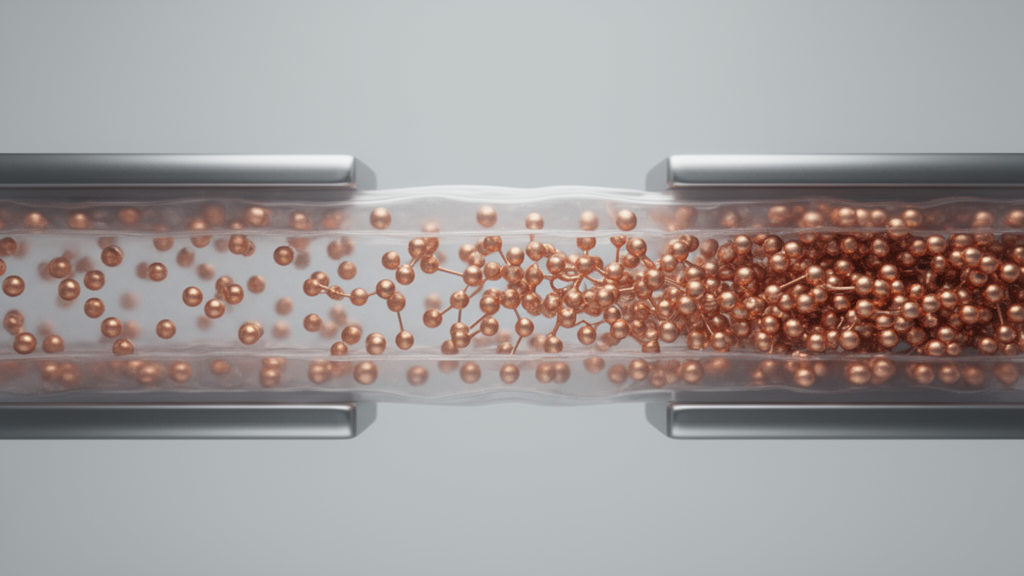
Adding copper nanoparticles to a purpose-designed carbazole copolymer produced a laboratory resistive random-access memory device with improved voltage and current characteristics, according to a study in the Journal of Materials Science. The composite device supported flash-type ternary memory behavior, meaning that it operated among three distinct resistance states rather than the two states used in binary storage. The authors identify this multilevel operation as a way to increase storage density compared with binary memory.

The underlying material, PCz–BB, is a donor–acceptor copolymer containing two different electron-withdrawing receptor groups. The researchers synthesized this polymer and incorporated copper nanoparticles to create PCz–BB:Cu nanocomposite films for memory devices. Compared with the unmodified polymer device, the composite had a smaller interval between its two threshold voltages: the reported values changed from −1.05/−1.95 V to −0.45/−0.90 V. In other words, the separation between the two switching thresholds decreased while both listed threshold values moved closer to zero.

The composite also increased the contrast among the device’s three current levels. The reported ON2/ON1/OFF current ratio rose from 1905:15:1 for the polymer memory device to 8950:50:1 for the copper-containing nanocomposite. Its three resistive states remained stable for more than three hours and 10^4 cycles. These findings describe the performance of the tested laboratory devices; the supplied abstract does not specify the number of devices examined, the measurement conditions or the results of testing beyond the reported duration and cycle count.

The authors explain the resistive switching using two concepts: charge trapping and conducting-filament theory. The study abstract presents these as the framework for the observed behavior but does not provide separate experimental measurements that distinguish the contribution of each mechanism. It also does not establish how copper nanoparticles individually affect charge trapping or filament formation. The work therefore demonstrates a measured improvement in selected ternary-memory characteristics for PCz–BB:Cu films and contributes to the design of materials intended to support higher-density electronic storage, rather than establishing performance under conditions outside those reported in the study.

Subject of Research: Copper-nanoparticle carbazole copolymer films for ternary resistive random-access memory

Article Title: Carbazole copolymer: Cu nanocomposite films for ternary resistive random access memory

Article References: Zhang, W., Dou, F., Wang, S., & Wang, C. (2026). Carbazole copolymer: Cu nanocomposite films for ternary resistive random access memory. Journal of Materials Science, 61(40), 30890-30903. https://doi.org/10.1007/s10853-026-12173-5

Image Credits: AI Generated

DOI: 10.1007/s10853-026-12173-5

Keywords: ternary memory, resistive random-access memory, carbazole copolymer, copper nanoparticles, nanocomposite films, charge trapping, conducting filaments, electronic storage, Carbazole, copolymer, nanocomposite, films

Cite Scienmag News

Neil Sanderson. (October 25, 2026). Copper nanoparticles improve three-state polymer memory performance. Scienmag. https://scienmag.com/copper-nanoparticles-improve-three-state-polymer-memory-performance/

Neil Sanderson. "Copper nanoparticles improve three-state polymer memory performance." Scienmag, 25 October 2026, https://scienmag.com/copper-nanoparticles-improve-three-state-polymer-memory-performance/. Accessed 15 November 2026.

Neil Sanderson. "Copper nanoparticles improve three-state polymer memory performance." Scienmag. October 25, 2026. https://scienmag.com/copper-nanoparticles-improve-three-state-polymer-memory-performance/

Tags: carbazolecarbazole copolymercharge trappingconducting filamentscopolymercopper nanoparticleselectronic storagefilmsnanocompositenanocomposite filmsresistive random-access memoryternary memory
Share26Tweet16
Previous Post

Wearable system detects and transmits scents over distance

Next Post

Single-hospital ICU study links catheter infections to 65.1% mortality

Related Posts

Decision Framework Evaluates Six Building Nanotechnologies for Egypt’s Hot Arid Architecture
Technology and Engineering

Decision Framework Evaluates Six Building Nanotechnologies for Egypt’s Hot Arid Architecture

November 15, 2026
Split-Parameter Federated Learning Detects Cyber Threats Across Incompatible Network Infrastructures
Technology and Engineering

Split-Parameter Federated Learning Detects Cyber Threats Across Incompatible Network Infrastructures

November 15, 2026
Self-Supervised Vision Model Estimates Live Pig Weight Within Three Kilograms
Agriculture

Self-Supervised Vision Model Estimates Live Pig Weight Within Three Kilograms

November 15, 2026
Custom YOLO26 Architecture Improves Grapevine Disease Detection on Embedded Devices
Agriculture

Custom YOLO26 Architecture Improves Grapevine Disease Detection on Embedded Devices

November 15, 2026
Survey Synthesizes Remote Sensing and Edge Computing Pathways for Rice Monitoring
Agriculture

Survey Synthesizes Remote Sensing and Edge Computing Pathways for Rice Monitoring

November 15, 2026
Increasing Weak Interlayers Reduces Rock Compressive Strength and Increases Fracture Density
Earth Science

Increasing Weak Interlayers Reduces Rock Compressive Strength and Increases Fracture Density

November 15, 2026
Next Post
Single-hospital ICU study links catheter infections to 65.1% mortality

Single-hospital ICU study links catheter infections to 65.1% mortality

  • Mothers who receive childcare support from maternal grandparents show more optimized

    Mothers who receive childcare support from maternal grandparents show more parental warmth, finds NTU Singapore study

    27656 shares
    Share 11059 Tweet 6912
  • University of Seville Breaks 120-Year-Old Mystery, Revises a Key Einstein Concept

    1061 shares
    Share 424 Tweet 265
  • Bee body mass, pathogens and local climate influence heat tolerance

    682 shares
    Share 273 Tweet 171
  • Researchers record first-ever images and data of a shark experiencing a boat strike

    546 shares
    Share 218 Tweet 137
  • Groundbreaking Clinical Trial Reveals Lubiprostone Enhances Kidney Function

    531 shares
    Share 212 Tweet 133
Science

Embark on a thrilling journey of discovery with Scienmag.com—your ultimate source for cutting-edge breakthroughs. Immerse yourself in a world where curiosity knows no limits and tomorrow’s possibilities become today’s reality!

RECENT NEWS

  • KAT6A Promotes Malignant Phenotypes and Suppresses Interferon Responses in Cervical Cancer
  • Displaced Women in Nigerian Camps Face Enduring Grief and Identity Loss
  • Early-Onset Chronic Disease Burden From Low Physical Activity Rose Ninety-Four Percent
  • Review Finds IPEX Syndrome Can Occur Despite Preserved Regulatory T Cells

Categories

  • Agriculture
  • Anthropology
  • Archaeology
  • Athmospheric
  • Biology
  • Biotechnology
  • Blog
  • Bussines
  • Cancer
  • Chemistry
  • Climate
  • Earth Science
  • Editorial Policy
  • Marine
  • Mathematics
  • Medicine
  • Pediatry
  • Policy
  • Psychology & Psychiatry
  • Science Education
  • Science News
  • Social Science
  • Space
  • Technology and Engineering

Subscribe to Blog via Email

Enter your email address to subscribe to this blog and receive notifications of new posts by email.

Join 5,150 other subscribers

© 2026 Scienmag - Science Magazine

Welcome Back!

Login to your account below

Forgotten Password?

Retrieve your password

Please enter your username or email address to reset your password.

Log In
No Result
View All Result
  • HOME
  • SCIENCE NEWS
  • CONTACT US

© 2026 Scienmag - Science Magazine

Discover more from Science

Subscribe now to keep reading and get access to the full archive.

Continue reading

