

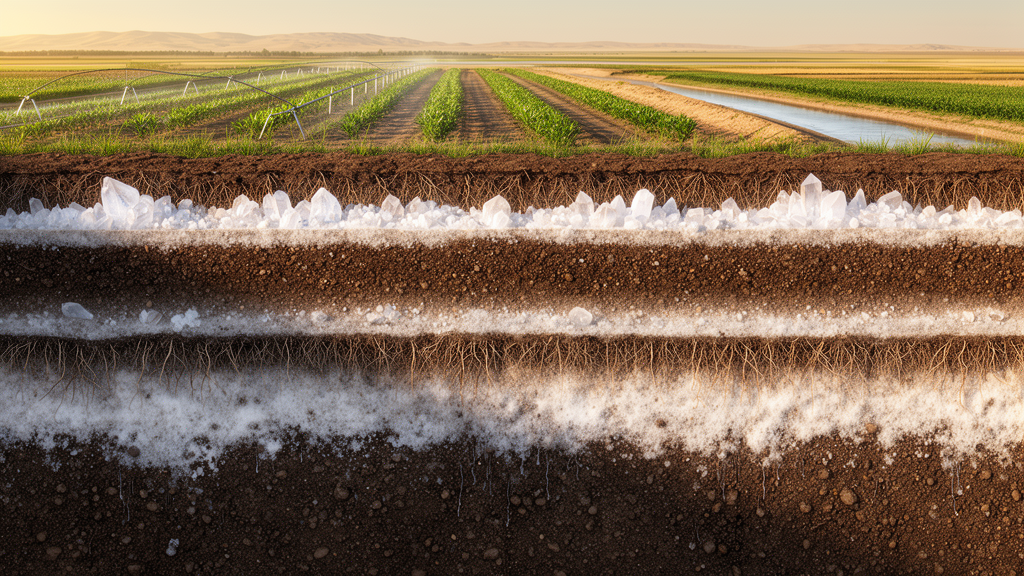
Soil water and salinity relationships diverge with depth across the Hetao Irrigation District in arid Northwest China, according to a 2025 growing-season field study. Researchers monitored soil moisture and electrical conductivity at six depths from 0 to 100 centimeters at 15 sites, finding that surface measurements did not capture the weak statistical relationship observed in deeper layers.
The study reported an electrical-conductivity-derived salinity index ranging from 0.08 to 42.91 grams per kilogram across the sampling area. This wide spread demonstrated extreme spatial heterogeneity within the irrigation district, with a coefficient of variation of 185.2%. The observations indicate that salinity conditions can differ sharply across the landscape rather than following a single, uniform pattern.
At the surface, from 0 to 20 centimeters, soil moisture and salinity showed a correlation of 0.07, which was not statistically significant. In the 60–100-centimeter layer, the relationship became positive but remained weak, with a correlation of 0.25, a p-value below 0.01 and an R² of 0.06. The low R² means that moisture explained only about 6% of the observed variation in the deep-layer salinity index.
Seasonal changes also differed by depth. The salinity index increased by 42% in the deeper layers, rising from 1.59 to 2.26 grams per kilogram, while surface layers showed a 136% fluctuation. The authors describe the depth pattern as consistent with a subtle tendency toward downward salt redistribution, but the observations do not establish a definitive pathway or quantify the movement of salt between layers.
These results point to a limitation in relying only on surface-soil measurements when assessing salinity in irrigated arid regions. Because the moisture–salinity relationship changes with depth, monitoring confined to the upper soil may miss subsurface patterns relevant to interpreting field conditions. The study is observational, covers one growing season and 15 sites, and its limited explanatory power means it cannot support strong causal conclusions about irrigation, drainage or long-term salinity trends.
Subject of Research: Depth-dependent soil water–salt relationships in an arid irrigation district
Article Title: Depth-dependent soil water-salt relationships in the Hetao Irrigation District, arid Northwest China: Implications for sustainable management
Article References: Cao, Y., Wang, H., Chen, X., & Zhu, L. (2026). Depth-dependent soil water-salt relationships in the Hetao Irrigation District, arid Northwest China: Implications for sustainable management. PLOS One, 21(10), e0360976. https://doi.org/10.1371/journal.pone.0360976
Image Credits: AI Generated
DOI: 10.1371/journal.pone.0360976
Keywords: soil salinity, soil moisture, Hetao Irrigation District, China, electrical conductivity, irrigation, soil profiles, salt redistribution, Depth-dependent, soil, water-salt, relationships
Cite Scienmag News
Scienmag. (October 26, 2026). Soil salinity varies by depth across Hetao Irrigation District. https://scienmag.com/soil-salinity-varies-by-depth-across-hetao-irrigation-district/
Scienmag. "Soil salinity varies by depth across Hetao Irrigation District." Scienmag, 26 October 2026, https://scienmag.com/soil-salinity-varies-by-depth-across-hetao-irrigation-district/. Accessed 26 October 2026.
Scienmag. "Soil salinity varies by depth across Hetao Irrigation District." Scienmag. October 26, 2026. https://scienmag.com/soil-salinity-varies-by-depth-across-hetao-irrigation-district/


