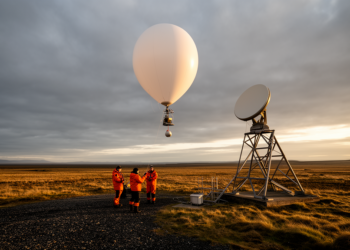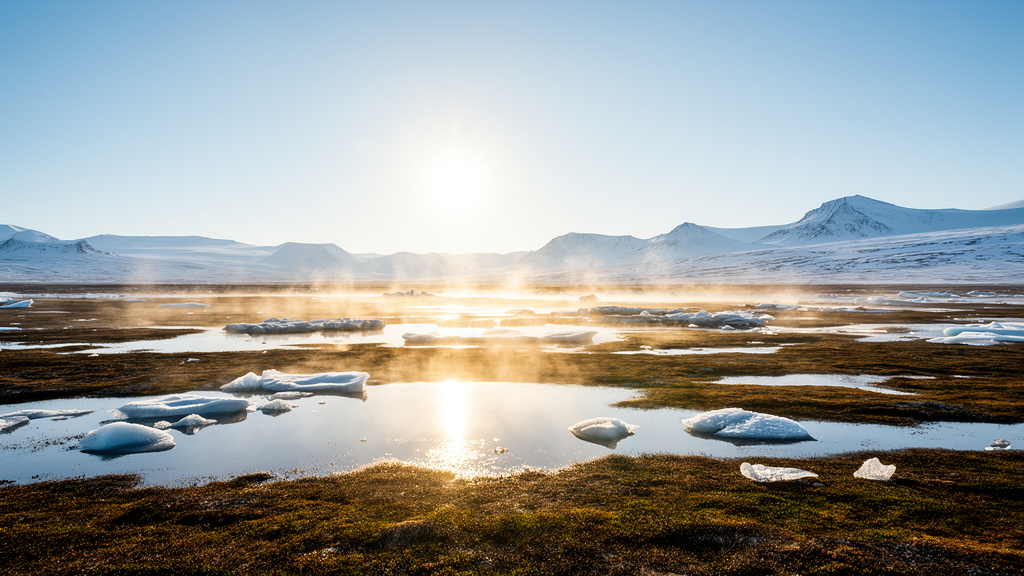
High on a mountain ridge above the Norwegian archipelago of Svalbard, one of the most sensitive particle detectors in the Arctic has been quietly recording the birth of new atmospheric particles, molecule by molecule. A research team led by Dominic Heslin-Rees of Stockholm University has now analysed nearly three years of these measurements, from April 2022 to October 2024, at the Zeppelin Observatory, and the results offer the clearest picture yet of when, where, and why new particle formation happens in one of Earth’s most pristine environments. The findings, published in the journal Aerosol Research, reveal a delicate tug-of-war between sunlight and pollution that ultimately shapes the clouds over the top of the world.
New particle formation, or NPF, is one of the atmosphere’s most remarkable phenomena. Gaseous precursor molecules, often just a handful of atoms clustered together, spontaneously form critical clusters only a few nanometres across. Under favourable conditions, these tiny seeds grow by condensing vapours and colliding with one another, eventually becoming particles tens of nanometres wide. At that size, they can act as cloud condensation nuclei, the seeds around which cloud droplets form. Because the Arctic is often limited in cloud condensation nuclei, even small changes in particle supply could alter cloud brightness, lifetime, and their warming or cooling effects, making NPF a potentially powerful lever on the region’s climate.
The team classified 848 days of valid measurements using two complementary schemes. In total, 157 days qualified as NPF events, roughly 19 percent of all measured days. The events begin in April, peak in late spring with 30 to 40 percent of days experiencing formation events between May and July, and taper off until they cease beyond November. Crucially, the strongest events, producing the largest bursts of nucleation mode particles, consistently occurred at the very start of the season, in late April and May, coinciding with peaks in the solar radiation accumulated by the air masses arriving at the observatory. As summer progressed, events became more frequent but noticeably weaker.
The explanation lies in a simple but elegant balance between two competing forces. On one side is solar insolation, which drives the photochemical production of nucleating vapours such as sulfuric acid, formed when dimethyl sulfide emitted by phytoplankton is oxidised. On the other side is the condensation sink, a measure of how quickly pre-existing aerosol particles mop up those precious vapours before they can nucleate. When the researchers divided solar insolation by the condensation sink, the resulting ratio tracked the observed frequency of NPF events with remarkable skill, achieving a coefficient of determination of 0.78 with a 30-day rolling average. In other words, two readily measurable parameters capture most of the story.
The condensation sink itself follows a dramatic seasonal cycle shaped by the infamous Arctic haze. In late winter and early spring, long-range transport from Eurasian industrial regions loads the atmosphere with accumulation mode particles around 100 nanometres, pushing the sink to its annual maximum. As spring gives way to summer, increased precipitation scavenges these particles from the air, and the sink drops. This cleansing by wet removal, the study shows, is a critical trigger: rainfall and cloudy conditions were systematically more likely in the hours before strong NPF events began. Once the sink falls low enough and sunlight is abundant, the atmosphere responds almost immediately with a burst of new particles.
Perhaps the most surprising discovery was that NPF does not stop when the Sun does. Five events were observed during the polar night, when the Sun never rises above the horizon at Ny-Ålesund and direct solar radiation is essentially absent. Back-trajectory analysis revealed that the air masses involved had descended from higher altitudes, where they had travelled further south and picked up enough solar energy to build up nucleating vapours aloft, far from the particle-laden surface. With the condensation sink extremely low at altitude, these vapours survived long enough to nucleate as the air descended toward the observatory, growing at a sluggish 0.43 nanometres per hour compared with the Arctic average of about 2.2.
Where do these particles come from? By tracing air masses backwards in time and estimating the geographic origin of the freshly nucleated particles, the team found that formation overwhelmingly occurs over the ocean, particularly off the western coast of Svalbard. Air masses arriving from the Greenland Sea showed the highest probability of producing an NPF day, with 27 percent of such air masses linked to formation events, compared with just 13 percent for the Barents Sea. This asymmetry likely reflects the Greenland Sea’s greater dimethyl sulfide production capacity, estimated to be three times that of the Barents Sea thanks to phytoplankton species rich in dimethylsulfoniopropionate, combined with more sunlight exposure and less sea ice blocking the ocean-atmosphere exchange.
The chemistry of nucleation itself appears to shift with the seasons. In May, the growing particles were dominated by negatively charged intermediate ions, consistent with ion-induced nucleation involving sulfuric acid and ammonia. From September onwards, the balance flipped toward positively charged ions, coinciding with a seasonal transformation in the vapour composition, as highly oxygenated organic molecules overtook sulfuric acid and methanesulfonic acid as the dominant condensable species. This polarity switch, the authors suggest, hints at a fundamental change in the molecular machinery of particle birth as the Arctic moves from spring into autumn.
What makes the study genuinely consequential is its link to clouds. During formation and growth events, the concentration of Aitken mode particles, those tens of nanometres across, increased 3.6-fold compared with pre-event conditions, suggesting that NPF is the main source of the Arctic’s Aitken mode aerosol. Moreover, in 37 percent of measured events, the newly formed particles grew beyond 25 nanometres, a diameter considered the minimum activation size for cloud condensation nuclei under strong updrafts, typically after roughly 30 hours of growth. Some particles even grew beyond 80 nanometres. Since these particles continue to condense vapours and undergo cloud processing downwind, a substantial fraction of the Aitken mode likely reaches climate-relevant sizes in due course.
The study also carries a cautionary note for a warming Arctic. The authors speculate that a warmer, wetter Arctic may increasingly resemble the late summer conditions they observed, with heavier cloud cover cutting solar insolation even as precipitation cleanses the condensation sink. Because cloudiness simultaneously promotes and suppresses NPF, predicting how particle production responds to climate change is far from straightforward. Yet the elegant simplicity of the solar-insolation-to-sink ratio offers a practical tool: in a remote region where elaborate instrumentation is rarely feasible, two basic measurements may suffice to anticipate when the Arctic atmosphere will switch on its particle factories, and with them, a hidden influence on the clouds that help set the pace of polar warming.
Subject of Research: Seasonality and drivers of atmospheric new particle formation in the Arctic
Article Title: Drivers governing the seasonality of new particle formation in the Arctic
Article References: Heslin-Rees, D., Tunved, P., Aliaga, D., Lampilahti, J., Riipinen, I., Ekman, A. M. L., Park, K.-T., Mazzini, M., Gilardoni, S., Thakur, R., Park, K., Yoon, Y. J., Lee, K., Sipilä, M., Mazzola, M., & Krejci, R. (2026). Drivers governing the seasonality of new particle formation in the Arctic. Aerosol Research, 4(2), 457-483. https://doi.org/10.5194/ar-4-457-2026
Image Credits: AI Generated
Keywords: new particle formation, Arctic aerosol, Zeppelin Observatory, cloud condensation nuclei, dimethyl sulfide, condensation sink, solar insolation, Greenland Sea, polar night, Aitken mode, Arctic haze, Svalbard
Cite Scienmag News
Russell Cooper. (October 8, 2026). Sunlight and Clean Air Drive the Arctic’s Secret Particle Factories. Scienmag. https://scienmag.com/sunlight-and-clean-air-drive-the-arctics-secret-particle-factories/
Russell Cooper. "Sunlight and Clean Air Drive the Arctic’s Secret Particle Factories." Scienmag, 8 October 2026, https://scienmag.com/sunlight-and-clean-air-drive-the-arctics-secret-particle-factories/. Accessed 8 October 2026.
Russell Cooper. "Sunlight and Clean Air Drive the Arctic’s Secret Particle Factories." Scienmag. October 8, 2026. https://scienmag.com/sunlight-and-clean-air-drive-the-arctics-secret-particle-factories/