


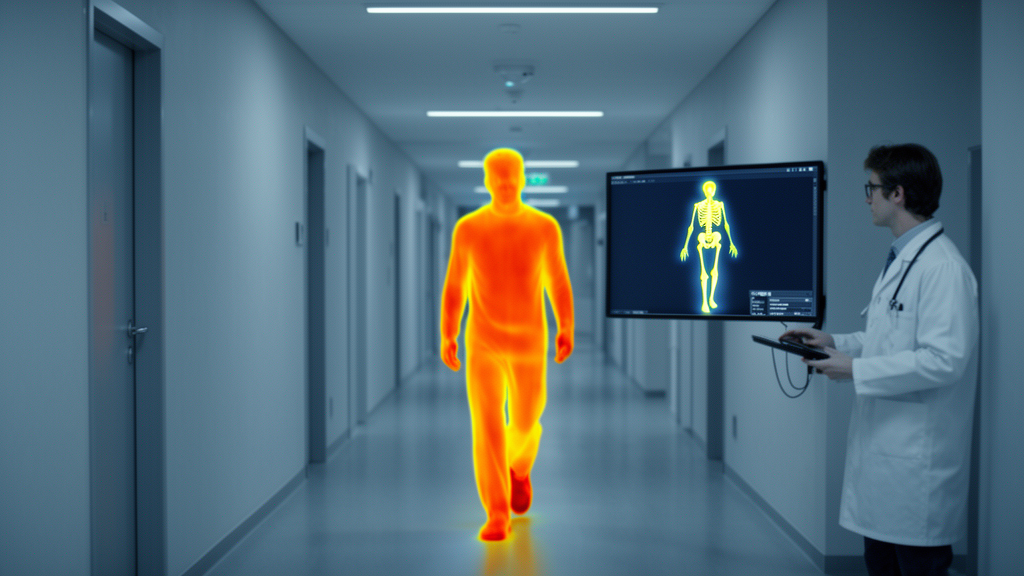
Every step a person takes tells a story about their body. The way weight shifts from heel to toe, the rhythm of the stride, the subtle asymmetries between the left and right leg — all of these encode information about joints, muscles and the nervous system. For clinicians, decoding that story has long meant expensive motion-capture laboratories, reflective markers stuck to the skin and teams of specialists. Now, a comprehensive survey published in Artificial Intelligence Review by Mohammad Abudayeh, David Elizondo, Sarah Greenfield and Fabio Caraffini of De Montfort University and Swansea University maps out how artificial intelligence is transforming gait analysis into something that could one day happen in a clinic corridor or even a living room, with a particular eye on one of the most disabling conditions of ageing: knee osteoarthritis.
Knee osteoarthritis is a chronic degenerative condition in which the cartilage that cushions the knee joint gradually wears away, producing pain, stiffness and progressively altered movement. It is one of the leading causes of disability in the United Kingdom, and its prevalence rises steeply with age. Because people with painful knees instinctively change how they walk — shortening strides, limping, shifting load to the healthier leg — gait carries a measurable signature of the disease. The challenge is capturing that signature reliably and affordably. The new survey argues that machine learning, and deep learning in particular, has reached a point where it can identify relationships in complex movement data that would be difficult or impossible for a human observer to detect, making automated gait analysis a realistic tool for detecting, diagnosing and monitoring musculoskeletal disorders with minimal human intervention.
At the heart of the survey lies a technical distinction that shapes the entire field: marker-based versus markerless human pose estimation. Pose estimation is the task of locating the human body in an image or video stream and identifying key anatomical points — hips, knees, ankles, shoulders — so that posture and movement can be quantified frame by frame. Marker-based systems, the traditional gold standard, require subjects to wear physical reflective or inertial markers placed at precise anatomical landmarks. Cameras or sensors track these markers with high accuracy, producing detailed three-dimensional kinematic data. The drawback is obvious: the procedure is time-consuming, requires specialist equipment and trained staff, and confines gait analysis to dedicated laboratories. For a condition like knee osteoarthritis, which affects millions and requires repeated monitoring over years, that model of care simply does not scale.
Markerless techniques flip the problem. Instead of tracking physical markers, deep neural networks learn to infer skeletal keypoints directly from ordinary video. Convolutional neural networks and, increasingly, transformer-based architectures are trained on vast annotated datasets of human movement, allowing them to estimate joint positions from a single camera view. The survey highlights how this opens the door to gait analysis in everyday environments — a smartphone camera, a webcam in a GP’s surgery — without any equipment attached to the patient. The trade-offs are equally clear. Markerless accuracy depends on lighting, clothing, camera angle and occlusion, and it typically yields two-dimensional or reconstructed three-dimensional estimates that are less precise than laboratory systems. For detecting the subtle gait deteriorations of early osteoarthritis, that precision gap matters, and the survey treats the comparison between the two paradigms as a central question rather than a settled one.
The most striking contribution of the review, however, is its attention to a third option that receives far less coverage in mainstream pose-estimation literature: thermal imaging. Thermal camera sensors capture the infrared radiation emitted naturally by the human body, producing images of heat distribution rather than reflected visible light. Because every person radiates heat, no external illumination is needed, and because thermal sensors record temperature patterns rather than identifiable facial features, they offer a non-invasive and privacy-preserving way to capture gait-related features. The survey examines how thermal data can complement or substitute for conventional video in pose estimation, potentially allowing movement analysis in complete darkness, in cluttered clinical settings, or in contexts where patients would reasonably object to being filmed with standard cameras.
The privacy argument deserves emphasis, because it is one of the reasons thermal imaging could prove decisive for real-world deployment. Standard video-based pose estimation raises genuine concerns: cameras in clinics, care homes or public spaces record faces, bodies and surroundings that patients may not consent to share, and the datasets used to train algorithms can expose sensitive information. Thermal imagery sidesteps much of this. A heat map of a walking person reveals the geometry of their stride and the temperature distribution of their limbs — which may itself carry clinical meaning, since inflammation and altered blood flow around an arthritic knee change local thermal patterns — while obscuring identity far more effectively than an RGB photograph. For a healthcare system that must balance innovation against data-protection obligations, a sensor that is simultaneously informative and privacy-preserving is an attractive proposition.
The survey situates these sensing technologies within the broader machinery of modern machine learning. Deep learning models excel at finding structure in high-dimensional data, and gait data is nothing if not high-dimensional: joint trajectories over time, spatiotemporal image sequences, pressure profiles and thermal signatures all must be fused and interpreted. Models trained on such data can classify gait patterns associated with musculoskeletal disorders, grade their severity and track progression over repeated assessments. The authors frame this as part of a wider revolution in which AI and machine learning have enabled systems to analyse complex patterns and make accurate predictions from large datasets across healthcare, detecting and monitoring conditions with minimal human intervention. Gait analysis, they argue, is a natural beneficiary: the signals are objective, quantifiable and rich, precisely the kind of input that deep networks handle well.
What emerges from the comparison is not a single winner but a trade-off space. Marker-based systems remain unmatched in accuracy and are likely to keep their place in research laboratories and biomechanical reference measurements. Markerless vision systems offer accessibility and scale, at the cost of some precision and robustness under uncontrolled conditions. Thermal imaging occupies a distinctive niche: it is non-invasive, works without lighting and protects privacy, but it is a younger technology in this application domain, with open questions about how well skeletal keypoints can be extracted from heat signatures alone and how large the training datasets are. The survey’s central message is that the choice of technique should follow the clinical context — screening a large population demands cheap, privacy-friendly, scalable sensing, while precise surgical planning may still justify the laboratory gold standard.
The clinical stakes are considerable. Early detection of knee osteoarthritis could shift management from reactive pain treatment toward proactive intervention — physiotherapy, weight management, lifestyle modification — before irreversible joint damage accumulates. Because gait changes often precede a patient’s decision to seek help, an automated, repeatable, low-cost measurement of how someone walks could serve as an early-warning system. The survey’s bridging of AI innovation with healthcare needs points toward exactly this: routine, unobtrusive gait monitoring integrated into ordinary care pathways, flagging deterioration for human clinicians to investigate. The authors are careful to present this as potential rather than accomplished fact; the field still needs validation studies, standardised datasets and regulatory-grade evidence before algorithms join the diagnostic toolkit.
Published open access in Artificial Intelligence Review, the survey arrives at a moment when the ingredients for this transformation — cheap cameras, powerful deep learning models and growing clinical interest in digital biomarkers — are all in place simultaneously. Its systematic comparison of marker-based, markerless and thermal approaches gives researchers a map of where the field stands and where the gaps lie, particularly around the underexplored promise of infrared sensing. If the authors are right, the future of musculoskeletal medicine may involve far fewer laboratories full of reflective markers and far more quiet, camera-free measurements of the most ordinary human act there is: putting one foot in front of the other. For the millions living with aching knees, a technology that watches how they walk — without ever really watching them — could change how early their disease is caught and how well it is managed.
Subject of Research: AI-based gait analysis and pose estimation techniques, including thermal imaging, for detecting knee osteoarthritis
Article Title: How does thermal imaging compare with other pose estimation techniques? A survey on gait analysis in healthcare applications with a focus on knee osteoarthritis
Article References: Abudayeh, M., Elizondo, D., Greenfield, S., & Caraffini, F. (2026). How does thermal imaging compare with other pose estimation techniques? A survey on gait analysis in healthcare applications with a focus on knee osteoarthritis. Artificial Intelligence Review. https://doi.org/10.1007/s10462-026-11732-1
Image Credits: AI Generated
DOI: 10.1007/s10462-026-11732-1
Keywords: gait analysis, human pose estimation, thermal imaging, knee osteoarthritis, machine learning, deep learning, computer vision, healthcare AI, musculoskeletal disorders, markerless motion capture, privacy-preserving sensing, survey
Cite Scienmag News
Blake Davidson. (October 8, 2026). Thermal Cameras Emerge as a Privacy-Preserving Rival in AI-Powered Gait Analysis. Scienmag. https://scienmag.com/thermal-cameras-emerge-as-a-privacy-preserving-rival-in-ai-powered-gait-analysis/
Blake Davidson. "Thermal Cameras Emerge as a Privacy-Preserving Rival in AI-Powered Gait Analysis." Scienmag, 8 October 2026, https://scienmag.com/thermal-cameras-emerge-as-a-privacy-preserving-rival-in-ai-powered-gait-analysis/. Accessed 8 October 2026.
Blake Davidson. "Thermal Cameras Emerge as a Privacy-Preserving Rival in AI-Powered Gait Analysis." Scienmag. October 8, 2026. https://scienmag.com/thermal-cameras-emerge-as-a-privacy-preserving-rival-in-ai-powered-gait-analysis/


