


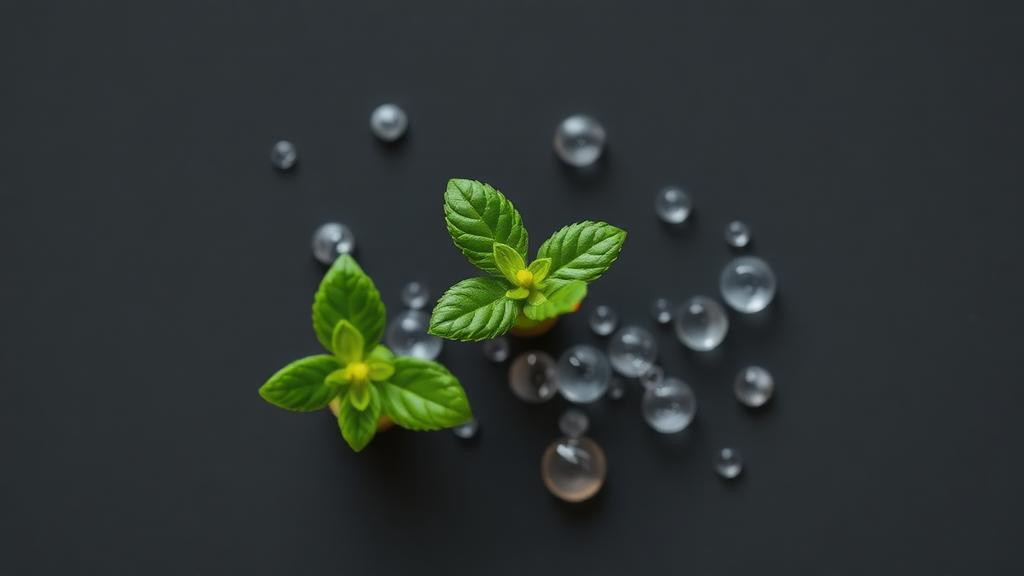
In a development that sounds more like kitchen chemistry than cutting-edge energy science, researchers in India have turned the leaves of a fragrant culinary herb into the beating heart of a working battery. Plectranthus amboinicus, known variously as Cuban oregano, Indian borage, and country borage, has long been prized in traditional medicine and cooking across tropical Asia and Africa. Now, according to a study published in the journal Ionics by S. Kowsalya, P. Prameela, S. Selvasekarapandian, and S. Kamatchi Devi, its leaves can be processed into a solid membrane that conducts protons well enough to power a primary battery delivering 1.64 volts. The work forms part of a broader and increasingly urgent search for electrolyte materials that are cheap, abundant, biodegradable, and safe, as the world’s appetite for portable energy storage collides with the environmental costs of conventional lithium-ion technology.
The central component of any solid-state battery is the electrolyte, the medium through which charge-carrying ions shuttle between electrodes while electrons are forced around the external circuit. Liquid electrolytes dominate today’s commercial cells, but they bring well-documented problems: flammability, leakage, volatility, and complicated packaging. Solid polymer electrolytes promise a way around these hazards, yet many of the synthetic polymers used to make them, such as poly(vinyl alcohol) and polyacrylonitrile, are derived from petrochemicals and resist degradation. Biopolymer electrolytes offer an alternative route. Natural polysaccharides and plant-derived materials are renewable, inexpensive, and rich in oxygen-containing functional groups that can host mobile ions. Over the past decade, research groups have explored tamarind seed polysaccharide, iota-carrageenan, pectin, gellan gum, cellulose acetate, sodium alginate, agar, and even Moringa oleifera seeds as ion-conducting hosts. The new study adds a familiar garden herb to that growing roster.
The team’s method was deliberately simple. Leaves of Plectranthus amboinicus were processed and blended with ammonium nitrate, NH4NO3, in varying proportions using the solution casting technique, a low-energy process in which a dissolved mixture is poured into a mold and left to dry into a free-standing film. The resulting bio-membranes were then interrogated with a battery of characterization techniques: X-ray diffraction to probe their internal structure, differential scanning calorimetry and thermogravimetric analysis to assess thermal behavior, electrochemical impedance spectroscopy to measure ionic conductivity, linear sweep voltammetry to test electrochemical stability, and ion transport number measurements to confirm which charge carriers were actually moving.
The structural findings explain much of the material’s performance. X-ray diffraction revealed that the films were predominantly amorphous, meaning their molecular chains lacked the long-range ordered packing of a crystal. This matters because ion transport in polymer electrolytes proceeds through flexible, disordered regions: amorphous chains segment and rearrange with thermal motion, opening transient pathways through which small ions can hop. The most amorphous membrane, labeled PALN3, contained 1 gram of Plectranthus amboinicus leaf material complexed with 0.8 percent molecular weight of ammonium nitrate. In crystalline regions, by contrast, polymer chains are locked in place and ions are trapped or blocked. The amorphous character of the best composition thus set the stage for the conductivity results that followed.
And those results were striking. Electrochemical impedance spectroscopy showed that the PALN3 membrane achieved an ionic conductivity of 1.18 times ten to the minus two siemens per centimeter, a figure that places it among the highest values reported for biopolymer electrolyte systems. For context, many undoped biopolymer membranes conduct at rates six or more orders of magnitude lower. The ammonium nitrate salt is the key additive: when ammonium ions dissociate from nitrate counterions within the leaf-derived polymer matrix, they provide mobile proton carriers, while the salt disrupts chain packing and further suppresses crystallinity. The researchers also computed transport parameters using an equivalent circuit formalism developed by A. K. Arof, a widely used analytical approach that separates bulk, grain boundary, and electrode contributions from the impedance response.
Proton conduction itself is a fascinating and unusual branch of ion transport. Unlike lithium or sodium ions, which drag a solvation shell through the electrolyte in a vehicle-like mechanism, protons are far too small to exist freely in a condensed medium. Instead, they typically migrate through hydrogen-bonded networks via the Grotthuss mechanism, essentially relayed from one hydrogen-bonded site to the next, like a bucket brigade passing water along a line. Plant-derived polymers, dense with hydroxyl, ether, and carbonyl groups, are naturally rich in hydrogen-bonding sites, which is precisely why they make such effective proton hosts. Recent work in the literature, including studies published in Communications Chemistry, has focused on directly observing this proton transfer process, and the field increasingly recognizes biological and bioinspired materials as ideal scaffolds for engineering Grotthuss-type conduction.
Before a membrane can serve in a device, it must survive the electrochemical environment. The team’s thermogravimetric analysis established the material’s thermal stability window, while linear sweep voltammetry confirmed that the electrolyte remains electrochemically stable across the operating range of the cell. Ion transport number measurements verified that protons, rather than electrons or other ionic species, dominate the conduction, a crucial check because electronic leakage would cause self-discharge and render the membrane useless as a battery separator. With these criteria satisfied, the researchers selected the highest-conductivity PALN3 membrane as the electrolyte for fabricating a primary proton-conducting battery.
The assembled cell delivered an open-circuit voltage of 1.64 volts, a respectable figure for a proton battery built from a plant-based electrolyte, comparable to the nominal voltages of many conventional primary chemistries. The team then examined the battery under different load conditions to assess how the voltage and current output held up as the cell was asked to do real work. Load testing is where laboratory curiosities either prove their mettle or fall apart, since internal resistance and mass transport limitations typically cause voltage to sag under current draw. While the study reports the device as a primary, non-rechargeable cell, the demonstration completes the full chain from raw leaf to functioning electrochemical device, a pipeline that earlier work from the same research community has applied to Centella asiatica, Peltophorum pterocarpum, and Ocimum sanctus membranes.
The appeal of this approach extends beyond novelty. Plectranthus amboinicus is fast-growing, widely cultivated, and requires no exotic processing infrastructure, and ammonium nitrate is an inexpensive commodity chemical. Solution casting needs no high temperatures or vacuum systems, making the entire fabrication route accessible and low-carbon. At end of life, a biodegradable membrane avoids the persistent waste problems associated with synthetic polymer separators. None of this means herb-based proton batteries will displace lithium-ion in smartphones tomorrow; primary cells, energy density, cycle behavior, and scale-up all remain open questions, and the published abstract does not report long-term cycling data. But as a proof of concept, the work is compelling. It suggests that the next generation of safe, sustainable solid-state energy storage might be grown in a garden rather than refined from a mine, and that the humble oregano pot on a windowsill could one day share a lineage with the battery in your pocket.
Subject of Research: A plant-derived biopolymer electrolyte from Plectranthus amboinicus leaves and ammonium nitrate for proton-conducting solid-state batteries
Article Title: Development of biomaterial plectranthus amboinicus for proton conducting battery
Article References: Kowsalya, S., Prameela, P., Selvasekarapandian, S., & Devi, S. K. (2026). Development of biomaterial plectranthus amboinicus for proton conducting battery. Ionics. https://doi.org/10.1007/s11581-026-07569-x
Image Credits: AI Generated
DOI: 10.1007/s11581-026-07569-x
Keywords: Plectranthus amboinicus, biopolymer electrolyte, proton conduction, ammonium nitrate, solid-state battery, solution casting, ionic conductivity, X-ray diffraction, electrochemical impedance spectroscopy, Grotthuss mechanism, primary battery, sustainable energy materials
Cite Scienmag News
Faith Mcneil. (October 8, 2026). A Common Herb Becomes a High-Performance Proton Battery Electrolyte. Scienmag. https://scienmag.com/a-common-herb-becomes-a-high-performance-proton-battery-electrolyte/
Faith Mcneil. "A Common Herb Becomes a High-Performance Proton Battery Electrolyte." Scienmag, 8 October 2026, https://scienmag.com/a-common-herb-becomes-a-high-performance-proton-battery-electrolyte/. Accessed 8 October 2026.
Faith Mcneil. "A Common Herb Becomes a High-Performance Proton Battery Electrolyte." Scienmag. October 8, 2026. https://scienmag.com/a-common-herb-becomes-a-high-performance-proton-battery-electrolyte/


