


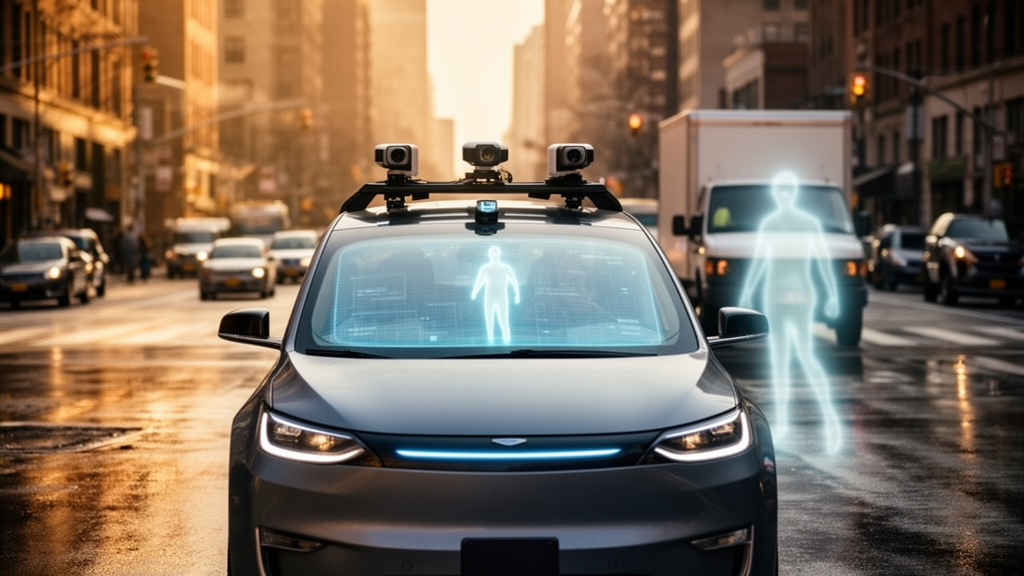
Autonomous vehicles face a deceptively simple problem every millisecond of every drive: figuring out what is around them, even when much of it is hidden. A pedestrian stepping out from behind a parked truck, a cyclist half-concealed by a bus, a car partially blocked by a concrete barrier — these are the moments when perception systems are tested hardest, and the moments when every millisecond of delay matters. A new study from researchers at Chongqing Vocational and Technical University of Mechatronics in China proposes a way to solve both problems at once, delivering fast, camera-only 3D object detection that adapts its own processing to how difficult the scene actually is.
The work, published as a preprint under review in the journal Mechanical Sciences by Yi Zhang, Anhua Zhou, and Jun Li, describes a lightweight optimization framework built around Bird’s Eye View, or BEV, perception. In BEV-based systems, images from cameras mounted around the vehicle are transformed into a top-down grid representation of the world, in which the positions and sizes of surrounding objects can be estimated directly in three dimensions. The approach has become one of the dominant paradigms in vision-based autonomous driving because it naturally fuses information from multiple cameras into a single coherent spatial map. But it comes with a heavy computational price, and that price has been the central obstacle to running it on the modest, power-constrained computers that actually fit inside a car.
The authors identify three specific weaknesses in existing dense BEV detection methods. First, the neural network backbones that process the visual features carry redundant parameters, inflating both memory use and computation time. Second, the sampling strategies that decide where in an image to gather information are fixed and inflexible, treating a wide-open highway exactly the same as a cluttered, occlusion-heavy urban intersection. Third, the temporal modeling that combines information across consecutive video frames tends to be coarse-grained, failing to exploit the rich continuity of video in an efficient way. Together, these shortcomings make it difficult to satisfy the twin demands of high detection accuracy and real-time latency on embedded vehicle platforms.
The team’s answer to the first two problems is an occlusion-aware adaptive voxel feature sampling module, and it is the most conceptually striking piece of the framework. Rather than committing to a single strategy for lifting image features into the BEV grid, the system dynamically switches between two paths according to a measure of scene complexity. When the scene is relatively simple, the system uses fast ray projection, an inexpensive technique that casts rays from the cameras into the three-dimensional space to collect features along each ray. When the scene becomes complex — dense with objects, cluttered, and heavily occluded — the system switches to deformable attention, a more powerful but more computationally expensive sampling method that can flexibly adjust where it looks to gather the information needed to resolve ambiguity. The result is a perception pipeline that spends its computational budget where it is actually needed, rather than paying the full price everywhere, all the time.
This kind of adaptive computation reflects a broader shift in how researchers think about efficiency in machine learning. The traditional approach scales a model up or down uniformly, but adaptive methods recognize that the difficulty of perception varies dramatically from moment to moment. A vehicle driving down an empty rural road does not need the same inferential effort as one navigating a crowded market street. By building a switch that responds to scene difficulty, the framework converts variability in the environment into savings in computation, without sacrificing accuracy precisely in the situations — occluded, cluttered scenes — where accuracy matters most.
The second major contribution addresses time. A single frame of camera data is ambiguous: a shadow can look like an object, and a partially visible car can be misjudged in size and position. Human drivers resolve these ambiguities effortlessly by integrating what they see over time, and the new framework does something similar with a temporal grouping fusion module based on Res2Net principles. Res2Net is an architectural design that splits feature channels into groups and processes them in a hierarchical, cascaded manner, allowing the network to capture patterns at multiple scales. The authors adapt this principle to fuse consecutive BEV feature maps across frames in groups, extracting richer temporal context without introducing any additional learnable parameters. That last point is crucial for a lightweight system: the module improves the temporal reasoning of the network while adding nothing to the model’s size or its inference cost.
The third contribution tackles one of the most persistent weaknesses of camera-only perception: depth. Cameras are inherently poor at measuring distance, while LiDAR sensors — laser rangefinders that sweep their surroundings with pulses of light — excel at it. But LiDAR is expensive, mechanically delicate, and adds significant cost to every vehicle. The framework resolves this tension with a two-stage LiDAR-to-camera knowledge distillation scheme, paired with a geometric compensation module. Knowledge distillation is a training technique in which a student model learns to mimic the outputs of a teacher model; here, the camera-based network is the student, and the LiDAR data serves as the teacher during training. The camera network learns the depth geometry that LiDAR captures so effortlessly, internalizing that knowledge into its own weights. Crucially, once training is complete, the LiDAR is no longer needed. The distilled knowledge is baked into the model, so the system incurs zero inference overhead — it runs exactly as fast as it would have without the distillation, but with a better grasp of three-dimensional geometry.
The experimental results, reported on the widely used nuScenes autonomous driving benchmark, are substantial. Under a lightweight configuration, the proposed method achieves a mean average precision, or mAP, of 38.7 percent and a nuScenes detection score, or NDS, of 51.3 percent — the NDS being a composite metric that rewards not just raw detection but also accurate estimation of position, velocity, and orientation. On an NVIDIA Tesla T4 graphics processor, the system runs with an inference latency of 38.2 milliseconds per frame, corresponding to 26.2 frames per second, and the authors report that it ranks highest in NDS among comparable methods in its class. For context, real-time perception generally requires processing at rates fast enough to keep up with the vehicle’s control loop, and 26.2 frames per second comfortably clears that bar on hardware that is far less powerful than the data-center GPUs on which many research models are developed.
The study has already attracted scrutiny through the open peer discussion that Copernicus Publications runs for its preprints. An anonymous referee, commenting on 27 September 2026, described the manuscript as presenting a practical lightweight BEV framework that achieves a reasonable trade-off between accuracy and efficiency, and called the scene-complexity-driven adaptive switching between inexpensive ray projection and deformable sampling interesting and of potential practical value for engineering applications. The referee also raised pointed concerns, however. Among them: the manuscript’s claims about real-time embedded deployment rest on efficiency measurements taken only on the Tesla T4, a server-class accelerator whose power consumption substantially exceeds the roughly 20-watt budgets typical of mobile automotive computing platforms, so evaluation on representative embedded hardware would strengthen the deployment claims. The referee further encouraged the authors to provide more rigorous experiments verifying that the complexity metric genuinely reflects the degree of occlusion, and to quantify performance improvements at different occlusion levels. These are exactly the kinds of questions that the ongoing review process is designed to resolve before the work earns final publication.
Even with those caveats, the significance of the work is easy to see. Camera-based perception is widely regarded as the most scalable path to affordable autonomous driving: cameras are cheap, compact, and already installed on most new vehicles, whereas LiDAR remains a premium component. A framework that lets a camera-only system approach the geometric understanding of laser-based sensing — by borrowing that knowledge during training and then running entirely on its own — attacks the cost problem at its root. Combined with adaptive computation that reserves expensive processing for genuinely difficult scenes, and parameter-free temporal fusion that squeezes more insight out of every video stream, the framework sketches a blueprint for perception systems that are simultaneously accurate, fast, and inexpensive. If subsequent review and embedded-hardware validation bear out the results, the technology could bring real-time, occlusion-robust 3D detection within reach of the mass-market vehicles that will ultimately carry autonomous driving beyond the laboratory and onto ordinary streets.
Subject of Research: Lightweight bird's eye view perception for real-time camera-based 3D object detection in occluded autonomous driving scenes
Article Title: A Lightweight BEV Perception Optimization Framework for Real-Time 3D Object Detection in Occluded Scenes
Article References: Zhang, Y., Zhou, A., & Li, J. (2026). A Lightweight BEV Perception Optimization Framework for Real-Time 3D Object Detection in Occluded Scenes. https://doi.org/10.5194/ms-2026-168
Image Credits: AI Generated
DOI: 10.5194/ms-2026-168
Keywords: autonomous vehicles, 3D object detection, bird's eye view perception, occlusion, knowledge distillation, LiDAR, nuScenes, real-time inference, deformable attention, temporal fusion, lightweight neural networks, computer vision
Cite Scienmag News
Denise Maddox. (October 8, 2026). Camera-Only AI Sees Past Occlusions in Real Time for Self-Driving Cars. Scienmag. https://scienmag.com/camera-only-ai-sees-past-occlusions-in-real-time-for-self-driving-cars/
Denise Maddox. "Camera-Only AI Sees Past Occlusions in Real Time for Self-Driving Cars." Scienmag, 8 October 2026, https://scienmag.com/camera-only-ai-sees-past-occlusions-in-real-time-for-self-driving-cars/. Accessed 8 October 2026.
Denise Maddox. "Camera-Only AI Sees Past Occlusions in Real Time for Self-Driving Cars." Scienmag. October 8, 2026. https://scienmag.com/camera-only-ai-sees-past-occlusions-in-real-time-for-self-driving-cars/


