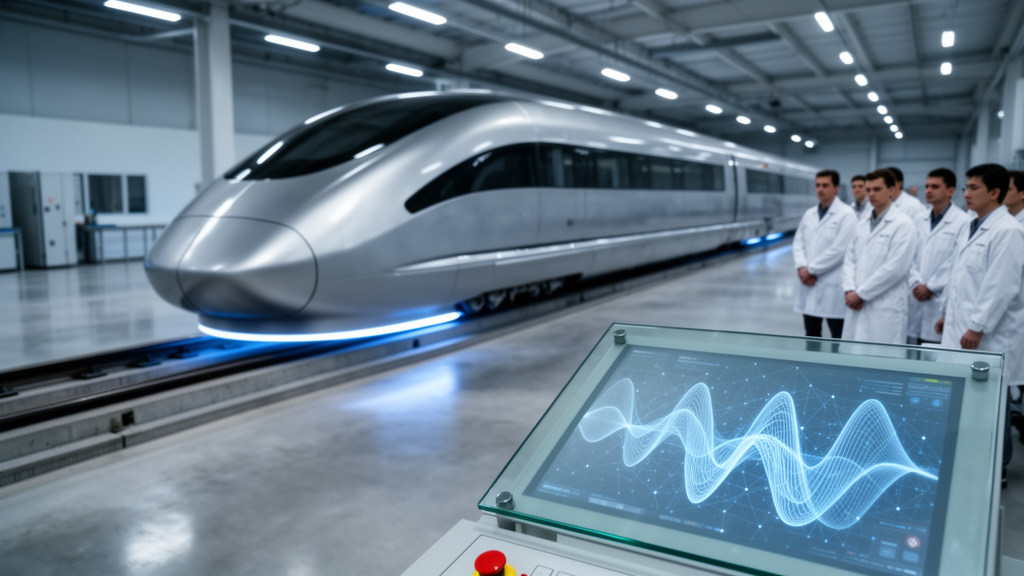
At 500 kilometers per hour, a magnetic levitation train does not touch the track beneath it. Instead, it rides on a cushion of magnetic force just a few millimeters to a few centimeters thick, and the stability of that invisible gap between vehicle and guideway is the single most important quantity in the entire system. If the gap grows too large, levitation force weakens and the train can sag toward the guideway. If it shrinks too far, the electromagnets can collide with the track with destructive consequences. Keeping this air gap within safe limits requires the onboard control system to respond to every bump, dip, and ripple in the track in real time, which means engineers need to understand exactly how the gap responds to track irregularities before a train ever rolls out of the depot.
The traditional way of gaining that understanding is brute force. Engineers build high-fidelity simulations that couple the vehicle dynamics, the flexible guideway, and the electromagnetics of the levitation system into one integrated model, then run that model over and over for different track profiles and operating speeds. Each run is computationally expensive, and a thorough assessment of a maglev line across many operating conditions can consume enormous amounts of time and computing resources. A team of researchers at the Shanghai Institute of Technology and Fudan University, led by Rang Zhang, Jiwei Liu, Chenxu Lu, Dilai Chen, and Qin Li, has now proposed a way to escape this computational bottleneck, and their approach is as much about physics as it is about artificial intelligence.
In a preprint published on 1 October 2026 in Mechanical Sciences Discuss., the Copernicus discussion forum of the journal Mechanical Sciences, the team introduces a physics-guided Residual Discrete Cosine Transform Spectral Neural Operator, abbreviated DCT-SNO. The model is designed to learn a function-to-function mapping: feed it a description of track irregularity as a function of position or time, and it returns the resulting air-gap response as a function of time. This is a fundamentally different task from predicting a single number or classifying a signal. The output is an entire time series, and the quality of the prediction depends on reproducing the fine temporal structure of the vibration, not just its average behavior.
The central insight of the work is that maglev dynamics are not spectrally neutral. The air-gap response of an electromagnetic suspension system is dominated by low-frequency content, with characteristic narrowband peaks that reflect the natural frequencies of the coupled vehicle-guideway-electromagnet system. Conventional sequence models, such as recurrent neural networks, process signals step by step and struggle to preserve these spectral signatures over long horizons. Even the Fourier Neural Operator, or FNO, a powerful architecture that has transformed scientific machine learning by learning mappings in the frequency domain, treats all frequency bands with a generality that does not match the physics of levitation. The Shanghai team decided to build that physics directly into the architecture.
Their solution replaces the complex-valued Fourier transform at the heart of the FNO with a real-valued discrete cosine transform, or DCT. The DCT has a long and distinguished history in signal processing, most famously as the workhorse of JPEG image compression, and it shares with the Fourier transform the ability to decompose a signal into frequency components. But the DCT has a property that makes it particularly attractive for real-valued physical signals: it produces purely real coefficients, avoiding the bookkeeping of complex phases, and it is known for compactly concentrating the energy of smooth signals in a small number of low-order coefficients. That is precisely the structure of maglev air-gap responses, where most of the energy lives at low frequencies.
The DCT-SNO exploits this structure in two ways. First, it applies learnable weights only to the retained low-order DCT modes, effectively telling the network that the physically meaningful action happens in the low-frequency band, while higher modes are discarded. This restriction is not a limitation but an inductive bias: it encodes the low-frequency-dominant character of maglev dynamics into the architecture itself, so the model does not have to rediscover that fact from data. Second, the model includes a residual time-domain branch that runs in parallel, capturing nonlinear response features that a purely spectral treatment might miss. The combination means the network can represent both the clean spectral skeleton of the vibration and the nonlinear flesh that hangs on it.
To train and evaluate the model, the researchers generated high-fidelity data using a co-simulation framework that couples UM, a multibody dynamics package, with Simulink, the control-oriented simulation environment. The dataset covers multiple track-irregularity spectra and operating speeds ranging from 300 to 500 kilometers per hour, spanning the realistic envelope of high-speed maglev operation. Training a surrogate model on such data is only useful if the model generalizes, so the team tested DCT-SNO on held-out cases that it had never seen, checking whether it could reconstruct air-gap responses for new combinations of track conditions and speeds.
The results are striking on two fronts. In terms of accuracy, DCT-SNO accurately reconstructs the held-out air-gap responses and, crucially, preserves the characteristic narrowband peaks and frequency-domain energy distributions that matter for engineering assessment. The model achieves better spectral consistency than both the FNO and recurrent baselines, meaning that when you transform its predictions into the frequency domain, the resulting spectra match the ground truth more faithfully. For a vibration engineer, this is the difference between a model that produces plausible-looking time series and one that can actually be trusted to identify resonance behavior and fatigue-relevant loading. In terms of speed, DCT-SNO reduces inference latency by approximately one order of magnitude relative to the FNO, meaning that once trained, it can produce predictions roughly ten times faster than its closest spectral competitor.
The practical implications extend well beyond a single benchmark. Because the surrogate is so fast, it becomes feasible to run repeated assessments of train performance under many different operating conditions, sweeping through track-quality scenarios, speed profiles, and parameter variations that would be prohibitively expensive with full co-simulation. This kind of rapid, repeated evaluation is exactly what is needed during the design of new maglev lines, the certification of vehicles, the tuning of levitation controllers, and the ongoing health monitoring of operational systems. A controller designer, for example, could use the surrogate to test thousands of candidate control strategies against realistic track irregularities in the time it would take to run a handful of full simulations.
The work also contributes to a broader trend in scientific machine learning: the recognition that generic architectures are often outperformed by physics-guided ones. By choosing the DCT over the Fourier transform, restricting learnable weights to physically relevant modes, and adding a residual branch for nonlinearities, the researchers demonstrated that domain knowledge can be baked into neural architecture in a way that improves both accuracy and efficiency. The preprint is currently under peer review for Mechanical Sciences, with the discussion open until 7 November 2026, so the community will have the opportunity to scrutinize the methods and results. If the findings hold up, the approach could influence how engineers build surrogates not just for maglev systems but for any vibration-dominated physical system where the low-frequency content carries the physics and the speed of prediction carries the value. For now, the study offers a glimpse of a future in which the invisible, millimeter-scale dance between a levitating train and its track can be simulated almost instantaneously, bringing the design of faster, safer, and smoother ground transportation within closer computational reach.
Subject of Research: Physics-guided spectral neural operator for predicting air-gap vibration responses in electromagnetic suspension maglev trains
Article Title: Physics-Guided Residual DCT Spectral Neural Operator for Air-Gap Response Prediction in EMS Maglev Trains
Article References: Zhang, R., Liu, J., Lu, C., Chen, D., & Li, Q. (2026). Physics-Guided Residual DCT Spectral Neural Operator for Air-Gap Response Prediction in EMS Maglev Trains. https://doi.org/10.5194/ms-2026-172
Image Credits: AI Generated
DOI: 10.5194/ms-2026-172
Keywords: maglev trains, electromagnetic suspension, air-gap prediction, spectral neural operator, discrete cosine transform, physics-guided machine learning, track irregularity, vibration dynamics, surrogate modeling, Fourier Neural Operator, co-simulation, high-speed rail
Cite Scienmag News
Cassandra Pierce. (October 8, 2026). AI Learns the Rhythm of Maglev: New Neural Operator Predicts Levitation Gaps in a Flash. Scienmag. https://scienmag.com/ai-learns-the-rhythm-of-maglev-new-neural-operator-predicts-levitation-gaps-in-a-flash/
Cassandra Pierce. "AI Learns the Rhythm of Maglev: New Neural Operator Predicts Levitation Gaps in a Flash." Scienmag, 8 October 2026, https://scienmag.com/ai-learns-the-rhythm-of-maglev-new-neural-operator-predicts-levitation-gaps-in-a-flash/. Accessed 8 October 2026.
Cassandra Pierce. "AI Learns the Rhythm of Maglev: New Neural Operator Predicts Levitation Gaps in a Flash." Scienmag. October 8, 2026. https://scienmag.com/ai-learns-the-rhythm-of-maglev-new-neural-operator-predicts-levitation-gaps-in-a-flash/