


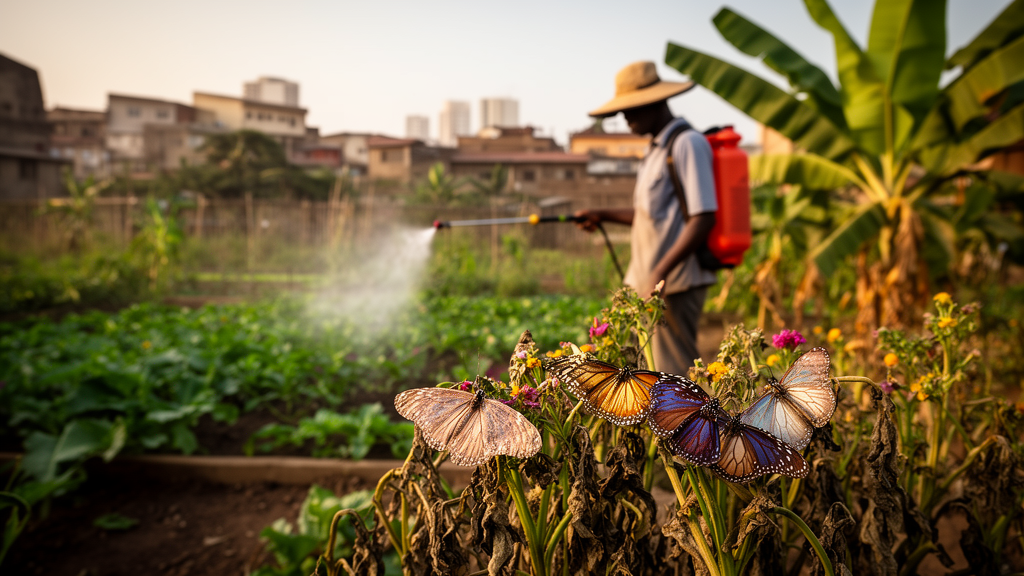
In the courtyards, roadside verges, and vacant lots of Ghana’s rapidly expanding towns, a quiet chemical campaign is underway. Households spray glyphosate, paraquat, and related herbicides to keep weeds at bay, treating the green clutter around their homes as an enemy to be eliminated. A new study from the University of Cape Coast and collaborating institutions suggests that this routine practice carries a hidden cost: it is poisoning a striking non-target butterfly and degrading the very plant its caterpillars depend on. The research, published in PLOS Ecosystems, offers one of the most detailed pictures yet of how urban weed management in sub-Saharan Africa ripples outward through plant–insect relationships that most residents never see.
The team, led by Andreas A. Kudom, began with a simple question: how do people actually manage weeds in Ghanaian cities? To find out, they surveyed 600 households across twelve urban towns in the country’s Central Region. The results were unambiguous. Herbicides have become the dominant method of weed control in residential areas, displacing hand weeding and other mechanical approaches. Glyphosate-based formulations, the same active ingredient found in the world’s best-selling weedkiller, and paraquat-based products, a fast-acting and highly toxic bipyridyl herbicide, were the most frequently reported choices. Haloxyfop-methyl, a selective herbicide targeting grasses, also appeared in the urban arsenal. This chemical reliance matters because residential spraying happens close to homes, gardens, and the wild plants that urban insects rely on, often with little regulation or protective equipment.
With the spraying patterns established, the researchers turned to the butterfly. Hypolimnas misippus, commonly known as the Danaid eggfly, is a widespread and visually arresting species in which females mimic the toxic monarch-like Danaid butterflies. Its caterpillars feed on Portulaca quadrifida, a low-growing succulent herb that thrives in disturbed urban soils, exactly the habitats where herbicide spraying is most intense. The team conducted laboratory no-choice bioassays in which butterfly eggs and larvae were exposed to glyphosate, paraquat, and haloxyfop-methyl at field-recommended concentrations, the doses a homeowner following the label would actually apply. This design choice is important: the study did not rely on exaggerated laboratory doses but tested the concentrations that urban spraying routinely delivers to non-target plants and insects.
The paraquat results were stark. Within 24 hours of exposure, every larva in the treatment group was dead, a complete mortality event that left no survivors to continue development. Eggs fared scarcely better, with mortality reaching 96 percent. Paraquat’s mechanism explains this ferocity: the compound acts as a redox cycler, generating reactive oxygen species inside cells that destroy membranes and tissues within hours. A caterpillar crawling across or feeding on freshly sprayed vegetation essentially ingests a molecule that dismantles its biochemistry on contact. For an urban butterfly population, a single spraying event on a patch of host plants could effectively wipe out the entire generation of eggs and young larvae occupying that patch.
Haloxyfop-methyl told a slower but equally troubling story. Rather than killing larvae outright within a day, the herbicide substantially reduced overall survival and, critically, slashed adult emergence. Mortality was distributed across both the larval and pupal stages, meaning individuals that survived early exposure often failed to complete metamorphosis or died before emerging as adults. In population terms, adult emergence is the metric that matters most, because only adults can disperse, mate, and found the next generation. A chemical that allows caterpillars to feed and pupate but prevents them from ever becoming flying adults functions as a demographic trap, luring females to lay eggs on plants that will produce no surviving offspring.
Glyphosate, by contrast, emerged as the least directly lethal of the three. Butterfly survival was not significantly affected at field-recommended concentrations, though exposed individuals took slightly longer to complete their development. This nuance is worth pausing on. Glyphosate’s reputation as relatively benign for animals has made it the default choice for urban weed control worldwide, and the study does not overturn that picture for direct contact. But the researchers’ second line of investigation reveals why direct toxicity assays alone can miss the real ecological damage. The herbicide that spares the caterpillar may still starve it, by degrading the plant it eats.
To quantify that plant-mediated pathway, the team used laser-induced chlorophyll fluorescence, or LICF, a technique that measures how a leaf’s photosynthetic machinery responds to pulses of light. When chlorophyll molecules absorb light, a fraction of the energy is re-emitted as fluorescence, and the shape and speed of that fluorescence response act as a sensitive diagnostic of plant health. Healthy leaves show a rapid rise and fall in fluorescence when a saturating light flash follows a period of adaptation, and the ratio of the maximum fluorescence peak to the steady-state level, known as the vitality index or Rfd value, indicates how vigorously the leaf is photosynthesizing. Stressed leaves, whose photosystems are damaged or whose energy metabolism is disrupted, produce flattened, sluggish curves and depressed Rfd values.
The LICF measurements revealed pronounced reductions in two vitality indices, Rfd-685 and Rfd-740, in Portulaca quadrifida leaves following exposure to paraquat and haloxyfop-methyl. In plain terms, the sprayed host plants were photosynthetically impaired, their leaf vitality measurably diminished. For a specialist herbivore like the Danaid eggfly caterpillar, this matters in two ways. Stressed plants may have altered nutritional chemistry, producing tougher tissues, changed nitrogen levels, or defensive compounds that reduce caterpillar growth and survival. Stressed plants may also wilt, yellow, or die, removing the food resource entirely before larvae finish development. The study thus demonstrates that herbicides disrupt plant–insect interactions through two simultaneous channels: direct toxicity to the insect and physiological stress to its host plant, each compounding the other.
The broader implications extend well beyond a single butterfly species. Urban ecosystems are increasingly recognized as refuges and corridors for biodiversity, particularly in tropical regions where cities expand into species-rich landscapes. Butterflies are pollinators and prey, and their caterpillars are a critical food source for birds and other animals. If routine residential spraying converts urban green spaces into ecological traps, where attractive host plants lure egg-laying females into chemical kill zones, the cumulative effect across a city could erode urban biodiversity and the ecosystem functions that depend on it. The finding that herbicides are already the dominant weed control method across twelve Ghanaian towns suggests this is not a marginal or hypothetical risk but an ongoing, landscape-scale process.
The authors argue that ecological considerations must be integrated into urban weed management strategies, and the study points toward practical adjustments. Reducing blanket spraying in residential areas, timing applications to avoid butterfly breeding periods, leaving patches of host plants unsprayed, and favoring mechanical or manual weed removal near gardens could all blunt the damage. The research also highlights the value of pairing toxicity bioassays with plant physiology measurements, a combination that captures the full chain of herbicide effects from leaf to larva. For now, the image that lingers is a small one: a Danaid eggfly egg glued to the underside of a purslane leaf in a Ghanaian courtyard, an egg that in a single day of ordinary household weed control has a 96 percent chance of never hatching. The tidy gardens of the city, the study suggests, are being purchased at a price written in the lives of its smallest residents.
Subject of Research: Effects of urban herbicide use on the non-target butterfly Hypolimnas misippus and its host plant in Ghana
Article Title: Urban herbicide use threatens a non-target butterfly ( Hypolimnas misippus ) through direct toxicity and host plant stress in Ghana
Article References: Kudom, A. A., Bosompem, M., Adu, M. O., Afful, B., Anderson, B., Armah, F., Asare, P. A., Ayettey, J., Mensah, B. A., & Adueming, P. O.-W. (2026). Urban herbicide use threatens a non-target butterfly (Hypolimnas misippus) through direct toxicity and host plant stress in Ghana. PLOS Ecosystems, 1(1), e0000020. https://doi.org/10.1371/journal.pesy.0000020
Image Credits: AI Generated
DOI: 10.1371/journal.pesy.0000020
Keywords: herbicides, glyphosate, paraquat, Hypolimnas misippus, butterflies, urban ecology, Ghana, host plant stress, chlorophyll fluorescence, pesticide toxicity, biodiversity, plant-insect interactions
Cite Scienmag News
Gavin Prescott. (October 8, 2026). Weedkillers in City Gardens Are Quietly Killing Ghana’s Butterflies. Scienmag. https://scienmag.com/weedkillers-in-city-gardens-are-quietly-killing-ghanas-butterflies/
Gavin Prescott. "Weedkillers in City Gardens Are Quietly Killing Ghana’s Butterflies." Scienmag, 8 October 2026, https://scienmag.com/weedkillers-in-city-gardens-are-quietly-killing-ghanas-butterflies/. Accessed 8 October 2026.
Gavin Prescott. "Weedkillers in City Gardens Are Quietly Killing Ghana’s Butterflies." Scienmag. October 8, 2026. https://scienmag.com/weedkillers-in-city-gardens-are-quietly-killing-ghanas-butterflies/


