


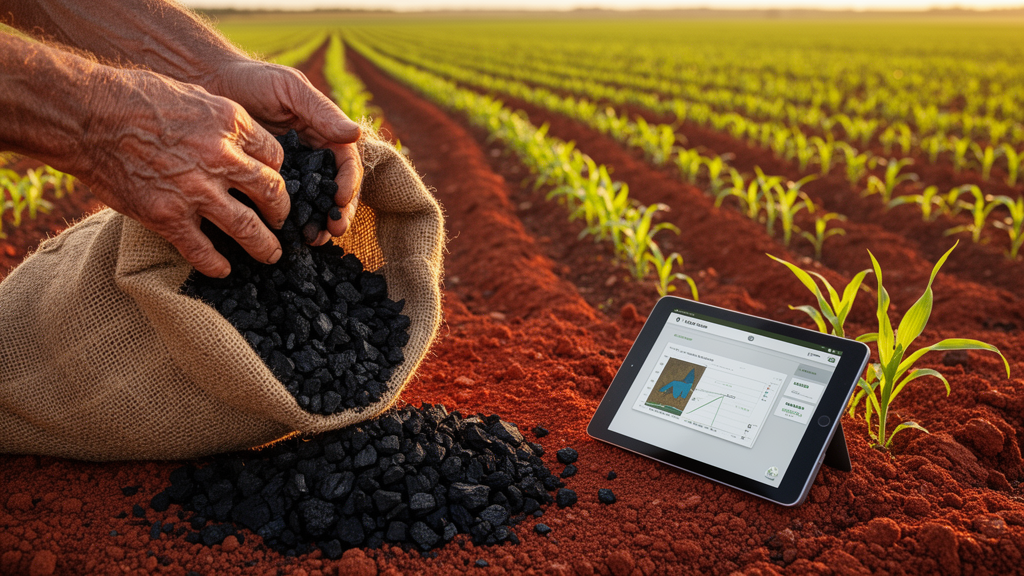
Soil acidification is one of the most quietly destructive forces in modern agriculture. Across vast stretches of farmland in Asia, South America, North America and Europe, decades of intensive fertilization, acid deposition and crop removal have steadily pushed soil pH downward, stripping fields of the chemical balance that crops need to thrive. A new review published in the journal Biochar argues that artificial intelligence could finally give scientists and farmers the predictive power they have lacked, transforming biochar application from a trial-and-error exercise into a precision-guided strategy for rescuing acidified soils.
The review, authored by Linyu Guo, Kewei Li and Ren-kou Xu of Shenyang Agricultural University, examines how biochar interacts with acidic soils on three interconnected fronts: neutralizing existing acidity, strengthening the soil’s resistance to future acidification, and reshaping the web of interactions among soil minerals, microorganisms and plant roots. The authors then assess the rapidly expanding use of artificial intelligence and machine learning to predict how well a given biochar will perform in a given soil, and they identify what must change for those predictions to become genuinely reliable.
The stakes are considerable. As soils acidify, they lose essential base cations such as calcium and magnesium, nutrients that plants depend on for structural growth and enzymatic function. At the same time, aluminum and certain heavy metals become increasingly soluble and toxic, poisoning root systems, stunting development and disrupting the microbial communities that underpin nutrient cycling. The combined effect is a slow but compounding decline in crop productivity that conventional remedies only partially address.
Lime application remains the standard treatment for acidic soils, but biochar offers a compelling alternative or complement. Produced by heating biomass in low-oxygen conditions, biochar can raise soil pH while simultaneously improving nutrient retention, enhancing water-holding capacity and buffering the soil against renewed acidification. Its porous structure and diverse surface chemistry mean it does more than simply neutralize acid; it can alter the physical and biological environment of the soil in ways that lime cannot. The challenge has always been knowing which biochar, applied at what rate, will work in which soil.
That is where the review’s most technically significant finding comes in. The authors argue that researchers must distinguish between the organic and inorganic sources of alkalinity within biochar. Current predictive models frequently treat total alkalinity as a single aggregated variable, a simplification that obscures fundamentally different neutralization pathways. Organic functional groups on the biochar surface can provide relatively rapid acid neutralization, while inorganic constituents such as carbonates and silicates deliver slower but more sustained buffering over time. Lumping these mechanisms together, the authors warn, makes machine-learning models less interpretable and limits their ability to forecast how different biochars will behave over months, years or across contrasting soil types.
This distinction matters because the two alkalinity pools deplete on different timescales. A biochar whose neutralizing power comes mainly from labile organic groups may deliver a quick pH correction that fades, whereas one rich in carbonates and silicates can maintain long-term buffering against the continuous acid inputs generated by nitrification and fertilizer hydrolysis. An AI model trained on total alkalinity alone cannot capture this temporal dynamics, and its predictions may therefore mislead field managers who need to know not just whether a biochar will raise pH, but for how long and at what rate the effect will diminish.
On the algorithmic side, the review finds that ensemble machine-learning approaches, and Random Forest in particular, have come to dominate biochar-related predictive research. These methods excel at capturing nonlinear relationships between biochar properties and soil outcomes, handling complex heterogeneous datasets and ranking the relative importance of individual variables, which helps researchers identify which feedstock characteristics and soil conditions matter most. Yet the authors are careful to note that no single algorithm is universally superior. Model selection, they argue, should be guided by data availability, problem complexity and the computational resources at hand, rather than by the popularity of a particular method in the literature.
Looking forward, the researchers propose a far more ambitious data architecture: the fusion of remote sensing imagery, proximal soil sensors, microbial community datasets, chemical imaging and multiple AI models working in concert. Such multi-source integration could allow predictive systems to represent the entire biochar-soil-microbe-plant system rather than relying on isolated laboratory measurements that strip away the contextual factors governing real-world performance. In principle, a farmer or extension service could feed field-level sensor and satellite data into such a platform and receive a tailored recommendation for biochar type, application rate and timing before any material is spread.
Corresponding author Ren-kou Xu frames the ambition in explicitly mechanistic terms. AI, he suggests, offers a powerful opportunity to connect the complex properties of biochar with soil conditions and biological responses, but better predictions will depend on whether models are built around the mechanisms that actually control soil acidification rather than simply identifying statistical correlations. The next generation of AI, in his view, should not function as a black box that merely predicts whether biochar works; the goal is interpretable models that can explain why a particular biochar succeeds in a particular soil and help identify the most appropriate treatment before it is applied in the field.
Realizing that vision, the authors acknowledge, requires substantial groundwork. They call for standardized benchmark datasets that allow models to be compared fairly, improved and more complete reporting of biochar properties in the published literature, stronger representation of microbial responses in training data, and closer collaboration among soil scientists, sensing specialists and AI researchers. The deeper aspiration is to couple machine learning with causal inference and the established chemical and biological mechanisms of acidification, elevating AI from a correlation-based prediction tool into a practical platform for precision management of acidified agricultural soils. If that integration succeeds, the humble charcoal-like soil amendment could become one of the clearest early demonstrations of how artificial intelligence can move agronomy from reactive treatment to genuinely predictive, mechanism-guided stewardship of the land.
Subject of Research: Application of artificial intelligence to predict and optimize biochar amelioration of acidic agricultural soils
Article Title: Artificial intelligence could help unlock smarter biochar strategies for acidic soils
Article References: Artificial intelligence could help unlock smarter biochar strategies for acidic soils. (n.d.). Original publication
Image Credits: AI Generated
DOI: Not provided
Keywords: biochar, soil acidification, artificial intelligence, machine learning, Random Forest, soil pH, alkalinity, soil microbiome, precision agriculture, lime, data fusion, soil remediation
Cite Scienmag News
Alan Morgan. (October 8, 2026). AI May Guide Precision Biochar Use to Restore Acidic Farm Soils. Scienmag. https://scienmag.com/ai-may-guide-precision-biochar-use-to-restore-acidic-farm-soils/
Alan Morgan. "AI May Guide Precision Biochar Use to Restore Acidic Farm Soils." Scienmag, 8 October 2026, https://scienmag.com/ai-may-guide-precision-biochar-use-to-restore-acidic-farm-soils/. Accessed 8 October 2026.
Alan Morgan. "AI May Guide Precision Biochar Use to Restore Acidic Farm Soils." Scienmag. October 8, 2026. https://scienmag.com/ai-may-guide-precision-biochar-use-to-restore-acidic-farm-soils/


