Researchers in Korea have used a Differential Absorption LiDAR (DIAL) system to remotely measure benzene concentrations and emission flux from an industrial flare stack, reporting peak concentrations between 2.23 and 3.17 ppm and fluxes ranging from 6.18 to 10.33 kilograms per hour across six repeated measurements. The field campaign, conducted on May 2, 2024, at Plant B within the A petrochemical industrial complex, represents what the authors describe as the first reported application of a remote DIAL system to quantitatively determine benzene flux from an industrial flare stack in Korea.
Flare stacks are safety fixtures at petroleum refineries and petrochemical plants, burning off excess gases and volatile organic compounds to prevent pressure buildup and reduce explosion risk. But combustion is not always complete: low-molecular-weight hydrocarbons such as ethane, propane, and butane, along with aromatic compounds including benzene and toluene, can escape into the atmosphere. Benzene is classified as a Group 1 carcinogen by the International Agency for Research on Cancer, and short-term exposure to high concentrations can cause mucous membrane irritation and corneal damage, while long-term exposure has been associated with hematological disorders and leukemia.
Measuring what actually leaves a flare stack is notoriously difficult. The stacks stand tens of meters tall in high-temperature, high-velocity environments, making conventional continuous emission monitoring systems impractical to install. Emissions are therefore typically estimated indirectly, using Pollutant Release and Transfer Register material balances or emission factor approaches. These coefficient-based methods, the researchers note, do not adequately reflect abnormal flare operating conditions, variations in combustion efficiency, plume dispersion, or meteorological influences—particularly problematic because flare operations are short-term and highly variable.
Existing alternatives fall short in other ways. Drone-based monitoring carries risks from flying near high-temperature flare flames and suffers from stability issues. Optical Gas Imaging cameras can visually detect gas emissions but cannot quantitatively determine concentrations or flux. Passive spectroscopic techniques such as Fourier Transform Infrared Spectroscopy and Differential Optical Absorption Spectroscopy provide only path-averaged concentrations, limiting their ability to resolve the precise location of emission sources and the spatial structure of plumes. DIAL, by contrast, offers range-resolved, spatially continuous concentration distributions, making it well suited to elevated, high-temperature sources like flares.
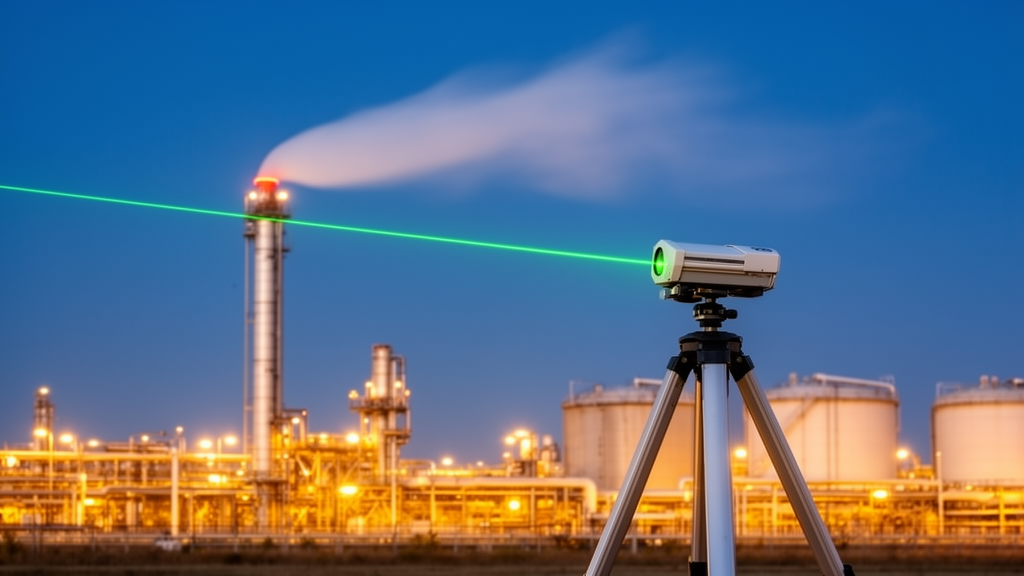
The DIAL system used in the study, operated by Korea’s National Institute of Environmental Research and originally developed by the National Physical Laboratory in the United Kingdom, works by alternately transmitting laser pulses at two closely spaced wavelengths—an on-resonant wavelength absorbed by the target gas and an off-resonant wavelength that is not—and analyzing the difference in the backscattered returns. Benzene exhibits a distinct absorption feature in the ultraviolet region around 250 nm, enabling both daytime and nighttime observations.
Selecting the correct wavelength was critical. Rather than relying solely on wavemeter verification, the team performed a cell scan procedure using a gas cell containing 0.1 percent benzene by volume with a 10-centimeter optical path. By tuning the laser across the range from 252.16 to 252.26 nm and comparing cell-transmitted signals against reference signals, they identified the wavelength of maximum differential absorption. The on-resonant wavelength was set to 252.1998 nm and the off-resonant wavelength to 252.1748 nm. The minimum On/Off ratio measured during the scan was 0.08, from which the team calculated a differential absorption cross-section for benzene of 9.1 × 10⁻²² m², a value applied directly in the concentration retrieval equation.
The laser hardware itself involved a dye laser pumped by the third harmonic of a Nd:YAG laser, using Coumarin 503 dye to generate a fundamental wavelength of 504.3996 nm, which was then converted to the ultraviolet through second harmonic generation in a beta-barium borate crystal. Pulse energies were maintained at approximately 6 mJ, with on- and off-resonant energies matched to ensure that signal differences arose solely from benzene absorption rather than detector nonlinearity.
During the field campaign, the DIAL system was positioned roughly 400 meters from the flare stack, with the laser fixed at an azimuth of 319° in a cross-wind geometry perpendicular to the prevailing northwesterly wind. Eleven observation lines were scanned at elevation angles from 14.9° to 15.9° in 0.1° increments, with each line sampled for 50 seconds at a 10 Hz repetition rate—500 shots per line, totaling about 550 seconds per scan. The measurements revealed a localized plume structure, with maximum concentrations occurring at distances of approximately 400–430 m from the DIAL and altitudes of about 120–135 m, reflecting the buoyant rise of hot exhaust gas followed by wind-driven transport.
To convert concentrations into flux, the team combined the two-dimensional concentration maps with wind speeds estimated at plume height using a logarithmic wind profile fitted to measurements from wind sensors at 3 m and 10 m. The plume cross-sectional area was defined as the region exceeding a background concentration threshold, corrected for the angle between the scan plane and the wind direction. Flux calculations used a spatial resolution of 0.25 m × 0.25 m per pixel. The six measurements yielded fluxes of 7.13, 6.18, 7.61, 8.11, 10.33, and 10.17 kg·hr⁻¹, and the results showed that wind speed variations significantly influenced the flux estimates—in some cases, relatively high flux was derived even when peak concentration was comparatively low, since flux depends on concentration, wind speed, and plume cross-sectional area together.
The authors acknowledge limitations: the observation period was short, the study focused on a single facility, and direct flare operating data were limited. Estimating wind speed from only two low-level measurement heights introduces uncertainty, particularly in the turbulent environment near flare stacks, and the team suggests future work could use Doppler LiDAR to measure wind directly at plume height. Longer-term datasets and comparison with PRTR-based emission estimates would help assess the policy applicability of DIAL-based measurements. Still, the study demonstrates that remote laser sensing can quantitatively evaluate both the spatial distribution and flux of benzene from flare stacks, offering a measurement-based complement to conventional indirect estimation methods for emission management and air quality policy.
Subject of Research: Remote DIAL measurement of benzene concentration and flux from a petrochemical flare stack in Korea
Article Title: Estimation of benzene concentration and flux from a flare stack using differential absorption LiDAR
Article References: Lee, Y., Kim, D., Kim, J., Kim, K., Gil, H., Cho, S., Jung, W., & Noh, Y. (2026). Estimation of benzene concentration and flux from a flare stack using differential absorption LiDAR. Asian Journal of Atmospheric Environment, 20(1), Article 9. https://doi.org/10.1007/s44273-026-00085-4
Image Credits: AI Generated
DOI: 10.1007/s44273-026-00085-4
Keywords: DIAL, benzene, flare stack, petrochemical, air quality, remote sensing, LiDAR, emissions monitoring, volatile organic compounds, flux estimation, UV laser, wind profile
Cite Scienmag News
Russell Cooper. (October 29, 2026). Laser Radar System Measures Benzene Flow from Petrochemical Flare Stack. Scienmag. https://scienmag.com/laser-radar-system-measures-benzene-flow-from-petrochemical-flare-stack/
Russell Cooper. "Laser Radar System Measures Benzene Flow from Petrochemical Flare Stack." Scienmag, 29 October 2026, https://scienmag.com/laser-radar-system-measures-benzene-flow-from-petrochemical-flare-stack/. Accessed 29 October 2026.
Russell Cooper. "Laser Radar System Measures Benzene Flow from Petrochemical Flare Stack." Scienmag. October 29, 2026. https://scienmag.com/laser-radar-system-measures-benzene-flow-from-petrochemical-flare-stack/